What is open source? Open-source software and AI, explained in plain English
The code behind Linux, Android and most of the apps you use: what makes software open source, how licences work, and why "open" AI models often don't qualify.
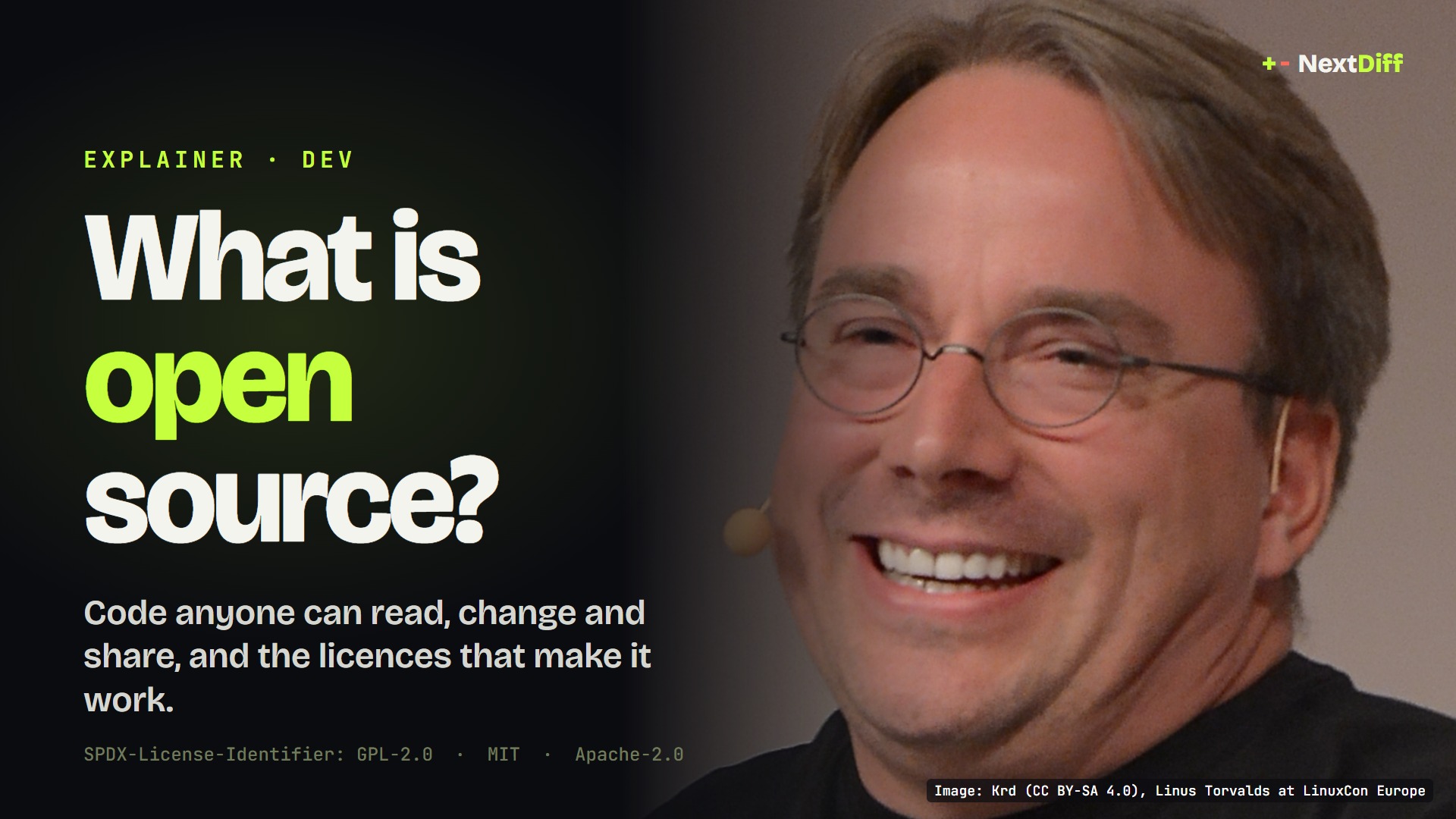
Open source is software whose source code is published under a licence that lets anyone use, study, change and share it, for any purpose. Linux and Android are built this way, and Harvard researchers found open-source code inside 96% of commercial programs. Rules still apply: the licence sets the conditions, such as keeping credits or sharing changes.
What is open source? Open source is software whose source code is published under a licence that lets anyone use, study, change and share it, for any purpose. The Linux kernel, Android and much of the code inside today's apps are built this way. The code is public; the licence sets the rules.
Our 26-second version:
Source code is the human-readable text programmers write. Most commercial software ships only as a finished program, with the code kept private. Open source flips that. As the Open Source Initiative (OSI) puts it in the Open Source Definition, "open source doesn't just mean access to the source code": the licence must also allow free redistribution, changes and derived works, and it may not discriminate against any person, group or field of use. The definition has 10 criteria in all, and it was originally derived from the Debian Free Software Guidelines.
The term itself is younger than the idea. According to the OSI's history, the label was created at a strategy session in Palo Alto, California, on 3 February 1998, shortly after Netscape announced it would release its browser's source code. Christine Peterson suggested the name, and Eric Raymond and Bruce Perens founded the OSI later that month.
How does open source work?
Think of a recipe published in a magazine with a note: cook it, change it, sell the dish, share your version. Anyone can follow it, and the best tweaks can end up in the next edition. The author still decides what goes into the official recipe.
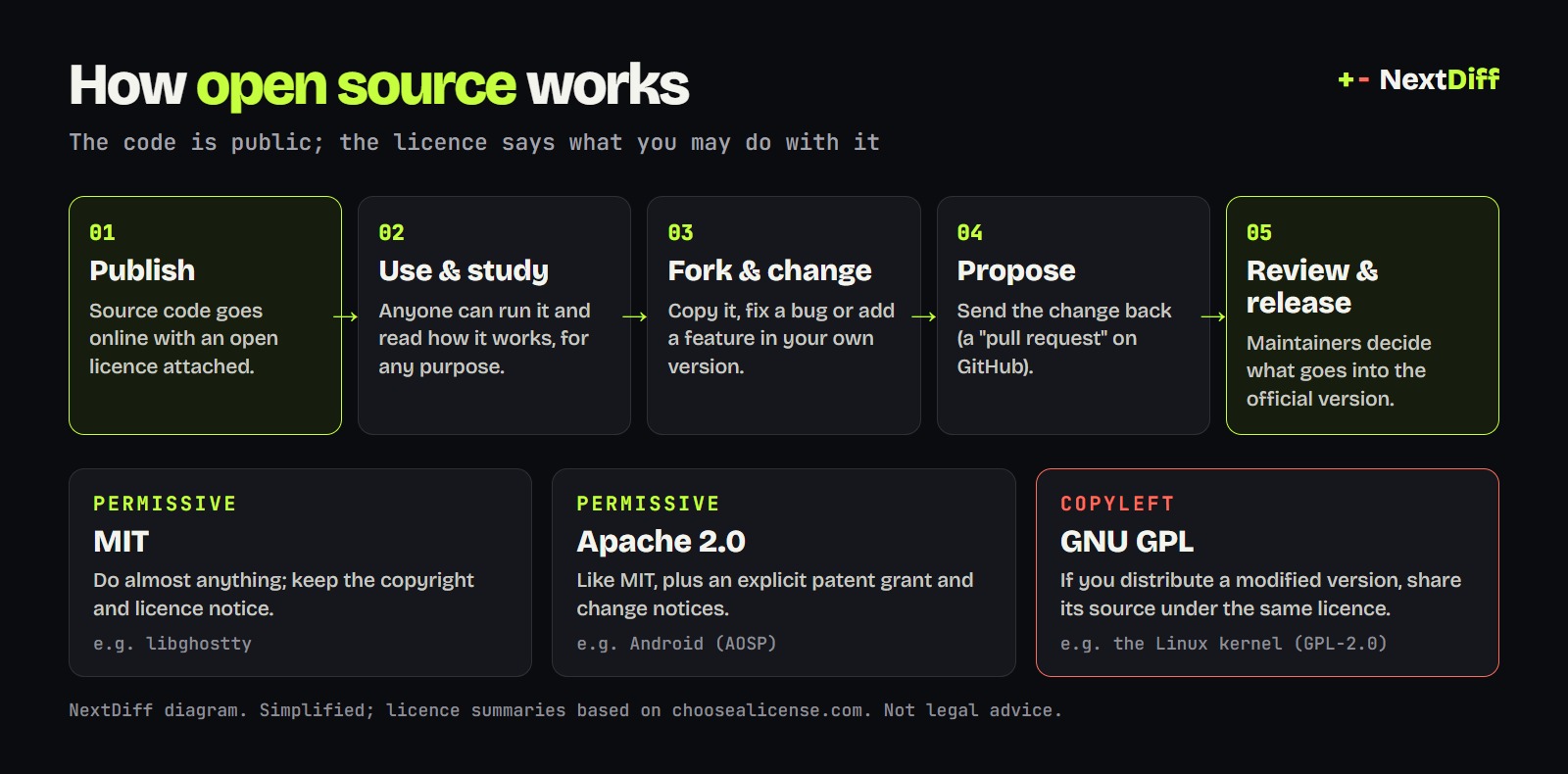 Image: NextDiff
In practice, three things make a project open source:
- A public codebase. The code lives somewhere anyone can download it, usually a Git repository on a site such as GitHub or GitLab.
- An open licence. A file in the project grants the rights. Without one, the code is merely visible, and copyright law still reserves the rights to its author.
- A way to contribute. Anyone can copy the project (a "fork"), make a change and propose it back, on GitHub as a "pull request". Maintainers review it and decide whether it goes into the official version.
The licence is the part people skip and the part that matters. Choose a License, a widely used licence guide, sorts the common ones into two families:
| Licence | Type | Main condition | Example |
|---|---|---|---|
| MIT | Permissive | Keep the copyright and licence notice | libghostty |
| Apache 2.0 | Permissive | Keep notices; includes a patent grant | Android Open Source Project |
| GNU GPL | Copyleft | Distribute changes as source under the same licence | Linux kernel (GPL-2.0) |
Permissive licences let a company fold the code into a closed product. Copyleft licences, such as the GPL, require that larger works built on the code and distributed to others stay under the same licence, with their source available.
Examples of open-source software
- Linux. The kernel at the heart of Linux is provided, in the words of its licensing rules, "under the terms of the GNU General Public License version 2 only". Linus Torvalds started it and still leads it, and he also created Git, the tool most developers use to track code changes.
- Android. Google's phone operating system is developed as the Android Open Source Project, where the preferred licence is Apache 2.0. Phone makers add their own, often closed, apps and services on top.
- Developer tools. The terminal engine libghostty, which JetBrains now ships inside its IDEs, is MIT-licensed.
- AI models, with an important asterisk, covered below.
 Image: Krd (CC BY-SA 4.0), via Wikimedia Commons
Open source vs closed source vs free software
| Open source | Free software | Closed source | Open weights (AI) | |
|---|---|---|---|---|
| Can you read the code? | Yes | Yes | No | Code often yes; training data usually no |
| Can you change and share it? | Yes, under the licence | Yes, under the licence | No | Depends on the licence |
| Who defines it | OSI (10 criteria) | Free Software Foundation (4 freedoms) | The vendor's terms | No formal definition |
| Example | Android (AOSP) | Linux kernel (GPL) | Windows, iOS | Llama, Mistral Large 4 |
Free software and open source mostly describe the same programs but different values. The GNU Project's four freedoms are to run a program for any purpose, study and change it, redistribute copies and distribute modified versions. The GNU Project, founded by Richard Stallman, says "open source" is "something different", with "a very different philosophy based on different values".
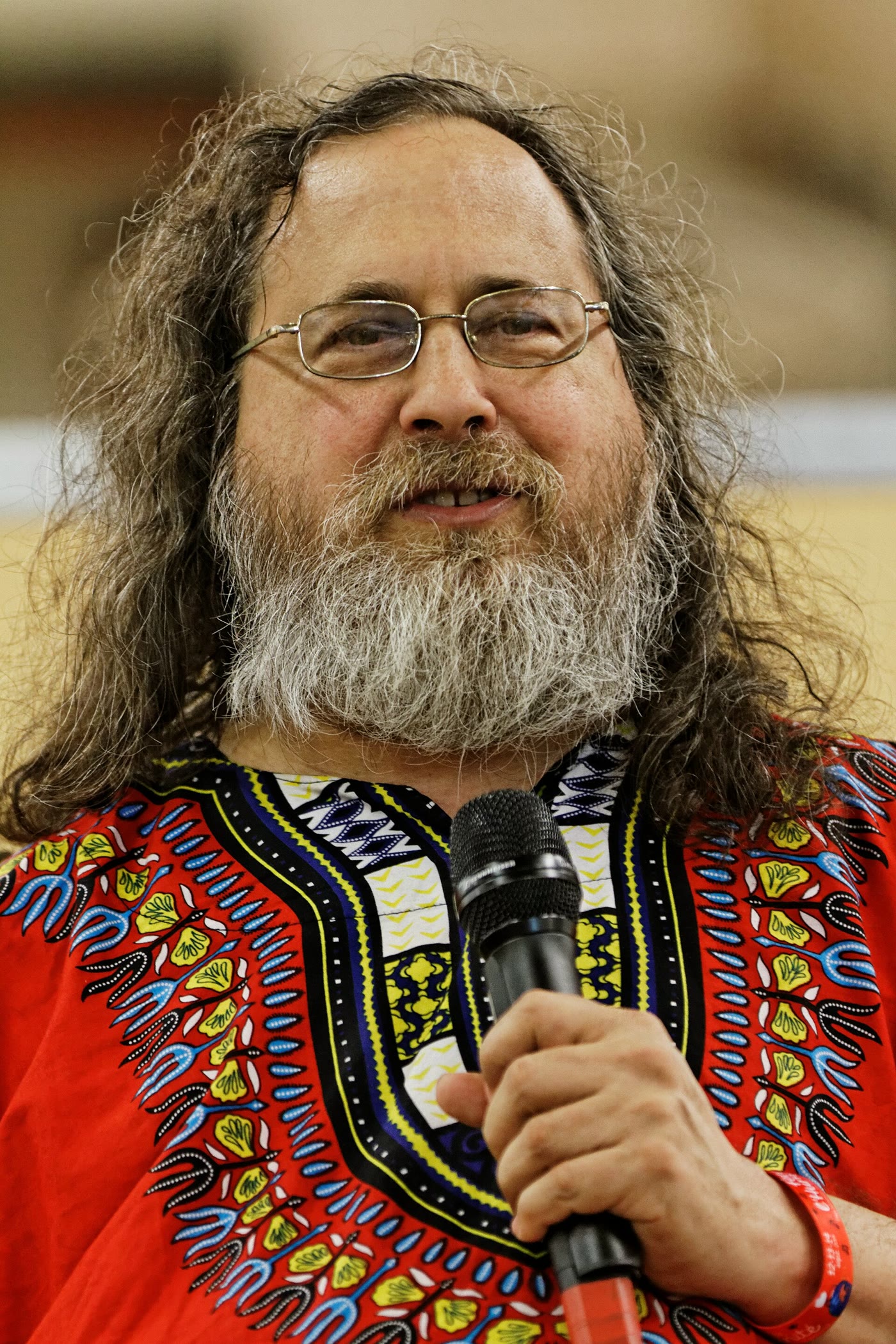 Image: Thesupermat (CC BY-SA 3.0), via Wikimedia Commons
Why open source matters
Nearly all modern software is built on it. A Harvard Business School study by Manuel Hoffmann, Frank Nagle and Yanuo Zhou found that some 96% of commercial programs include open-source code. Recreating the widely used packages once would cost about $4.2 billion, but the authors put the demand-side value, what every company using them would have to spend to write its own, at $8.8 trillion, and estimate firms would pay 3.5 times more for software without open source. They also found about 5% of programmers created more than 90% of that value.
The community keeps growing. GitHub's Octoverse 2025 report counts more than 180 million developers on the platform, over 36 million of them new in the past year, and more than 1.12 billion contributions to public and open-source projects. India added more than 5.2 million developers in 2025, a little over 14% of the newcomers, and GitHub projects it will have 57.5 million developers by 2030, ahead of the United States.
For developers and companies, that means faster building (no one writes their own encryption or web server), code anyone can audit, and no lock-in to one vendor. It also means a responsibility: the vibe coding wave produces apps assembled from hundreds of open-source packages that few people have read.
What is open source AI?
AI made the word "open" slippery. A model has code, trained weights (the billions of numbers it learned) and the data it was trained on. In October 2024 the OSI published the Open Source AI Definition 1.0. It requires the freedoms to use, study, modify and share the system, and it requires the code, the parameters (weights) and "sufficiently detailed information about the data" for a skilled person to build a substantially equivalent system.
Most downloadable models fall short of that. Meta's Llama licence, for example, says any company whose products had more than 700 million monthly active users must request a licence from Meta, a limit on who may use it that the Open Source Definition does not allow. That is why the industry increasingly uses "open weight" for models such as Mistral Large 4 and Moonshot's Kimi K3.1 Pro: you can download and run them, but you can't see or rebuild everything that made them.
Common misconceptions about open source
"Open source means free of charge." Usually, but not necessarily. The Open Source Definition says a licence may not stop anyone from selling or giving the software away, and many companies charge for support, cloud hosting or packaged versions of open code.
"Open source means no rules." Every licence has conditions. Ship a modified GPL program without its source, or strip the copyright notice from MIT code, and you are breaking the licence.
"Anyone can change the official version." Anyone can change their own copy. What goes into the official project is decided by its maintainers.
"More eyes make it automatically secure." Public code can be audited, but someone has to do it. In March 2024 CISA warned that malicious code had been embedded in versions 5.6.0 and 5.6.1 of XZ Utils, a compression library used in Linux systems. The project was open, and the backdoor still got in. Bugs in widely used code also travel far, as with the Linux TCP flaw we covered this month.
"Open weights means open source." Not under the OSI's AI definition, which also asks for training-data information and licences without use restrictions.
Latest news
- Ghostty terminal engine hits 1.0: an MIT-licensed library now inside JetBrains IDEs.
- Linux vulnerability CVE-2026-98432: a remote-root bug in the open-source kernel.
- Mistral Large 4 open weights: a 1-trillion-parameter model anyone can download.
- Kimi K3.1 Pro vs Opus 5.5: an open-weight model close to the top closed one.
- What is vibe coding? Building apps by prompting AI, on top of open-source packages.
- What is an LLM? The kind of model the open-weights debate is about.
Questions readers ask
- What is open source in simple words?
- Open source is software whose code is public and comes with a licence that lets anyone use it, see how it works, change it and pass it on. Think of a recipe published with permission to cook it, tweak it and share your version.
- What is open source software? Give some examples.
- Open-source software is any program released under a licence that meets the Open Source Definition. Well-known examples are the Linux kernel (GPL-2.0), the Android Open Source Project (mostly Apache 2.0), the Git version-control system and the libghostty terminal engine (MIT).
- Is open source software free?
- Usually free of charge, but "free" is about freedom more than price. The Open Source Definition says a licence may not stop anyone from selling or giving the software away, so companies can and do charge for support, hosting or packaged versions.
- What is open source AI?
- Under the Open Source Initiative's Open Source AI Definition 1.0, released in October 2024, an open-source AI system must let anyone use, study, modify and share it, and must publish its code, its weights and detailed information about the training data. Most downloadable models share weights only, so they are called open weight.
- What is the difference between open source and closed source?
- With open source, anyone can read and modify the code under its licence. With closed (proprietary) source, the company keeps the code private and you only get the finished program under terms it sets, usually without the right to change or redistribute it.
+ Sources
- Open Source Initiative — The Open Source Definition
- Open Source Initiative — History of the OSI
- Open Source Initiative — The Open Source AI Definition 1.0
- GNU Project — What is Free Software?
- GitHub — Octoverse 2025: A new developer joins GitHub every second
- Harvard Business School Working Knowledge — Open Source Software: The $9 Trillion Resource Companies Take for Granted
- Hoffmann, Nagle and Zhou — The Value of Open Source Software (HBS working paper, SSRN)
- Choose a License — Licenses
- Linux kernel documentation — Linux kernel licensing rules
- Android Open Source Project — Licenses
- Meta — Llama 3.1 Community License Agreement
- SiliconANGLE — OSI clarifies what makes AI systems open source
- CISA — Reported supply chain compromise affecting XZ Utils (CVE-2024-3094)
+ Rate this story
Get stories like this on your phone, the minute they drop.
 Scan with your Android phone
The Weekly Diff launches soon.
Subscribe on YouTubeKeep reading