What is quantum computing? Qubits, superposition and what it can really do, explained
Quantum computers do not run your apps faster. They use qubits, kept colder than outer space, to attack a narrow set of problems that ordinary chips cannot, and the hard part is keeping them from making mistakes.
Quantum computing is a way of computing with qubits, which can hold a weighted mix of 0 and 1 and become linked to each other. Algorithms use interference to boost correct answers. It could speed up chemistry, materials research and code-breaking, but today's machines from IBM, Google and others are still too error-prone for most useful work.
What is quantum computing? It is a way of computing that uses qubits instead of ordinary bits. A bit is always 0 or 1. A qubit can hold a weighted mix of 0 and 1 at the same time, and groups of qubits can be linked so their results depend on each other. A quantum program uses those effects to make wrong answers cancel out and the right answer stand out. That makes quantum computers very good at a narrow set of problems, such as simulating molecules, and no better at everyday jobs like browsing or gaming.
Our 28-second version:
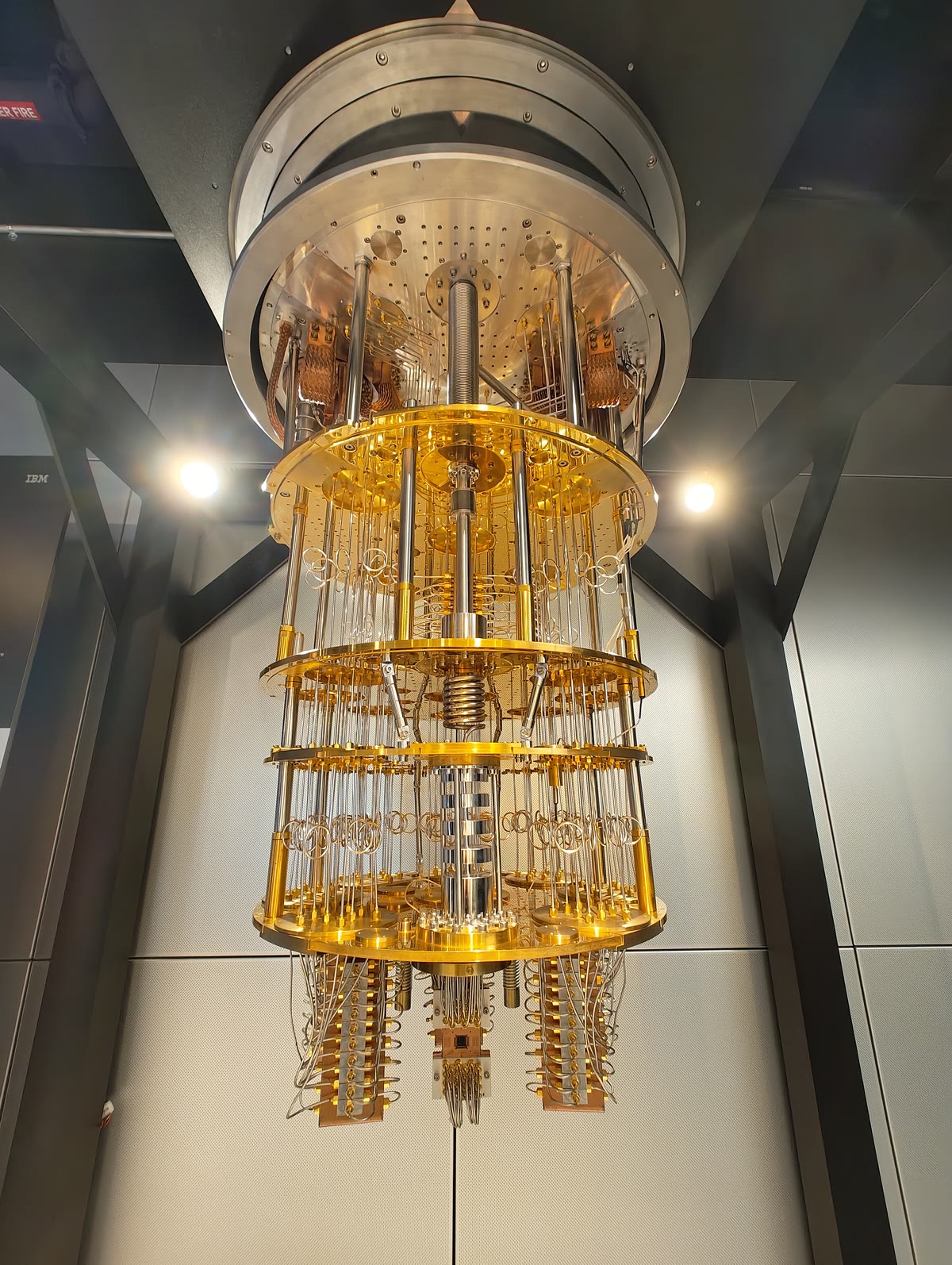 Image: OJB Quantum (CC BY 4.0), via Wikimedia Commons. The gold "chandelier" is the fridge; the chip sits at the very bottom.
How does quantum computing work?
The analogy. Imagine looking for the exit of a huge maze. A normal computer tries paths one by one, or splits them across many cores. A quantum computer is more like sending a wave through the maze: the parts of the wave that hit dead ends cancel each other out, and the part that reaches the exit gets stronger. The analogy is loose, but it captures the key idea: quantum computers do not try every answer and pick the best. They arrange things so the wrong answers interfere away.
The real mechanics. IBM's explainer lists four ideas you need:
- Superposition. A qubit carries a weight (an "amplitude") for 0 and a weight for 1. Three qubits carry weights for all eight patterns from 000 to 111. Every extra qubit doubles the number of weights.
- Entanglement. Qubits can be linked so that measuring one tells you something about another. This is what lets a group of qubits represent patterns that a set of independent coins never could.
- Interference. A quantum algorithm is a sequence of operations (gates) that shifts those weights so that wrong answers cancel and right ones add up.
- Decoherence. Any heat, vibration or stray signal knocks qubits out of their quantum state. When that happens mid-calculation, the answer is noise.
When you finally measure the qubits, you get one ordinary answer, 0s and 1s. That is why quantum programs are usually run many times and the results counted.
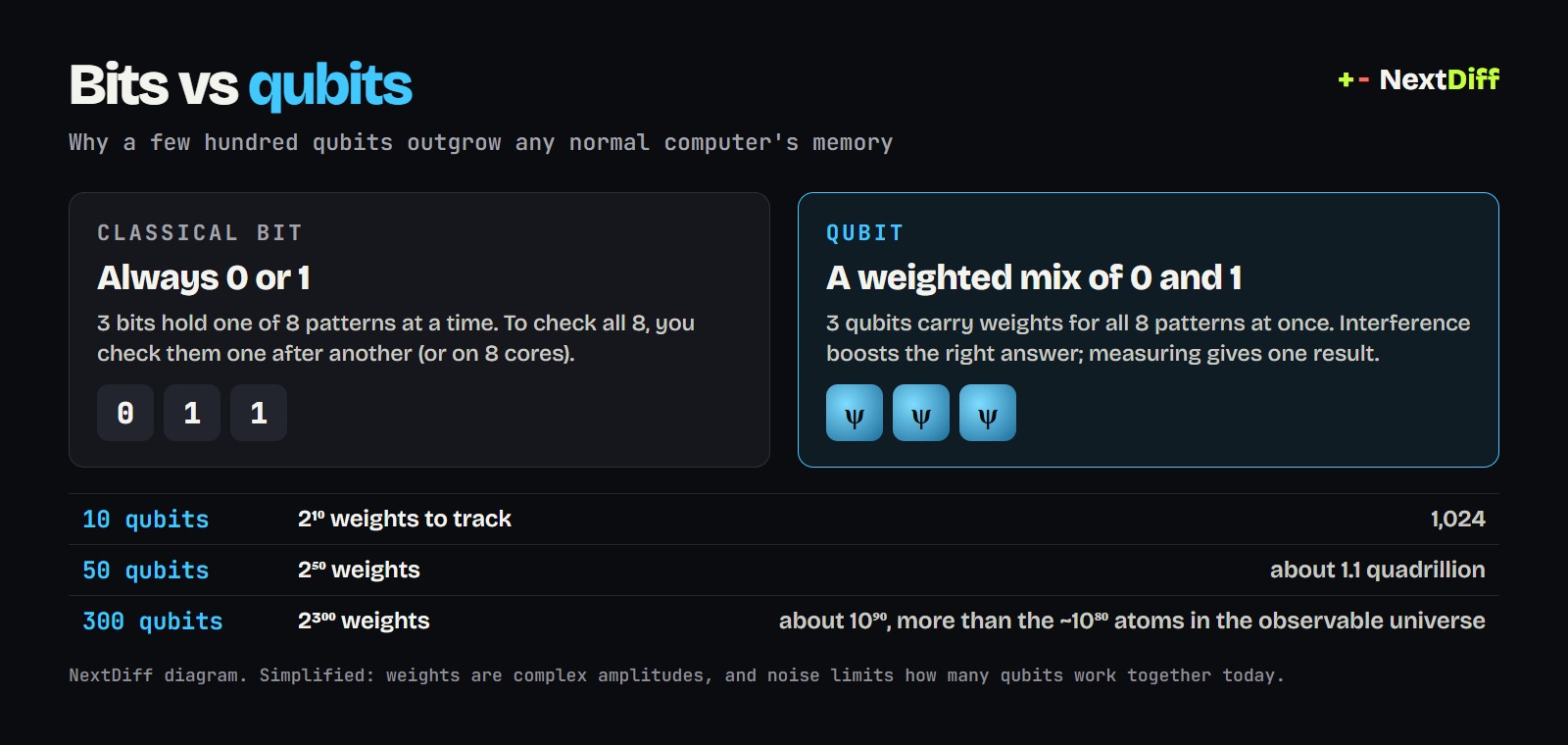 Image: NextDiff diagram
That doubling is the whole point. Writing down the full state of 50 qubits takes about 1.1 quadrillion numbers; 300 qubits would need more numbers than there are atoms in the observable universe. No ordinary computer can keep up with that, at least for the problems where the structure can be exploited.
Why the giant gold fridge? Most of today's leading machines, including IBM's and Google's, use superconducting circuits as qubits. IBM says its processors must be kept at roughly a hundredth of a degree above absolute zero, colder than outer space, to limit noise. The gold "chandelier" you see in photos is a dilution refrigerator that steps the temperature down layer by layer, with the chip at the bottom.
Examples: who is building quantum computers?
- Google Willow (December 2024). A 105-qubit superconducting chip. Google says that as it grew its error-corrected grid from 3×3 to 5×5 to 7×7 qubits, the error rate halved each time, a goal the field had chased for almost 30 years. It also ran a benchmark in under five minutes that Google estimates would take a top supercomputer 10 septillion years. Google itself notes that benchmark has no commercial use.
- IBM Nighthawk and Quantum System Two (November 2026). On 6 November 2026 IBM unveiled a Quantum System Two in Chicago, powered by Nighthawk, which IBM calls the most powerful quantum chip it has built. Reports put Nighthawk at 120 qubits. IBM's roadmap aims for Starling, a fault-tolerant machine with 200 error-corrected ("logical") qubits running 100 million operations, by 2029.
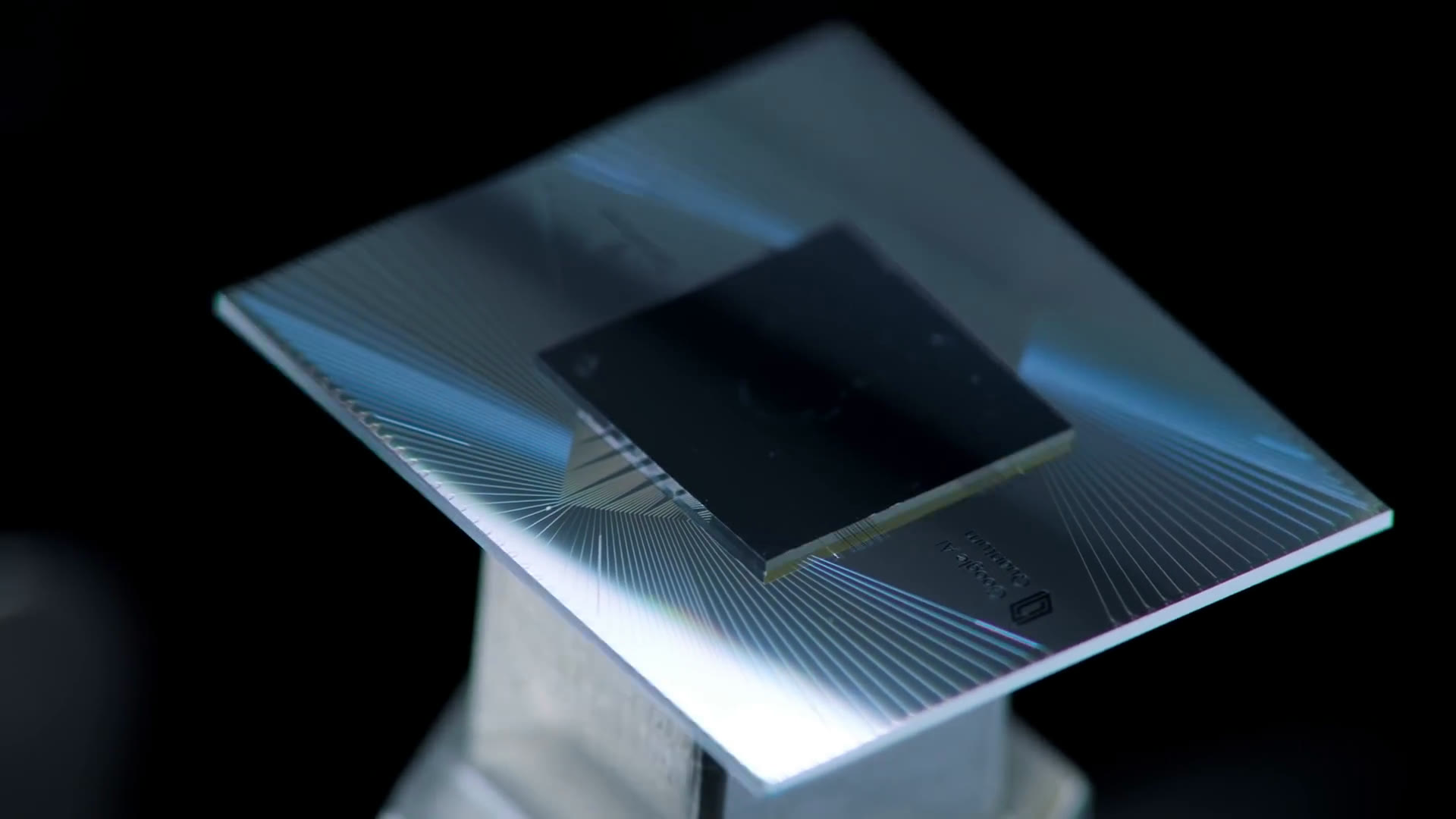 Image: Google (CC BY 3.0), via Wikimedia Commons. Google's earlier Sycamore chip; Willow is its successor.
- Other approaches. Not every qubit is a superconducting loop. IonQ and Quantinuum trap charged atoms (ions) with lasers; QuEra and Pasqal hold neutral atoms in beams of light; PsiQuantum and Xanadu use photons; Diraq and Intel use electron spins in silicon, closer to normal chip factories.
- India. The government's National Quantum Mission, approved in April 2023 with ₹6,003.65 crore to 2030-31, targets quantum computers with 50 to 1,000 physical qubits within eight years. Andhra Pradesh's Amaravati Quantum Valley plans to host a 156-qubit IBM system.
Quantum computer vs classical computer vs supercomputer
| Laptop / phone | Supercomputer | Quantum computer (today) | |
|---|---|---|---|
| Basic unit | Bit (0 or 1) | Bits, millions of cores | Qubit (weighted 0 and 1) |
| Good at | Everyday apps | Huge simulations, AI training | Narrow problems: molecules, some optimisation, factoring |
| Size of the hard part | A chip | A building of racks | A chip inside a fridge near absolute zero |
| Error rate | Practically zero | Practically zero | High; error correction is the main research race |
| Can you buy one? | Yes | Rent time | Rent time over the cloud (IBM, Google, AWS, Azure) |
What is quantum computing used for? Why it matters
- Chemistry and materials. Molecules follow quantum rules, so a quantum computer can in principle simulate them directly: batteries, catalysts, fertiliser, drug molecules. This is the most widely expected first win.
- Encryption. In 1994 Peter Shor showed that a large quantum computer could factor big numbers quickly, which would break RSA and the elliptic-curve keys behind HTTPS, banking and crypto wallets. Google researcher Craig Gidney's 2025 preprint (not peer-reviewed) estimates RSA-2048 could fall to under a million noisy qubits in under a week, far fewer than earlier estimates but far more than any machine has. Attackers can record encrypted traffic now and decrypt it later, which is why NIST published its first post-quantum standards (FIPS 203, 204 and 205) in August 2024. If you run software, the practical step is to plan your move to those algorithms.
- Optimisation and finance. Logistics, portfolios and scheduling are often named, but proven speed-ups here are much smaller and less certain.
Common misconceptions
- "It tries every answer at once." It holds weights for every pattern, but measuring gives you one result. The speed-up comes only when an algorithm makes the wrong answers cancel.
- "It will replace my laptop." No. Quantum computers are accelerators for specific maths, used alongside normal computers, and they need a lab-grade fridge.
- "More qubits means better." Quality matters as much as count. A few hundred low-error qubits can beat thousands of noisy ones, and error-corrected "logical" qubits need many physical qubits each.
- "It will make AI much faster." There is no proof that quantum computers speed up training today's AI models. AI runs on GPUs and custom chips, and that will not change soon.
Latest news
- IBM unveils its most advanced quantum computer, a Quantum System Two with the Nighthawk chip, in Chicago (6 November 2026).
- Other unusual computers we have covered: brain organoids that learned to read Braille.
- Why key security matters for crypto: the $6.3 billion Binance hack.
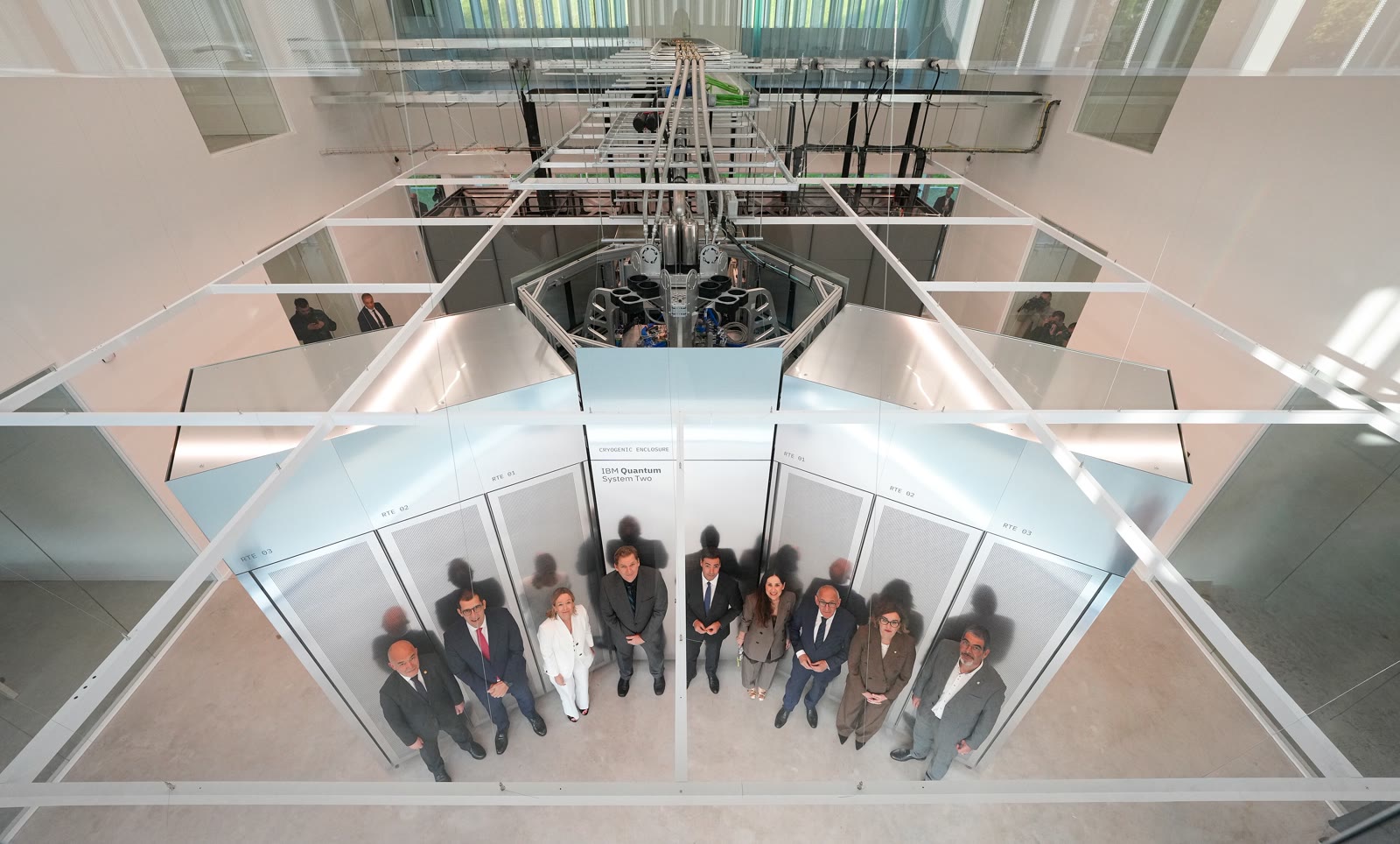 Image: Irekia / Eusko Jaurlaritza (CC BY 4.0), via Wikimedia Commons. An IBM Quantum System Two in Spain.
Questions readers ask
- What is quantum computing in simple terms?
- Quantum computing uses qubits, which can hold a weighted mix of 0 and 1 and be linked to each other, instead of ordinary bits. Programs use interference to cancel wrong answers and boost the right one, which helps on a narrow set of very hard problems.
- How does a quantum computer work?
- It runs a sequence of operations on qubits kept in superposition and entanglement, usually on a chip cooled close to absolute zero. The operations make wrong answers interfere away, and measuring the qubits at the end gives one ordinary answer, so programs are repeated many times.
- What is quantum computing used for?
- The best-understood uses are simulating molecules and materials for chemistry, batteries and drugs, and factoring large numbers, which threatens today's encryption. Optimisation and finance are often named, but proven speed-ups there are smaller.
- Is quantum computing better than AI?
- They are different things. AI is software that mostly runs on GPUs; quantum computing is a kind of hardware. There is no evidence yet that quantum computers speed up training today's AI models.
- Can quantum computers break encryption today?
- No. Breaking RSA-2048 is estimated to need around a million noisy qubits running for days, far beyond today's machines. Because data can be stored now and decrypted later, NIST published post-quantum encryption standards in 2024.
+ Sources
- IBM — What is quantum computing?
- Google — Meet Willow, our state-of-the-art quantum chip
- IBM Newsroom — IBM unveils its most advanced quantum computer in Chicago (6 Nov 2026)
- Live Science — IBM unveils two new quantum processors, blueprint for fault tolerance by 2029
- Interesting Engineering — IBM's Quantum System Two begins operations at Chicago hub
- Gidney (arXiv preprint) — How to factor 2048 bit RSA integers with less than a million noisy qubits
- NIST — Post-quantum cryptography FIPS approved (FIPS 203, 204, 205)
- PIB — Cabinet approves National Quantum Mission
- Quantum Computing Report — IBM to commission quantum computer in Amaravati
- Wikimedia Commons — IBM Quantum System One (OJB Quantum, CC BY 4.0)
- Wikimedia Commons — Google Sycamore Chip (Google, CC BY 3.0)
- Wikimedia Commons — IBM Q System Two Ikerbasque (CC BY 4.0)
+ Rate this story
Get stories like this on your phone, the minute they drop.
 Scan with your Android phone
The Weekly Diff launches soon.
Subscribe on YouTubeKeep reading