FAA ground stop: what caused it, the AI-tool question, and Duffy's $50B fix
Overloaded routers on 1980s copper lines grounded US departures for over four hours, officials say, as the FAA's $12.5 billion rebuild sits half done.
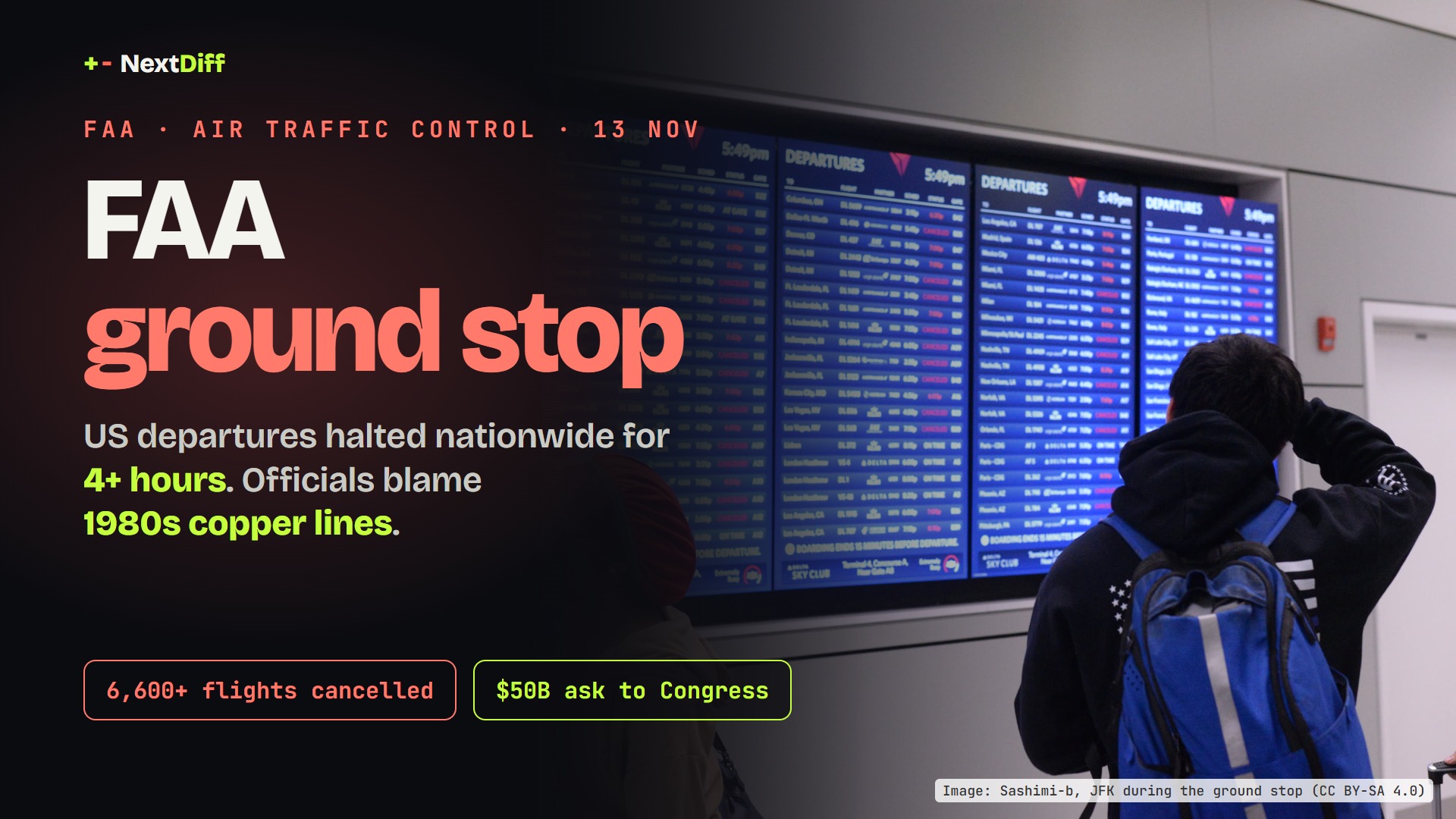
The FAA ground stop on 13 November 2026 halted US departures from 3:54 to 8:15 p.m. Eastern after radar and radio links to its en-route centres failed. Transportation Secretary Sean Duffy blamed overloaded routers on 1980s copper lines; officials saw no sign of a cyberattack. More than 6,600 flights were cancelled, and Duffy asked Congress for $50 billion.
The FAA ground stop on Friday, 13 November 2026 halted departures at airports across the US for about four hours and twenty minutes, the longest nationwide stop in years. The cause, according to Transportation Secretary Sean Duffy, was not a hacker or a new AI system but something older: overloaded switches and routers running on what he called "1980s little copper lines."
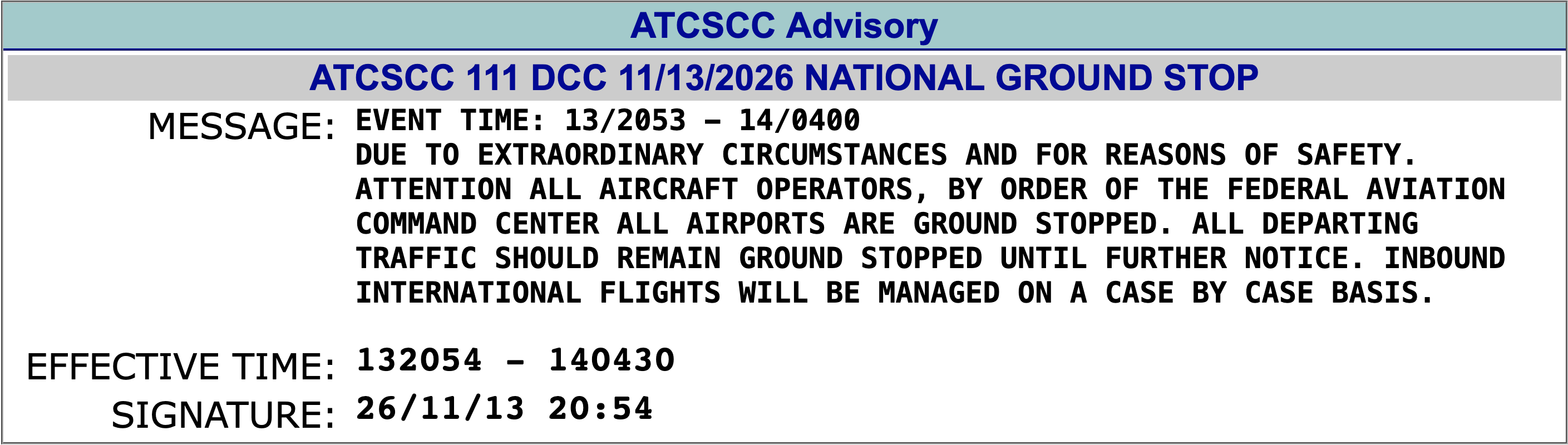 Image: Federal Aviation Administration, ATCSCC advisory 111 (public domain)
What happened during the FAA ground stop?
Radar and radio links to the FAA's en-route centres began to turn unstable just after 3:30 p.m. Eastern, AP reported. At 3:54 p.m. the FAA's Air Traffic Control System Command Center issued the order: "all airports are ground stopped," citing "extraordinary circumstances" and "reasons of safety." Inbound international flights were handled case by case, and some Alaska and Hawaii flights kept flying.
Duffy said a communication problem was affecting all of the country's Air Route Traffic Control Centers, the 21 regional facilities that guide planes at cruising altitude. About 3,500 planes were in the air when the order went out, by his count. "At 8:15 tonight, Eastern time, we've opened up the airspace," he said at the White House, CBS News reported.
By 9:30 p.m., FlightAware counted more than 6,600 cancelled flights and more than 25,100 delays within, into or out of the US, according to AP. Nationwide ground stops are rare: the last one was in January 2023, when the system that sends notices to pilots failed, and before that, 11 September 2001.
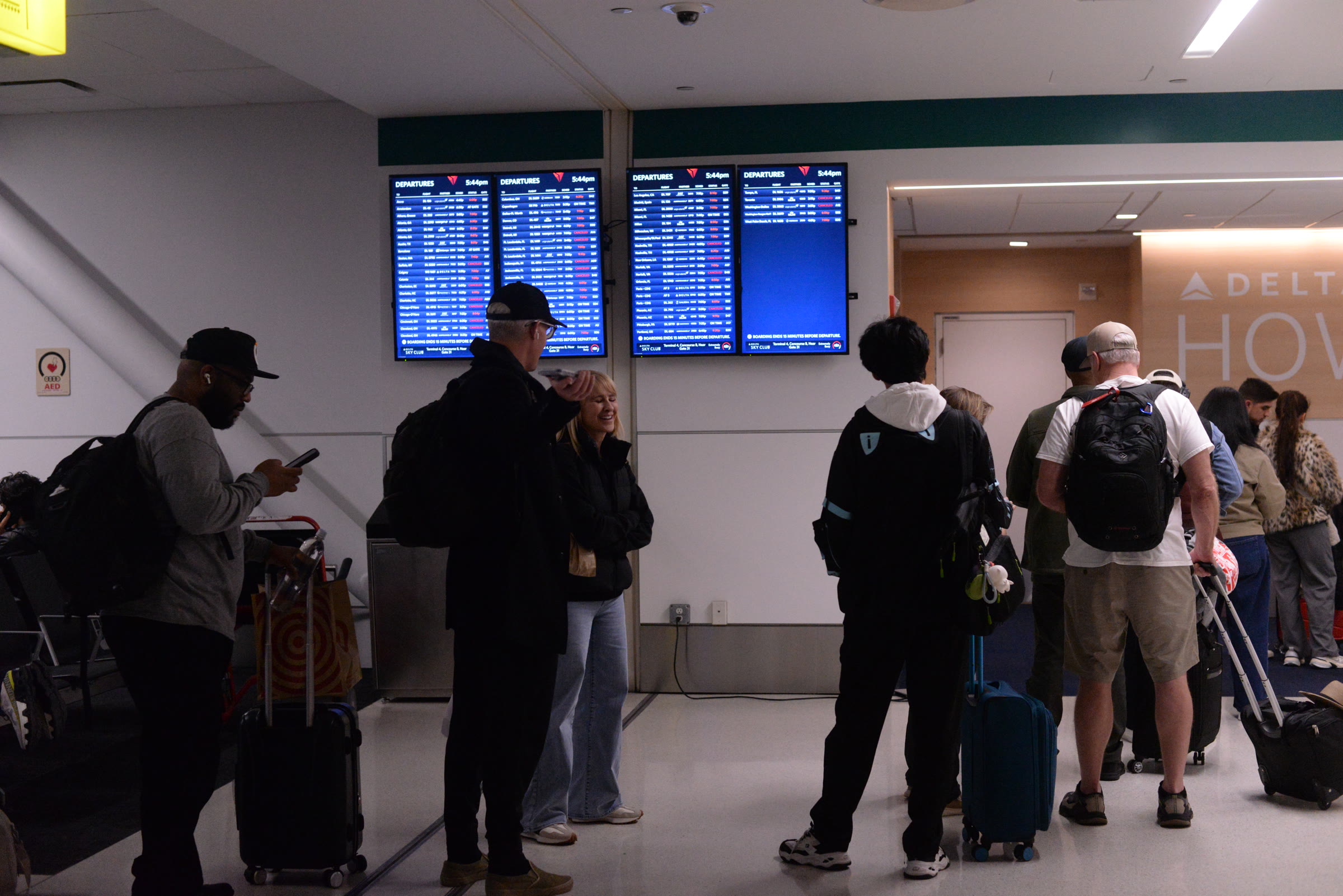 Image: Sashimi-b, JFK during the 2026 FAA ground stop (CC BY-SA 4.0, Wikimedia Commons)
What caused the FAA ground stop?
Air traffic control is a network problem as much as a people problem. Controllers in each centre see radar data and talk to pilots over radio sites that can be hundreds of kilometres away, and those feeds travel over telecom circuits. If the circuits drop or send garbage, controllers can no longer be sure where every plane is, so the safe move is to stop adding planes to the sky.
That is what officials say happened. "Our routers actually got overloaded with data and … they started to give us inconsistency in the data," Duffy said. He described the old core plainly: "We have old switches, old routers, we use 1980s little copper lines." Homeland Security Secretary Markwayne Mullin said new equipment, including security patches, appeared to have overwhelmed the older system. Duffy added that the new equipment already installed did not fail, per ABC7.
The FAA has not yet published a technical report, so the exact first failure (which circuit, which update) is still unconfirmed.
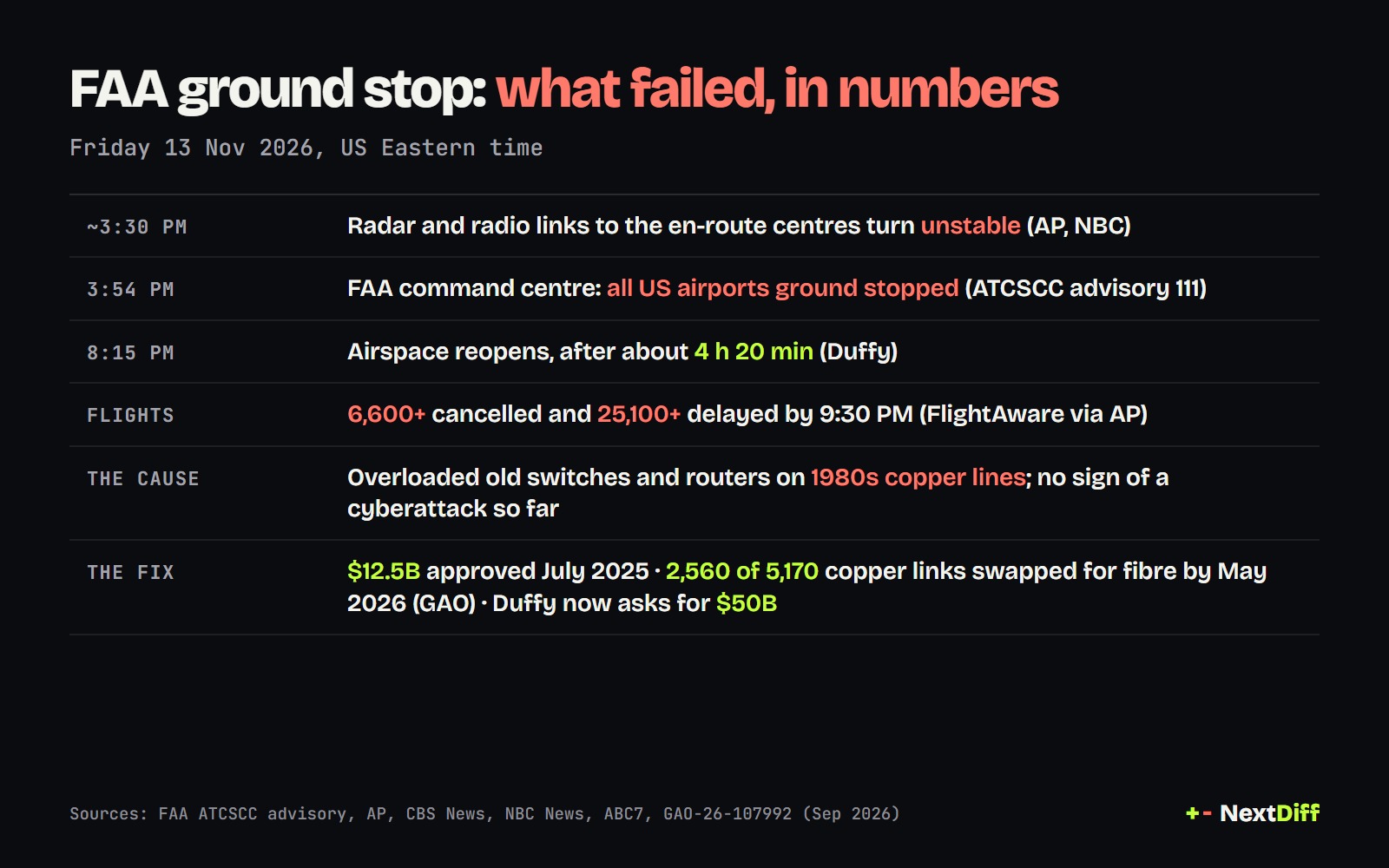 Graphic: NextDiff, from the FAA advisory, AP, CBS News, NBC News, ABC7 and GAO
Was it a cyberattack, or the new AI tool?
So far, officials say no to the first. Mullin said there was "no indication, as of yet, that this was a nefarious act against us," while adding that "there is nothing certain right now." Attacks on ageing infrastructure are real (see our story on the supermarket fridge hack), which is why the investigation matters.
The AI question comes from timing. This week the FAA announced a wider rollout of SMART (Strategic Management of Airspace, Routes and Trajectories), an $875 million AI traffic-flow tool from a company called ASI that has been used at Washington, DC airports since late September, according to AP. The vendor rejected the link: "The current ground stop is not based on or a result of the SMART system." No official has tied SMART to the failure, and the explanation given so far points at the telecom layer underneath it.
Why it matters: the fix is only half built
Congress gave the FAA $12.5 billion in July 2025 for what it calls the Brand New Air Traffic Control System. In September, the Government Accountability Office reported that by May 2026 the FAA had replaced 2,560 of its 5,170 "old and frail" copper links with fibre, roughly half. GAO also found the programme had no reliable lifecycle cost estimate and 11,389 project schedules that are not integrated, and warned the FAA "would need to continue to rely on severely outdated systems that are prone to failure." A 2024 GAO review had already rated over 75% of the FAA's 138 air traffic systems as unsustainable or potentially unsustainable.
Friday showed the risk of a half-finished migration: new and old equipment have to work together until the last copper circuit is gone.
What's next after the FAA ground stop?
Duffy turned the outage into a funding plea. "This is an emergency… I want $50 billion," he said, asking Congress for emergency money for a complete overhaul. Duffy said aircraft would start moving back into position on Saturday morning, and he expects flights to be back to normal before the Thanksgiving travel rush. The open questions: what exactly failed first, whether the FAA will publish a root-cause report, and whether Congress funds phase two, which GAO says still has no start or end date.
Questions readers ask
- What caused the FAA ground stop?
- The FAA cited a telecommunications outage affecting air traffic control. Transportation Secretary Sean Duffy said old switches and routers on 1980s copper lines were overloaded with data and sent inconsistent radar and radio information to the en-route centres. A full root-cause report has not been published.
- Was the FAA ground stop a cyberattack?
- Officials say there is no sign of one so far. Homeland Security Secretary Markwayne Mullin said there was no indication of a nefarious act, while noting that nothing was certain yet.
- Was the FAA ground stop caused by AI?
- There is no evidence of that. The FAA had just expanded an AI traffic-flow tool called SMART, but its maker, ASI, said the ground stop was not caused by it, and officials pointed to the telecom equipment instead.
- How long did the FAA ground stop last?
- About four hours and twenty minutes: the FAA advisory went out at 3:54 p.m. Eastern on Friday 13 November 2026, and Duffy said the airspace reopened at 8:15 p.m. Eastern.
- How many flights were cancelled by the FAA ground stop?
- By 9:30 p.m. Eastern on 13 November, FlightAware counted more than 6,600 cancellations and over 25,100 delays within, into or out of the US, according to AP.
+ Sources
- FAA — ATCSCC advisory 111: national ground stop (13 Nov 2026)
- AP via Yahoo News — FAA issues nationwide ground stop citing communication issue
- CBS News — FAA lifts nationwide ground stop; no indication of nefarious act
- NBC News — Live updates: flights grounded by FAA communications outage
- ABC7 New York — Duffy makes plea for funding: This is an emergency
- Al Jazeera — FAA ground stop lifted: why were US flights grounded?
- GAO-26-107992 — Air Traffic Control Systems: new modernization effort needs better cost and schedule planning
- The White House — Secretary Mullin and Secretary Duffy update on the FAA national ground stop (video)
+ Rate this story
Get stories like this on your phone, the minute they drop.
 Scan with your Android phone


The Weekly Diff launches soon.
Subscribe on YouTubeKeep reading