Linux vulnerability CVE-2026-98432: the 9.8 TCP bug an AI made into remote root
A ten-year-old race in the kernel's IPv4 handshake can be hit with no login. Debian, SUSE and Oracle shipped fixes in October; Ubuntu's are still in testing and Red Hat says it is expediting its own.

CVE-2026-98432 is a use-after-free in the Linux kernel's IPv4 TCP handshake, present since Linux 4.4 and rated 9.8. Anthropic says an internal Claude model turned it into a remote root exploit. Debian, SUSE, Oracle and some Amazon kernels are fixed; Ubuntu's fixes entered testing on 2 November and Red Hat's are still coming.
A Linux vulnerability that sat in the kernel's TCP code for almost ten years is now the most urgent patch on many server teams' lists. CVE-2026-98432 lets a remote attacker, with no password, corrupt kernel memory while a TCP connection is being set up. Anthropic says one of its unreleased Claude models turned it into a working root exploit. Some distributions fixed it in October. Ubuntu, the most common Linux on cloud servers, still has no fixed kernel in its normal update channel: on 2 November Canonical said its fixes are in testing.
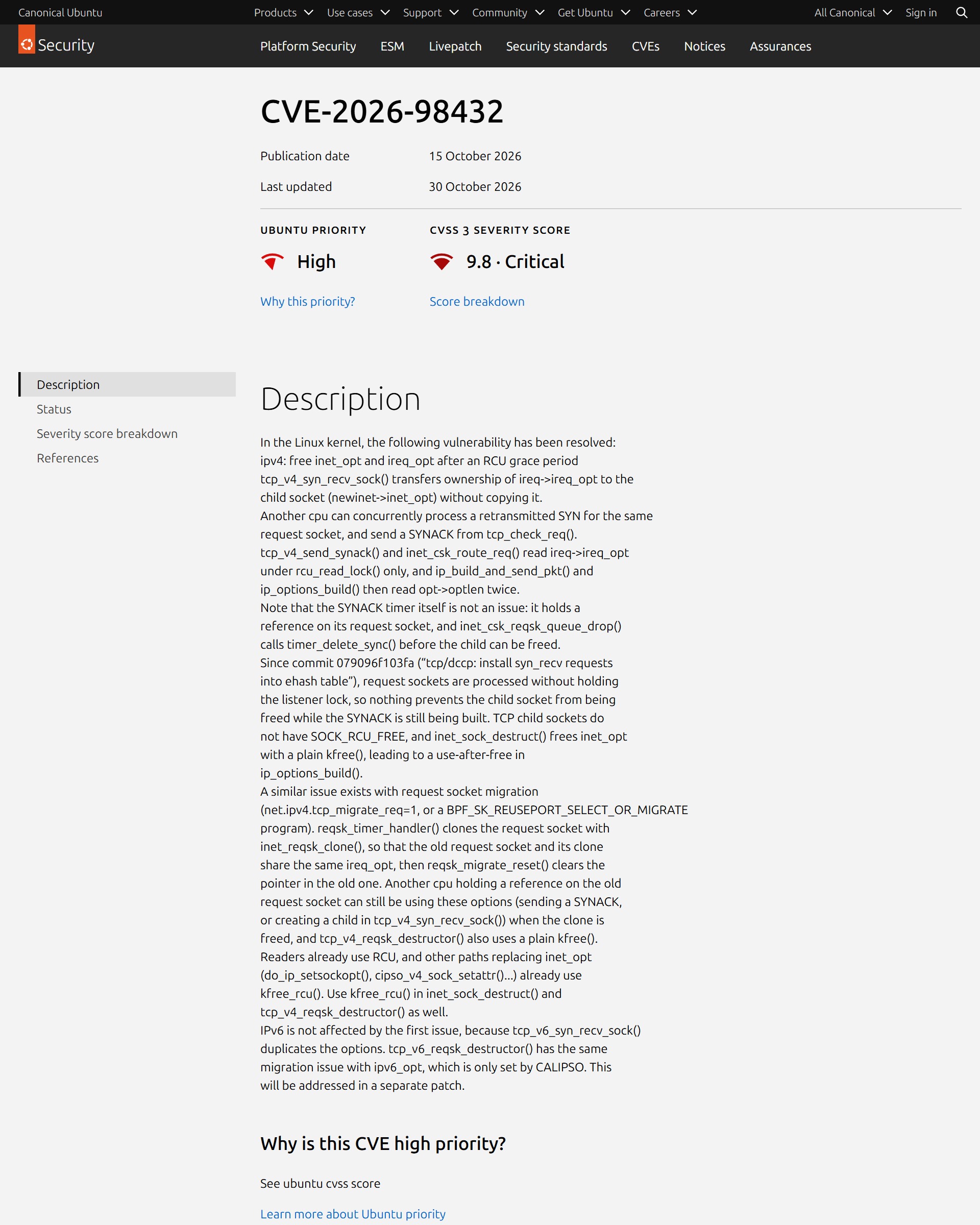 Screenshot: Ubuntu Security, ubuntu.com/security/CVE-2026-98432
What is the Linux vulnerability CVE-2026-98432?
It is a use-after-free: the kernel keeps reading a piece of memory after it has been handed back. According to Ubuntu's CVE page, when a new IPv4 connection is accepted, the kernel passes the "IP options" a client sent in its first packet (the SYN) to the new socket without copying them. If the client resends that SYN, another CPU core can still be reading those options while the first core frees them.
The bug came in with an older change that let Linux handle connection requests without holding a lock, which shipped in Linux 4.4 in January 2016, TuxCare notes. The upstream fix by Eric Dumazet is two lines: free that memory with kfree_rcu(), which waits until no CPU is still reading it, instead of a plain kfree(). It landed on 5 October, and the kernel CVE team published the CVE on 15 October. IPv6 is not affected by the main bug, because IPv6 copies the options.
Anthropic researcher Xinyang Ge is credited with reporting it, according to The Hacker News.
How did an AI turn it into remote root?
In a 27 October post, Anthropic's Frontier Red Team said an unreleased internal research model wrote a two-stage exploit after "initial prompting":
- Leak. Winning the race makes the kernel send back a few extra bytes. One of them is a kernel pointer, which defeats KASLR, the protection that hides where the kernel sits in memory. Anthropic says this took about 48 minutes of attempts.
- Take over. The same bug is used again to overflow a buffer and overwrite a function pointer, which then runs an attacker's command as root. That took about five more minutes.
A lost race only fails the handshake and does not crash the machine, so an attacker can keep trying. Anthropic's proof of concept targeted servers with a multipath TCP (MPTCP) listener. Anthropic has not published the code, and no one else has reproduced it publicly. As of 29 October no attacks had been reported and the bug was not in CISA's list of exploited vulnerabilities, The Hacker News reported.
The bug's severity is disputed. The kernel CVE team and Ubuntu score it 9.8. Oracle and SUSE say 8.1. Red Hat moved from Moderate to Critical and now says it has "no network prerequisites".
Which Linux distributions have a fix?
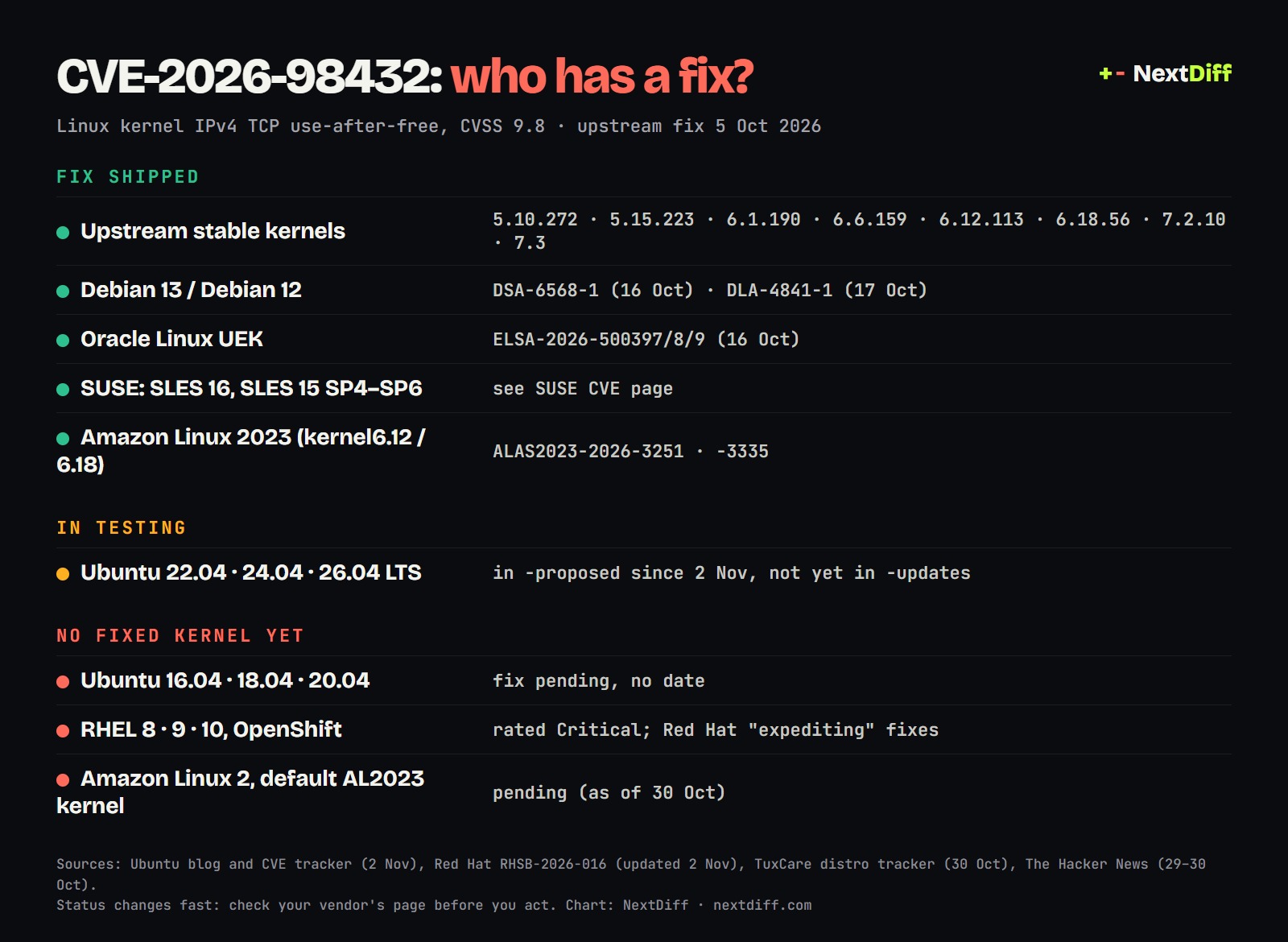 Chart: NextDiff, from Ubuntu, Red Hat, TuxCare and The Hacker News
- Fixed: upstream stable kernels 5.10.272, 5.15.223, 6.1.190, 6.6.159, 6.12.113, 6.18.56, 7.2.10 and 7.3; Debian 12 and 13; Oracle Linux UEK; SUSE's SLES 16 and SLES 15 SP4–SP6; Amazon Linux 2023's newer kernel6.12 and kernel6.18 packages.
- In testing: Ubuntu 22.04, 24.04 and 26.04 LTS. Canonical put fixed kernels (5.15.0-203.213, 6.8.0-149.149 and 7.0.0-43.43) in its -proposed pocket and says they move to normal updates once testing on over 2,000 certified machines finishes. It gives no date. Fixes for 16.04, 18.04 and 20.04 come later.
- Not yet fixed: RHEL 8, 9 and 10 and OpenShift. Red Hat's bulletin, updated 2 November, says it is "expediting the release of fixes".
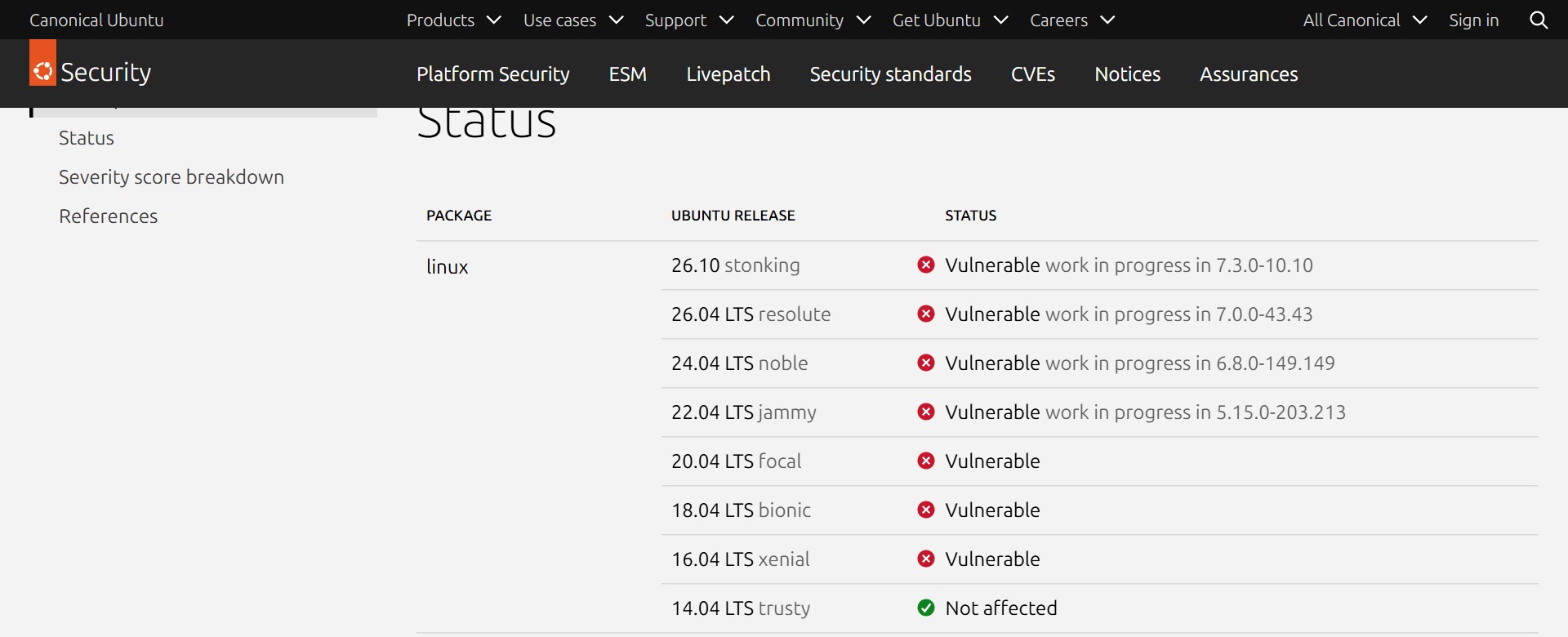 Screenshot: Ubuntu Security, status table on 3 Nov 2026
What should you do now?
- Check your kernel: run
uname -rand compare it with your vendor's fixed version. - Patch and reboot as soon as your distribution ships a fixed kernel. Ubuntu users who can't wait can install from -proposed, following Canonical's instructions.
- Stopgap: Red Hat and TuxCare describe an nftables rule that drops incoming IPv4 TCP packets carrying IP options, which normal clients almost never send. Test it first: it does not survive a reboot, and on OpenShift it doesn't cover pod traffic.
- Don't count on turning off MPTCP. Ubuntu and Red Hat both say the bug is not specific to MPTCP, and machines with it off are still affected.
 Image: Florian Hirzinger, CERN servers (CC BY-SA 3.0, Wikimedia Commons)
Why it matters
This is the gap that AI-found bugs widen. The fix was public on 5 October, so anyone reading kernel commits could see what changed. Anthropic shows that a model can now go from such a fix to a working exploit without a team of specialists. Distributions that take weeks to test and ship kernels leave that window open longer. On 22 October we saw a similar rush with PHP2Shell, where the advice was to patch or go offline.
What's next
Watch for Ubuntu's kernels to reach -updates and for Red Hat's errata. The open question is whether the exploit works without an MPTCP listener, which nobody has shown publicly. Anthropic usually waits 90 days for patches, plus 45 more, before sharing details beyond the public advisory.
Questions readers ask
- What is CVE-2026-98432?
- It is a use-after-free race in the Linux kernel's IPv4 TCP connection setup, present since Linux 4.4. A remote, unauthenticated attacker can corrupt kernel memory, and Anthropic says its AI model built a root exploit from it.
- Is Ubuntu patched for CVE-2026-98432?
- Not in the normal update channel yet. On 2 November Canonical put fixed kernels for Ubuntu 22.04, 24.04 and 26.04 in the -proposed pocket for testing; 16.04, 18.04 and 20.04 are still pending.
- Is Red Hat Enterprise Linux affected?
- Yes. RHEL 8, 9 and 10 and OpenShift are affected. Red Hat rates the bug Critical and says it is expediting fixes; RHEL 7 is not affected.
- Does disabling multipath TCP protect me?
- Not fully. Anthropic's exploit used an MPTCP listener, but Ubuntu and Red Hat say the bug is not specific to MPTCP and systems with it disabled are still affected. Patching is the only full fix.
- Is CVE-2026-98432 being exploited?
- No attacks had been reported as of late October, and the bug was not in CISA's Known Exploited Vulnerabilities catalogue. Anthropic has not released its exploit code.
+ Sources
- Ubuntu blog: Fixes available in -proposed pocket for CVE-2026-98432 (2 Nov 2026)
- Ubuntu Security: CVE-2026-98432
- Anthropic: Discovering vulnerabilities with Claude (27 Oct 2026)
- Red Hat: RHSB-2026-016, use-after-free in kernel IPv4
- Red Hat CVE page: CVE-2026-98432
- Linux kernel: upstream fix commit e3f33b0a1d89
- TuxCare: CVE-2026-98432 Linux TCP flaw and which distros are patched
- The Hacker News: Linux kernel TCP flaw with 9.8 CVSS score
+ Rate this story
Get stories like this on your phone, the minute they drop.
 Scan with your Android phone


The Weekly Diff launches soon.
Subscribe on YouTubeKeep reading