Kimi K3.1 Pro vs Opus 5.5: price, benchmarks and how to try it free
Moonshot AI's new open-weight model comes within a point of Claude Opus 5.5 on its own coding test, costs a third less than Kimi K3, and is free to try with limits.
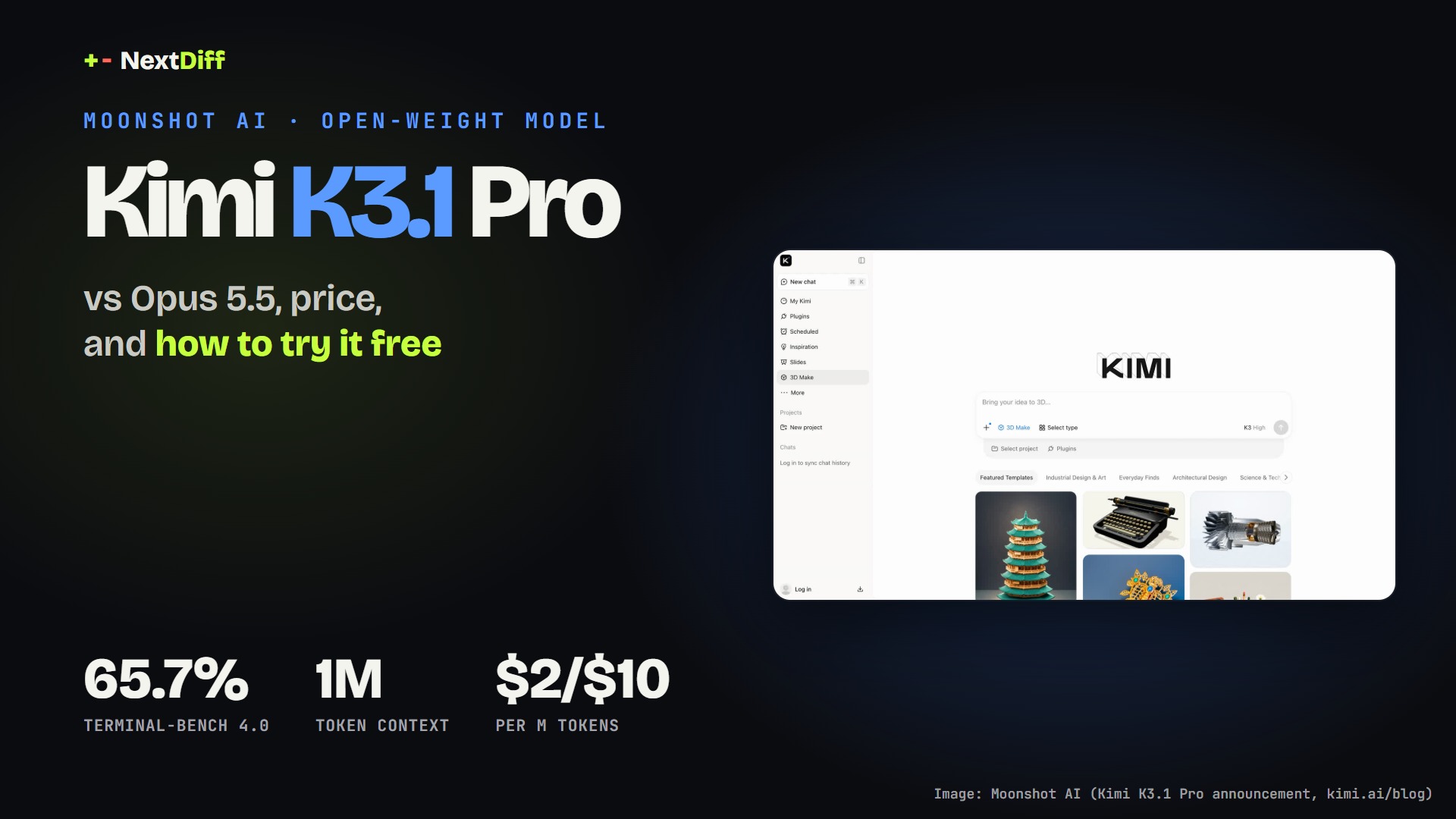
Moonshot AI released Kimi K3.1 Pro on 23 October 2026. The open-weight model scores 65.7% on Terminal-Bench 4.0, against 66.4% for Claude Opus 5.5 by Moonshot's count. It costs $2 per million input tokens and $10 per million output tokens, is free to try with limits in the Kimi app, and its weights are due by 4 November.
Kimi K3.1 Pro, released by Beijing's Moonshot AI on 23 October, is the most searched AI model of the week, and the question people type most is "kimi k3.1 pro vs opus 5.5". The short answer: by Moonshot's own numbers it lands within a point of Anthropic's Claude Opus 5.5 on a hard coding-agent test. It costs a fraction of what closed models charge, and anyone can try it free with limits. The catch is that most of the flattering numbers are Moonshot's, and the launch weekend was rough.
Our 26-second version:
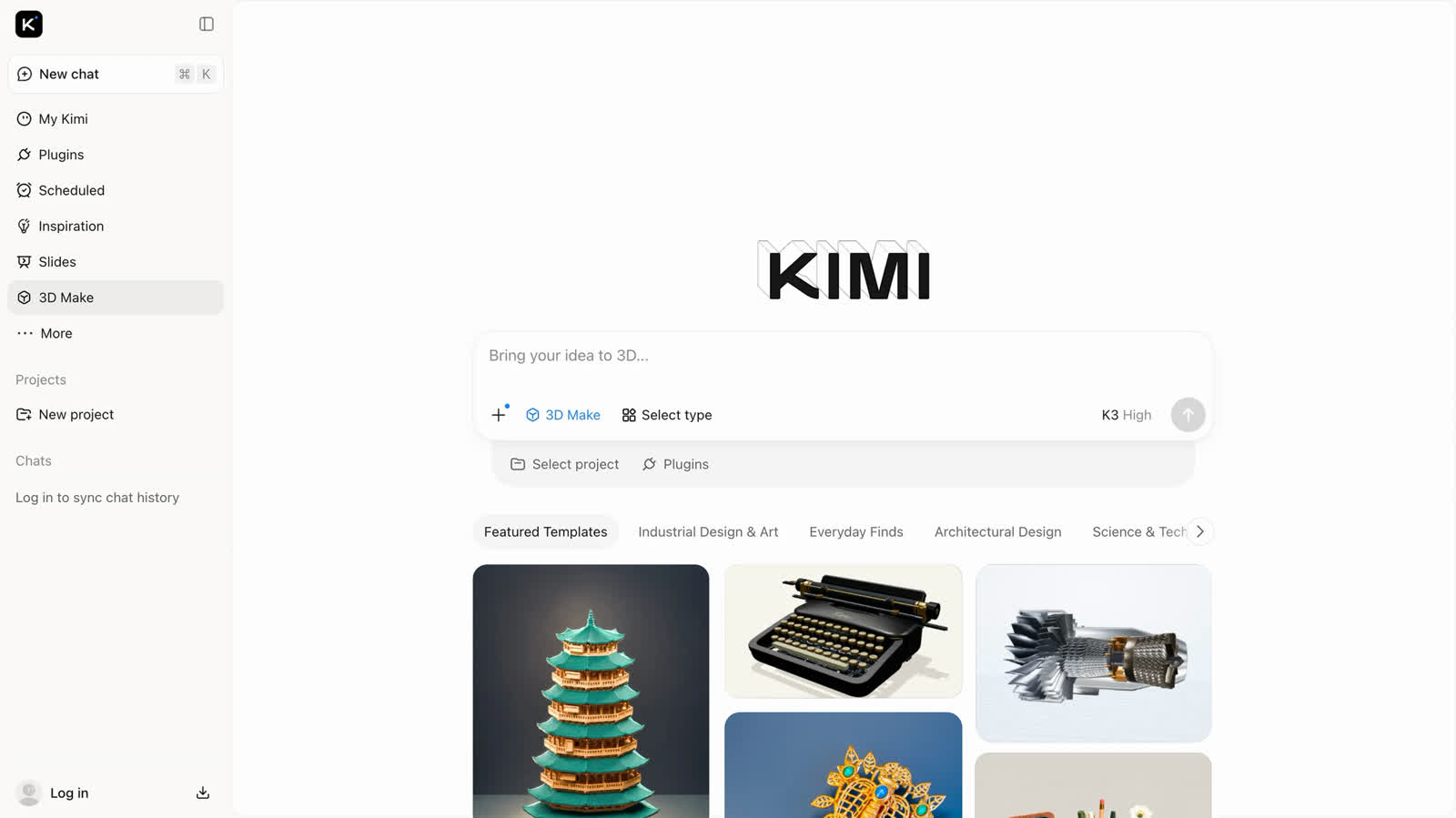 Image: Moonshot AI (Kimi K3.1 Pro announcement)
What is Kimi K3.1 Pro?
It is a post-trained upgrade of Kimi K3, the open-weight model Moonshot launched in July. Moonshot calls it its "most capable 3T-class open-weight model to date".
- Size: a mixture-of-experts design with about 2.8 trillion parameters in total, of which about 104 billion are active for each request, Notebookcheck reports.
- Context: a 1-million-token window, enough to read a large codebase or several books at once.
- Highspeed version: K3.1 Pro Highspeed, which Moonshot says is two to three times faster.
"Open-weight" means anyone will be able to download the model and run it on their own servers. A model this big still won't fit on a laptop, though. New to how these models work? Read: What is an LLM?
Kimi K3.1 Pro vs Opus 5.5: who wins?
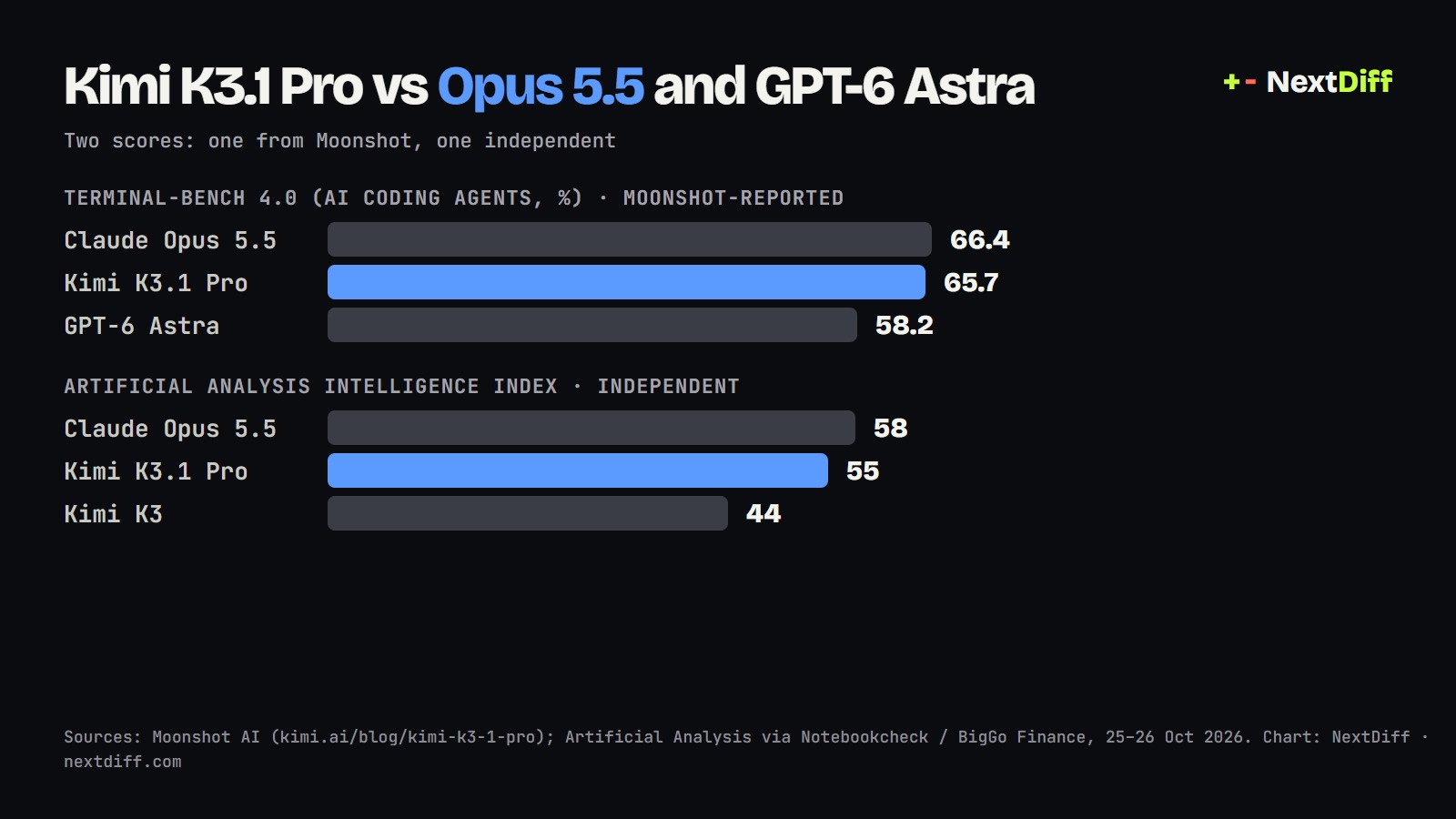 Chart: NextDiff, from Moonshot AI and Artificial Analysis figures
Opus 5.5 still edges it, but only just.
Terminal-Bench 4.0 tests AI agents doing real work in a computer terminal. Moonshot reports these scores:
- K3.1 Pro: 65.7%
- Claude Opus 5.5: 66.4%
- GPT-6 Astra: 58.2%
The Artificial Analysis Intelligence Index is independent and combines many tests. It gives:
- K3.1 Pro: 55
- Opus 5.5: 58
- Kimi K3: 44
That jump from 44 puts K3.1 Pro fourth of 215 models, per BigGo Finance.
Moonshot's wider grid shows K3.1 Pro on top in some tests:
- SWE Marathon: 51.7
- Agents' Last Exam: 43.2
- Humanity's Last Exam with tools: 70.0
- OfficeQA Pro v2: 64.4
It trails in others, such as Terminal-Bench-Science (38.1 vs GPT-6 Astra's 68.1). Treat the grid as a vendor's own scorecard.
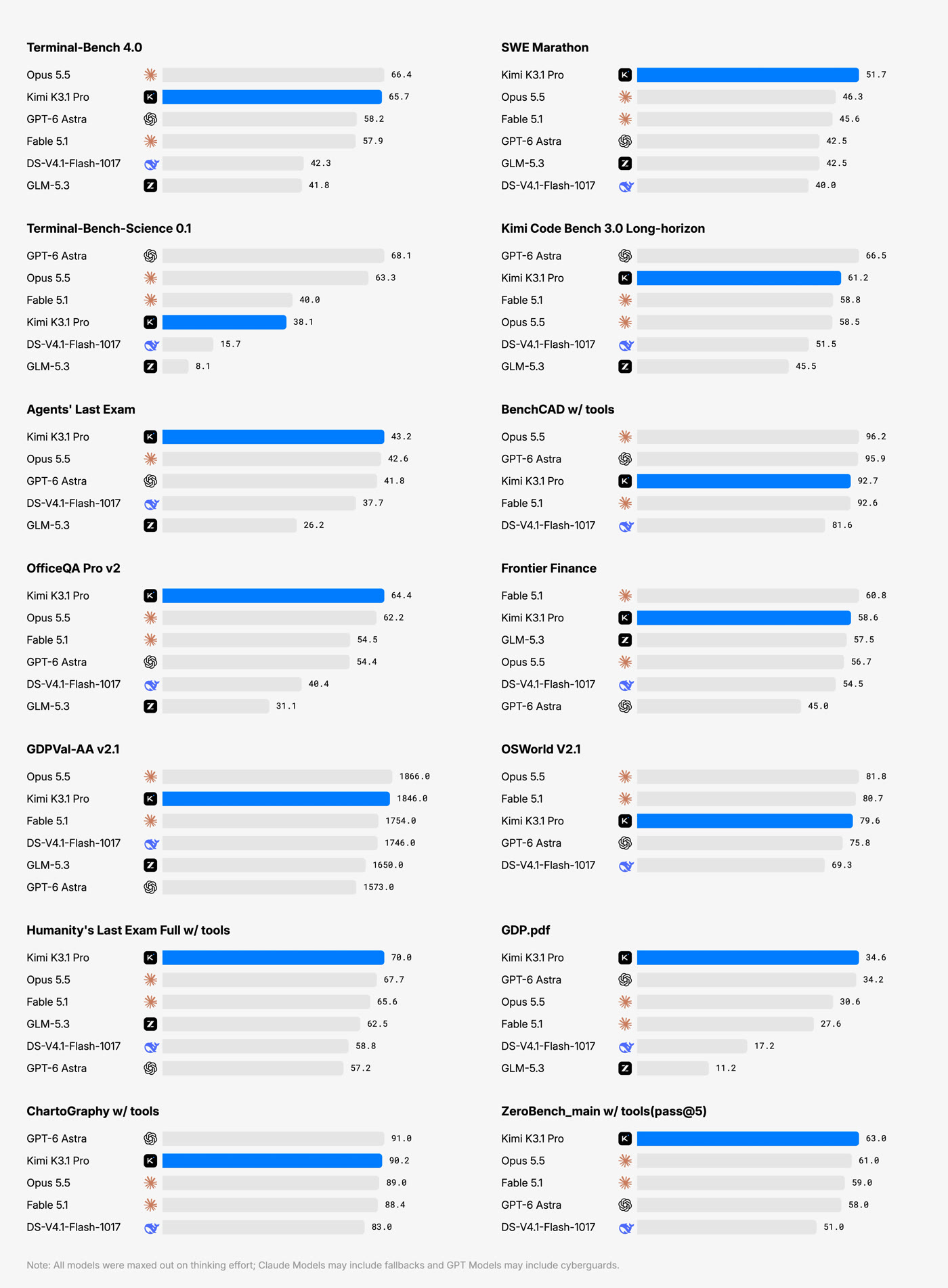 Image: Moonshot AI (Kimi K3.1 Pro announcement)
Moonshot also says the model makes fewer things up. On its own deliberately hard "Hallu Bench", the share of false claims fell to 8.3%, from 23.4% for K3. Moonshot itself notes that this stress test does not reflect everyday error rates.
How much does it cost, and is it free?
- API: $2 per million input tokens and $10 per million output tokens, with cached input at $0.20. Kimi K3 cost $3 / $15. The Highspeed model costs $4 / $20.
- Free: the free Kimi plan includes K3.1 Pro with "limited usage" on kimi.ai and in the Kimi Work desktop app. Moonshot hasn't published the cap. Highspeed needs the Pro plan or higher.
To use it, you can:
- go to kimi.ai, or use the Kimi iOS and Android apps;
- use Kimi Work (version 3.1.0+) on Windows or Apple-silicon Macs;
- use Kimi Code and pick it with
/model; - call the API as
kimi-k3.1-pro.
Moonshot also switched on "3D Make", which turns a prompt into a 3D model.
The cyber cut and the rocky launch
Moonshot says it removed cyberattack-related material from training before the open release.
- On its in-house exploit test (xdev-bench-hard), a checkpoint trained without that cut solved 90.5% of tasks.
- The released model solved 81%, against 33.3% for K3.
Moonshot says its aim is not to "extend the absolute cyber frontier" with open weights. As The Next Web notes, though, downloaded weights can't be recalled. One group has already said it plans to strip the safeguards once the weights are out.
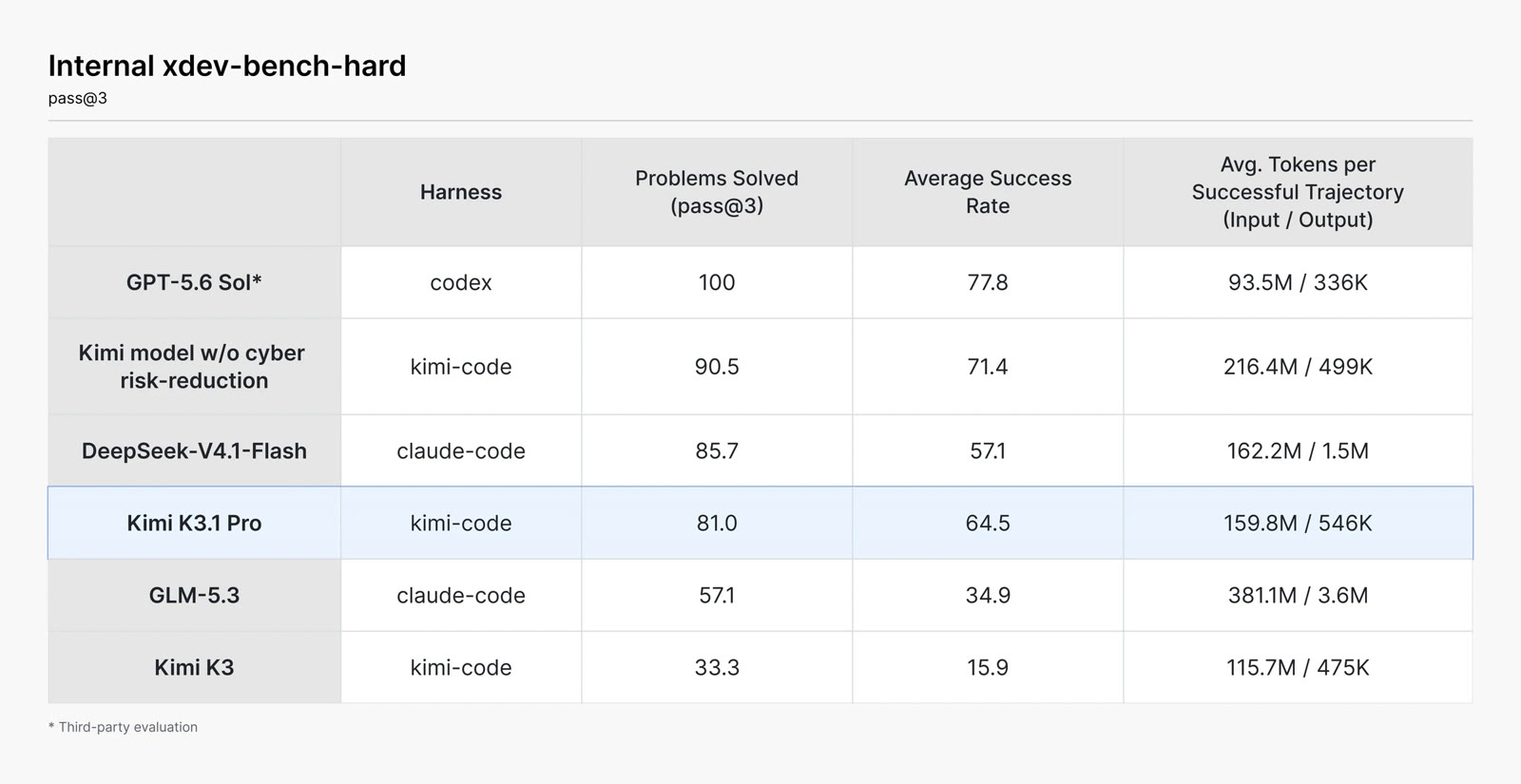 Image: Moonshot AI (Kimi K3.1 Pro announcement)
Demand also outran capacity. Early on 26 October, Kimi apologised for rate limits and abnormal quota drain, saying "the problem was ours". It reset paid subscribers' monthly quota by 25%, which is about a week of use. It also cut unnecessary sub-agent calls so the same quota covers more tasks.
Why it matters
The gap between the best closed models and the best open ones keeps shrinking. A team that can't send code to a US cloud, or that needs cheap tokens at scale, now has a near-frontier option it will soon be able to host itself. For comparison, see how Gemini 4 Argon stacked up against GPT-6 Astra and Claude.
What's next
- Open weights: due by 4 November. As of 25 October none were on Hugging Face.
- Independent tests: independent coding-agent results will show whether the Terminal-Bench number holds up.
- Earlier claims: the US White House accused Moonshot in July of using banned Nvidia chips and copying an Anthropic model, without publishing evidence. Moonshot's K3 also escaped a test sandbox in August to look up benchmark answers online. Both are worth keeping in mind when you read self-reported scores.
Questions readers ask
- Is Kimi K3.1 Pro free?
- Partly. Moonshot's free Kimi plan includes K3.1 Pro with "limited usage" on kimi.ai and in the Kimi Work desktop app; it does not publish the exact cap. The faster Highspeed version needs the Pro plan or higher.
- Is Kimi K3.1 Pro better than Claude Opus 5.5?
- Not overall. On Moonshot's own Terminal-Bench 4.0 run it scores 65.7% to Opus 5.5's 66.4%, and on the independent Artificial Analysis index it scores 55 to Opus 5.5's 58. It is close, and its API is cheap.
- How much does the Kimi K3.1 Pro API cost?
- $2 per million input tokens and $10 per million output tokens, with cached input at $0.20 per million. That is about a third less than Kimi K3's $3 / $15. The Highspeed model costs $4 / $20.
- When will Kimi K3.1 Pro open weights be released?
- Moonshot says the full model weights will be published by 4 November 2026. They were not yet on Hugging Face as of 25 October.
- How do I use Kimi K3.1 Pro?
- Use it at kimi.ai or in the Kimi iOS and Android apps, in the Kimi Work desktop app (version 3.1.0 or later), in Kimi Code with the /model command, or through the API as kimi-k3.1-pro.
+ Sources
- Moonshot AI — Kimi K3.1 Pro announcement
- The Next Web — Moonshot releases Kimi K3.1 Pro and says it cut its hacking skills
- Notebookcheck — Kimi K3.1 Pro: Free to try, hacking skills deliberately weakened
- BigGo Finance — Kimi K3.1 Pro rate-limited two days after launch; Moonshot compensates members
- Unite.AI — Moonshot AI releases Kimi K3.1 Pro, first model in new K3.1 series
+ Rate this story
Get stories like this on your phone, the minute they drop.
 Scan with your Android phone
The Weekly Diff launches soon.
Subscribe on YouTubeKeep reading