Gemini 4 Hydrogen vs 3.8 Flash: 2.5x faster, free in Search, double the API price
Google's new everyday model now answers in Search and the Gemini app, nearly matches Argon on one index, and costs developers $1.50 per million input tokens.
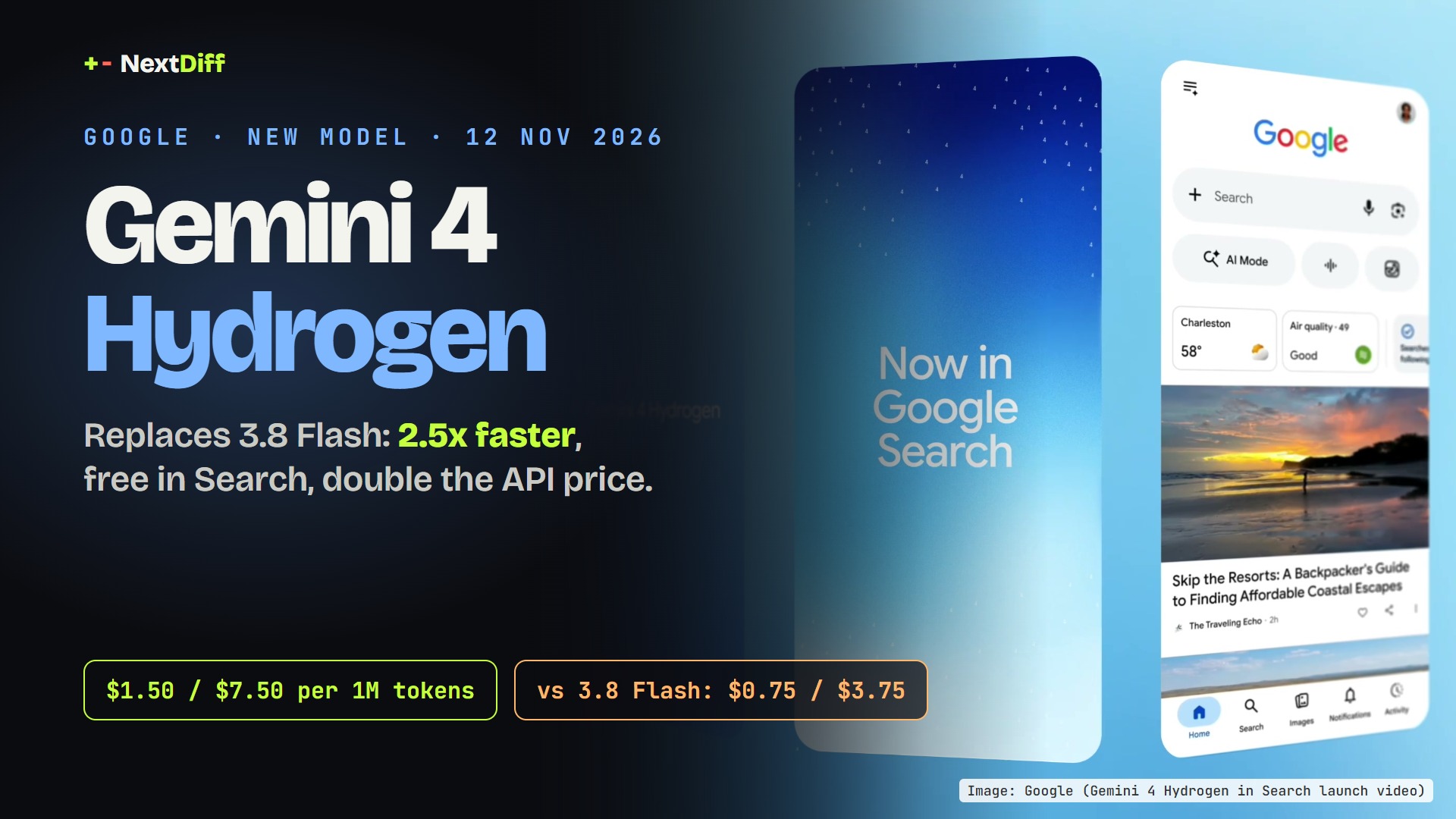
Google released Gemini 4 Hydrogen on 12 November 2026 as the fast successor to Gemini 3.8 Flash. Google says it finishes tasks 2.5 times faster and scores 57% on Terminal-Bench 4.1, up from 18.2%. It now powers Google Search for all users and is in the Gemini app, while API access costs $1.50 and $7.50 per million tokens.
Google released Gemini 4 Hydrogen on 12 November, and it quietly changes the model most people meet when they use Google. Hydrogen replaces Gemini 3.8 Flash as Google's fast, everyday model. Google says it finishes tasks 2.5 times faster than 3.8 Flash and more than triples its Terminal-Bench 4.1 score, from 18.2% to 57%. It is already answering questions in Google Search for all users worldwide and is in the Gemini app. For developers, the API price is double what 3.8 Flash costs today: $1.50 per million input tokens and $7.50 per million output tokens.
Our 24-second version:
 Image: Google (Gemini 4 Hydrogen in Search launch video)
What is Gemini 4 Hydrogen?
Google now has three Gemini 4 models. Gemini 4 Argon and Gemini 4 Carbon are the frontier models for what Google calls "deep, long-horizon reasoning". Hydrogen is the fast one, "built for rapid execution across diverse agentic workflows", according to Google's announcement by Koray Kavukcuoglu, Google DeepMind's SVP and chief AI architect.
In plain terms: Hydrogen does the many small steps an AI agent takes (reading files, writing code, running tests, searching the web) quickly and cheaply, while a bigger model like Carbon plans the hard parts. Google's new Orchestrator in its Antigravity coding tool switches between Carbon and Hydrogen inside one session. On Terminal-Bench 4.0, Google says that mix came close to Carbon's success rate while using 24% less quota and finishing 19% faster.
Gemini 4 Hydrogen vs 3.8 Flash: what changed?
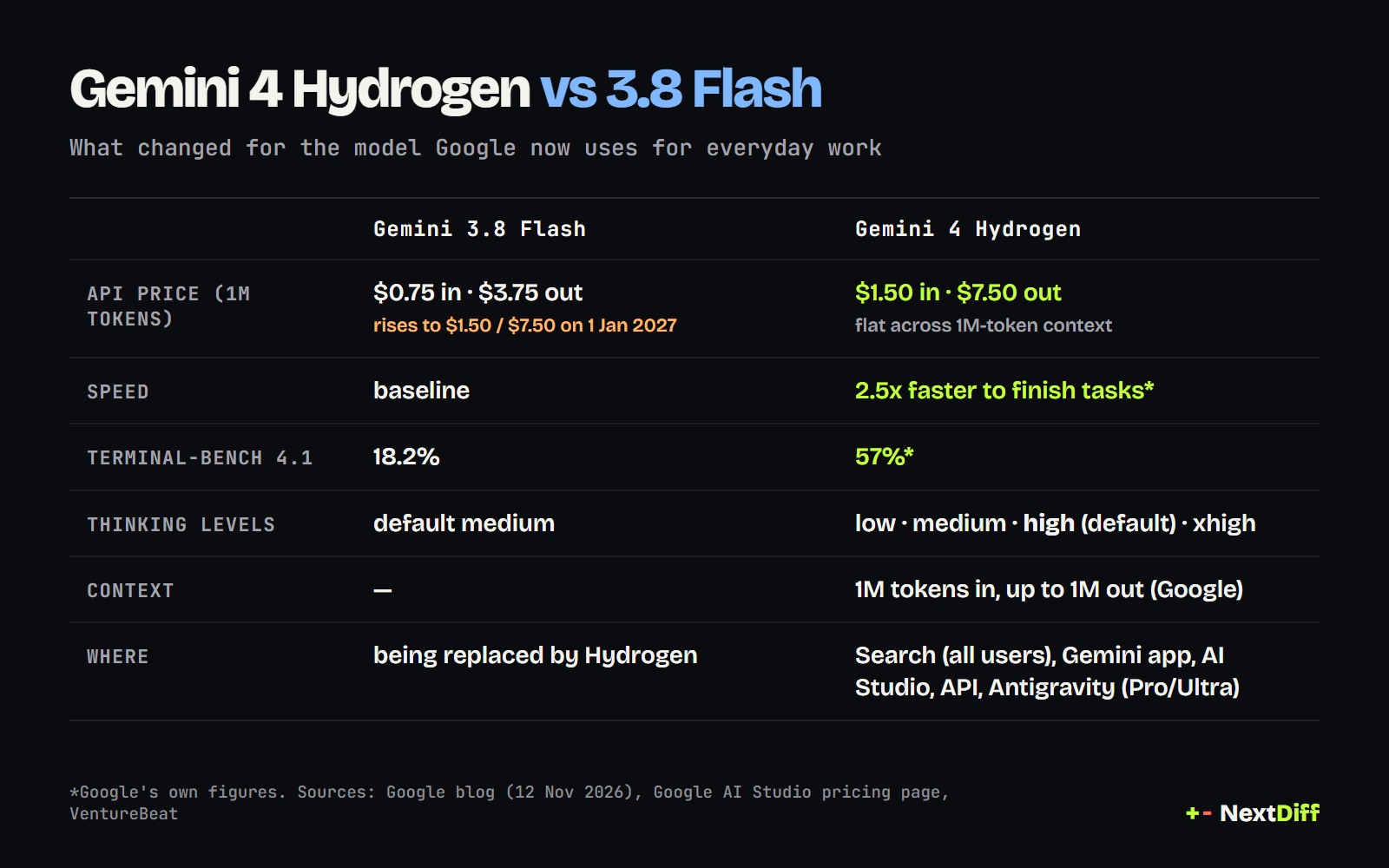 Chart: NextDiff, from Google's announcement and AI Studio pricing page
- Speed: 2.5 times faster to finish tasks at its default "high" thinking level, Google says. Partners testing graph, SQL and data-heavy work saw it run 2x to 2.8x faster with 12% to 23% fewer tokens.
- Coding: 57% on Terminal-Bench 4.1, against 18.2% for 3.8 Flash.
- Accuracy: Google says it cuts fabricated claims by more than five times.
- Thinking levels: low, medium, high (now the default) and a new xhigh.
- Context: 1 million input tokens and up to 1 million output tokens, per the blog post.
How does it compare with Argon? On the Artificial Analysis Intelligence Index, which Google cites, Hydrogen scores 51 at its default setting against Argon's 50, and 54 at xhigh. That is a small, fast model matching last month's frontier model on one broad index, not on every task.
Gemini 4 Hydrogen benchmarks
Google's own table puts Hydrogen ahead of Anthropic's Claude Sonnet 5.5 and OpenAI's GPT-6.1 Terra on seven of ten tests, including Agents' Last Exam v1.1 (71.6%), AutomationBench-AA (76.1%) and HLE-Diamond (58.8%). Sonnet 5.5 still leads on Terminal-Bench 4.1 (63.9% vs 57.0%), OSWorld-2.1 computer use (83.9% vs 77.6%) and Terminal-Bench-Science.
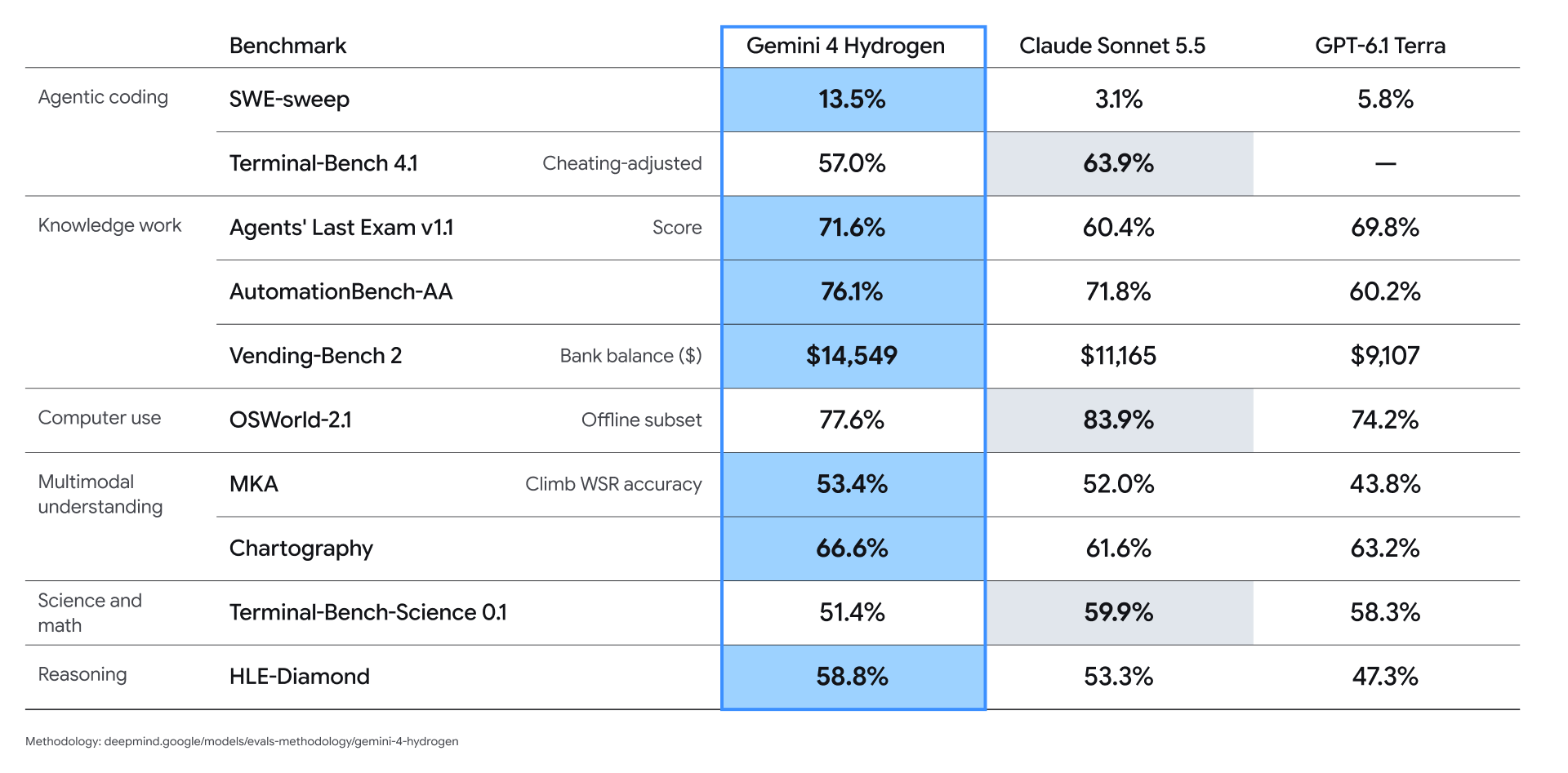 Image: Google DeepMind (benchmark table, Gemini 4 Hydrogen announcement)
These are vendor-reported numbers, and most of the speed gains are measured against Google's own older model. Independent results are only starting to appear: VentureBeat reports Artificial Analysis measured 54% on Terminal-Bench 4.0 at both high and xhigh.
How much does Hydrogen cost?
For people using Google Search or the Gemini app, nothing extra. Hydrogen is in Search for all users globally, and free Gemini app users get it through automatic model selection "when it's the appropriate model for the prompt". Paid Google AI Pro and Ultra subscribers can also use it in Antigravity.
For developers, the Gemini API pricing page lists the model id gemini-4-hydrogen at:
- $1.50 per million input tokens and $7.50 per million output tokens (thinking tokens included), flat across the whole 1M-token context;
- $0.075 per million cached input tokens (implicit caching only);
- half price on Batch and Flex ($0.75 / $3.75), and $2.70 / $13.50 on Priority.
Gemini 3.8 Flash costs $0.75 / $3.75 today, so Hydrogen is twice the price per token. But the same page shows 3.8 Flash rising to $1.50 / $7.50 on 1 January 2027, which means staying on the old model will not save money for long. Rivals are far cheaper per token: VentureBeat lists GPT-6 Luna and Claude Haiku 5.5 at $0.10 / $0.50. Whether Hydrogen ends up cheaper per finished task depends on how many fewer tokens and retries it needs.
Hydrogen in Search, including Hindi
Google's Robby Stein, VP of Product for Search, calls it "the biggest model upgrade to Search yet". Google says Search now handles longer, multi-part questions with typos, runs more parallel sub-searches ("query fan-out") so it links to a wider range of sites, and shows more tables, images and custom tools in answers, in every language AI Mode supports.
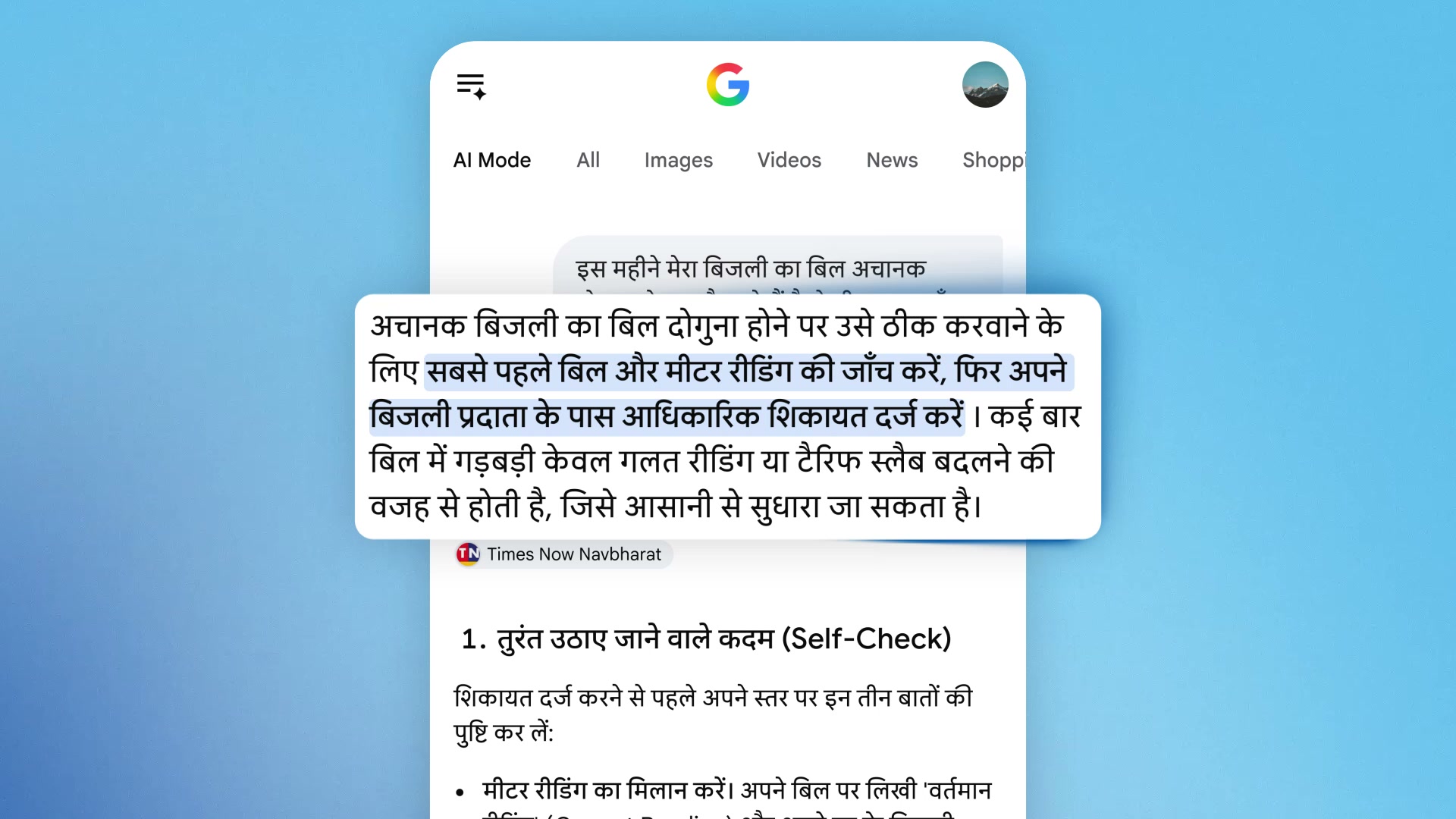 Image: Google (AI Mode demo video; sequence shortened by Google)
One of Google's own demos is an Indian one: on a phone showing Jaipur weather, a user asks AI Mode, in Hindi, why this month's electricity bill suddenly doubled and how to get it fixed. The answer comes back in Hindi with steps to check the meter reading, file a complaint with the distribution company and pay only the undisputed amount, with links to news sources. Google has not given India-specific availability details beyond "rolling out globally".
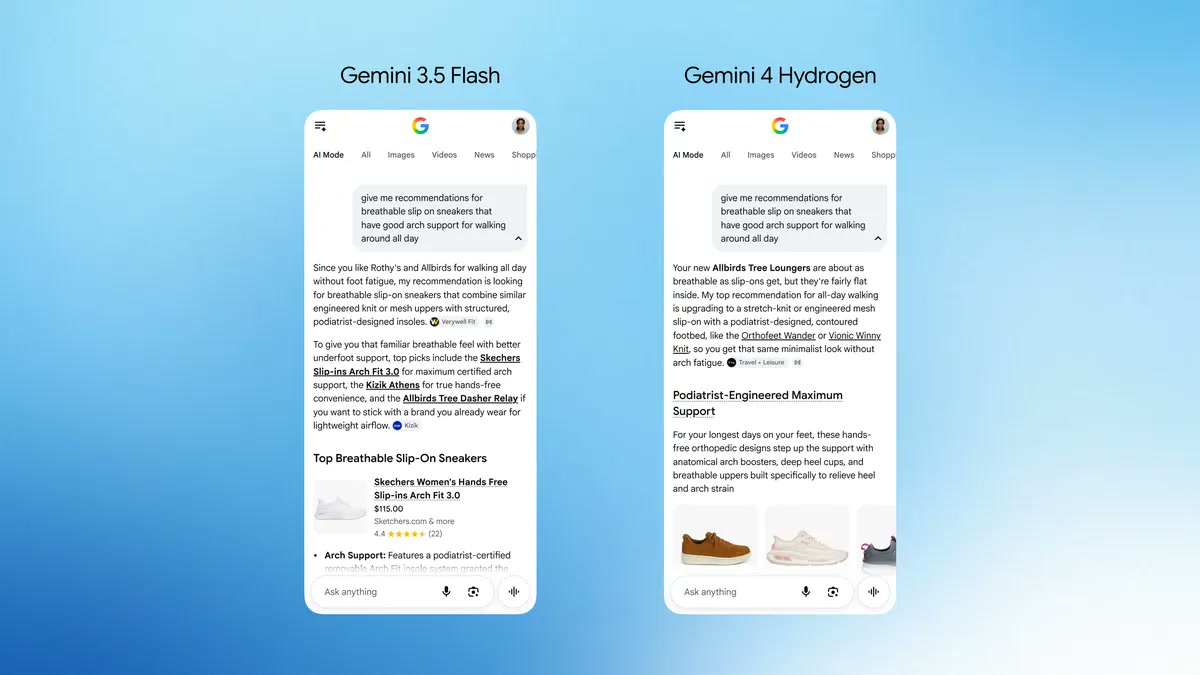 Image: Google (Gemini 4 Hydrogen Search upgrade post)
Why it matters
The fast model is the one that runs most of the time: in Search, in the Gemini app's default picks and in agents that take hundreds of steps. Making it smarter changes what billions of people see when they search, and making it pricier changes the maths for every startup built on Flash. Google is betting developers will pay more per token for fewer, faster, more reliable steps.
What's next
Developers on 3.8 Flash should test Hydrogen before the January price rise; Google's migration notes, as reported by VentureBeat, say it rejects the old thinking_budget setting and the MINIMAL level, so code may need changes. Watch for independent benchmarks over the coming week, and for whether Google brings Hydrogen to on-device features.
New to the basics? Read What is an LLM? or our Gemini vs ChatGPT comparison.
Questions readers ask
- What is Gemini 4 Hydrogen?
- Gemini 4 Hydrogen is Google's fast Gemini 4 model, released on 12 November 2026. It replaces Gemini 3.8 Flash for everyday coding, agent and search tasks, while Gemini 4 Argon and Carbon handle deeper reasoning.
- Is Gemini 4 Hydrogen better than 3.8 Flash?
- Google says Hydrogen finishes tasks 2.5 times faster than 3.8 Flash, scores 57% on Terminal-Bench 4.1 versus 18.2%, and cuts fabricated claims by more than five times. These are Google's own numbers.
- How much does Gemini 4 Hydrogen cost?
- It is free to use in Google Search and the Gemini app. In the Gemini API it costs $1.50 per million input tokens and $7.50 per million output tokens, with Batch and Flex at half price.
- Gemini 4 Hydrogen vs Argon: which is smarter?
- On the Artificial Analysis Intelligence Index cited by Google, Hydrogen scores 51 at its default setting against Argon's 50, and 54 at xhigh. Argon and Carbon remain Google's models for long, hard reasoning.
- Can I use Gemini 4 Hydrogen in Hindi?
- Yes. Google says Hydrogen in Search works in every language AI Mode supports, and one of its demos shows AI Mode answering a Hindi question about an electricity bill.
+ Sources
- Google — Introducing Gemini 4 Hydrogen (Koray Kavukcuoglu, 12 Nov 2026)
- Google — Google Search gets a major upgrade with Gemini 4 Hydrogen (Robby Stein)
- Google — Gemini 4 Hydrogen: fast agentic development for coders
- Google AI Studio — Gemini API pricing
- Google DeepMind — Gemini models and benchmark table
- VentureBeat — Google launches Gemini 4 Hydrogen, a faster, smarter, pricier Flash successor
+ Rate this story
Get stories like this on your phone, the minute they drop.
 Scan with your Android phone
The Weekly Diff launches soon.
Subscribe on YouTubeKeep reading