What is an operating system? How Windows, Android, iOS and Linux work, explained
Every app on your phone and laptop runs on top of one program that hands out the processor, memory and storage. Here is how it works, with real market-share numbers.
An operating system (OS) is the software that manages a device's hardware and runs every other program on it. Windows, macOS, Linux, Android and iOS are examples. Its core, the kernel, decides which app gets the processor, memory and storage, and keeps apps isolated so one crash does not take down the whole device.
What is an operating system? An operating system (OS) is the software that manages a device's hardware and runs every other program on it. Windows, macOS, Linux, Android and iOS are all operating systems. When an app saves a file, plays a sound or joins Wi-Fi, it asks the OS, which shares the processor, memory and storage safely between apps.
Wikipedia's definition is the textbook one: an OS is "system software that manages computer hardware and software resources" and provides common services for programs. Without one, every app would need its own code to talk to your screen, your storage chip and your Wi-Fi radio, and nothing would stop one app from wrecking another.
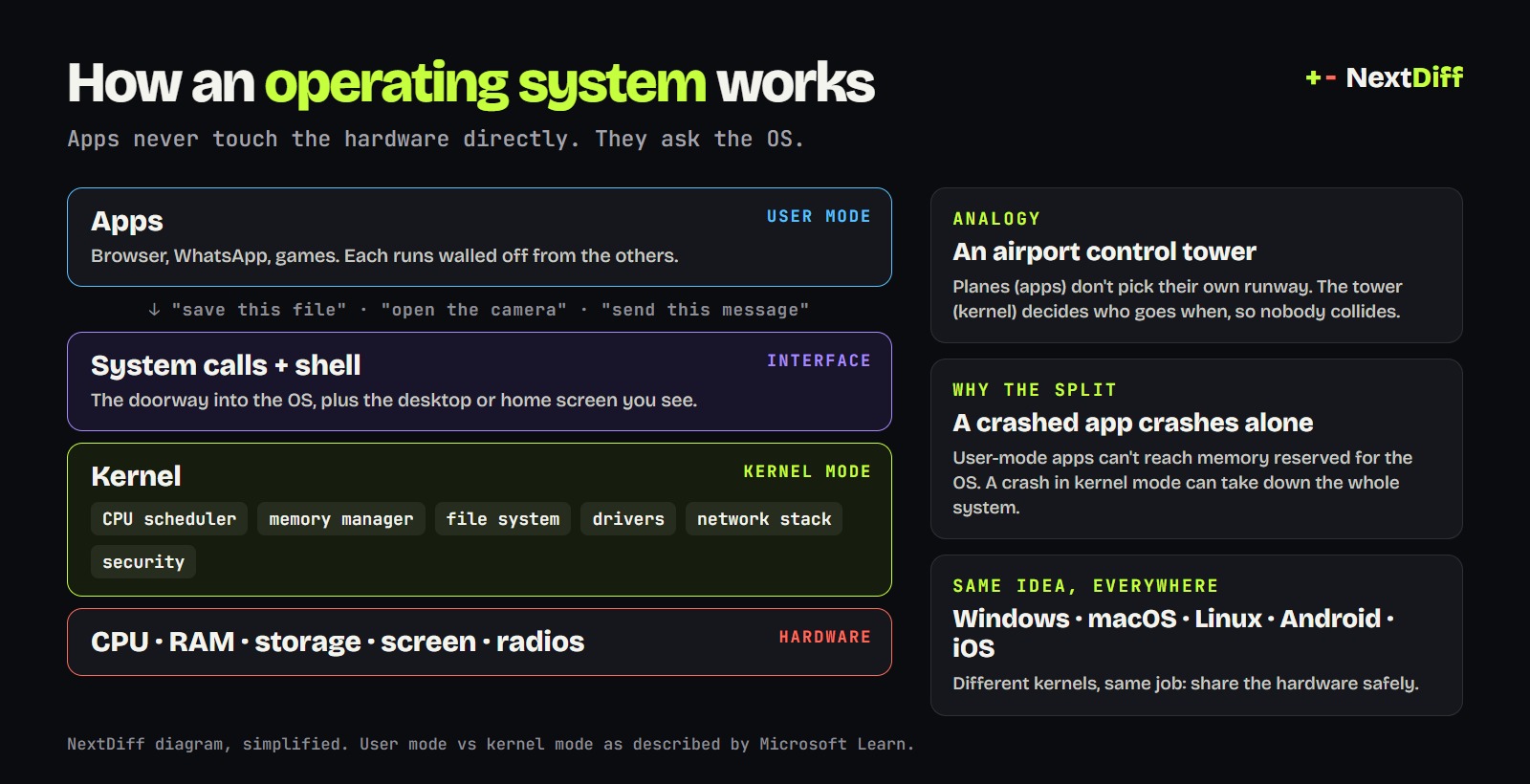 Image: NextDiff diagram
How does an operating system work?
Think of an airport control tower. Planes do not choose their own runway or take-off time; the tower decides, so they never collide. In a computer, the apps are the planes and the OS is the tower.
The real mechanics come in layers:
- The kernel is the core of the OS. It is always running and has full control of the machine. It decides which program gets the processor next (scheduling), which memory each program may use, and how programs reach devices through drivers. It also runs the file system, which turns raw storage into files and folders, and the network stack.
- User mode and kernel mode. Microsoft's developer documentation puts it simply: "Applications operate in user mode. Core operating system components function in kernel mode." Each app runs in isolation and cannot touch memory reserved for the OS, so a crashing app usually takes down only itself. A crash in kernel mode can bring down the whole system.
- System calls are the doorway between the two. When an app wants to open a file or use the camera, it makes a system call, and the kernel does the work on its behalf.
- The shell is the part you see: the Windows desktop, the macOS Dock, the Android home screen, or a text command line. It is part of the OS, but it is not the core of it.
Kernels come in different designs. The Linux kernel is monolithic: the whole kernel runs in one privileged space. Microkernels move most services out into user space. Windows uses a hybrid kernel, and Apple's systems are built on Darwin, which Apple describes as "based on BSD, Mach 3.0, and Apple technologies."
What is an operating system used for? Five examples
The five you meet every day:
- Android (Google) runs on most phones in the world. It is built on the Linux kernel, with Google's Android architecture adding a hardware abstraction layer and the Android Runtime on top.
- Windows (Microsoft) runs most PCs. Windows 11 came out on 5 October 2021.
- iOS and iPadOS (Apple) run iPhones and iPads. iOS first shipped as "iPhone OS" with the original iPhone in June 2007.
- macOS (Apple) runs Macs and shares its Darwin core with iOS.
- Linux runs most servers and powers distributions such as Ubuntu and Fedora on desktops. It also ran all of the world's 500 fastest supercomputers as of November 2017, according to Wikipedia.
There are many others: Huawei's HarmonyOS NEXT, which replaced the Linux kernel with Huawei's own microkernel and dropped Android code, plus the small real-time systems inside cars, routers and smartwatches.
| Operating system | Made by | Kernel | Runs on | Share of all devices (Oct 2026) |
|---|---|---|---|---|
| Android | Linux | Phones, tablets, TVs, cars | 44.6% | |
| Windows | Microsoft | Windows NT (hybrid) | PCs and laptops | 29.1% (76.7% of desktops) |
| iOS / iPadOS | Apple | XNU (Darwin) | iPhone, iPad | 17.5% |
| macOS | Apple | XNU (Darwin) | Mac | 5.9% (15.7% of desktops) |
| Linux distributions | Community and companies | Linux (monolithic) | Servers, PCs, supercomputers | 2.2% (5.6% of desktops) |
| HarmonyOS NEXT | Huawei | HongMeng (microkernel) | Huawei phones and tablets | Not listed separately |
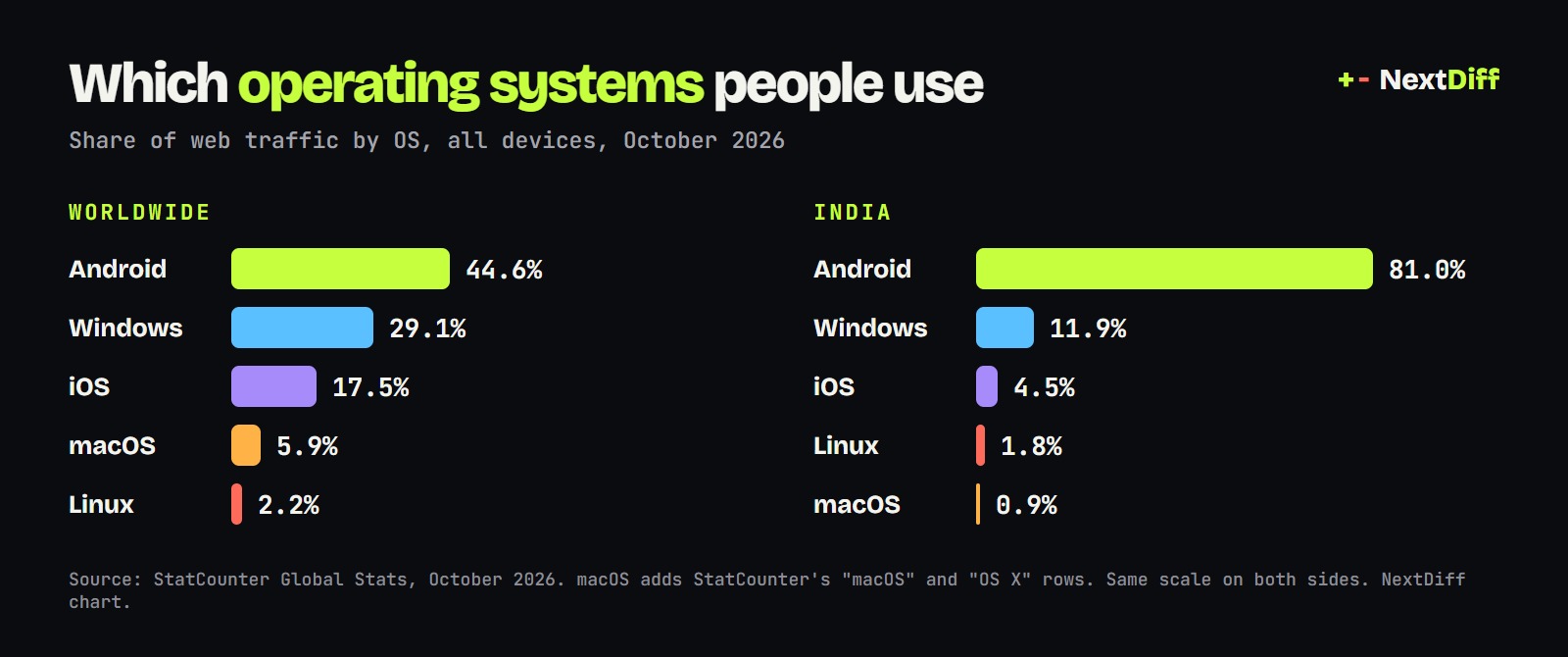 Image: NextDiff chart, data from StatCounter Global Stats
Shares are StatCounter's measure of web traffic in October 2026, so they count devices that browse, not devices sold. India is far more Android-heavy than the world: Android had 80.95% of traffic, Windows 11.85% and iOS 4.45%.
A short history of the operating system
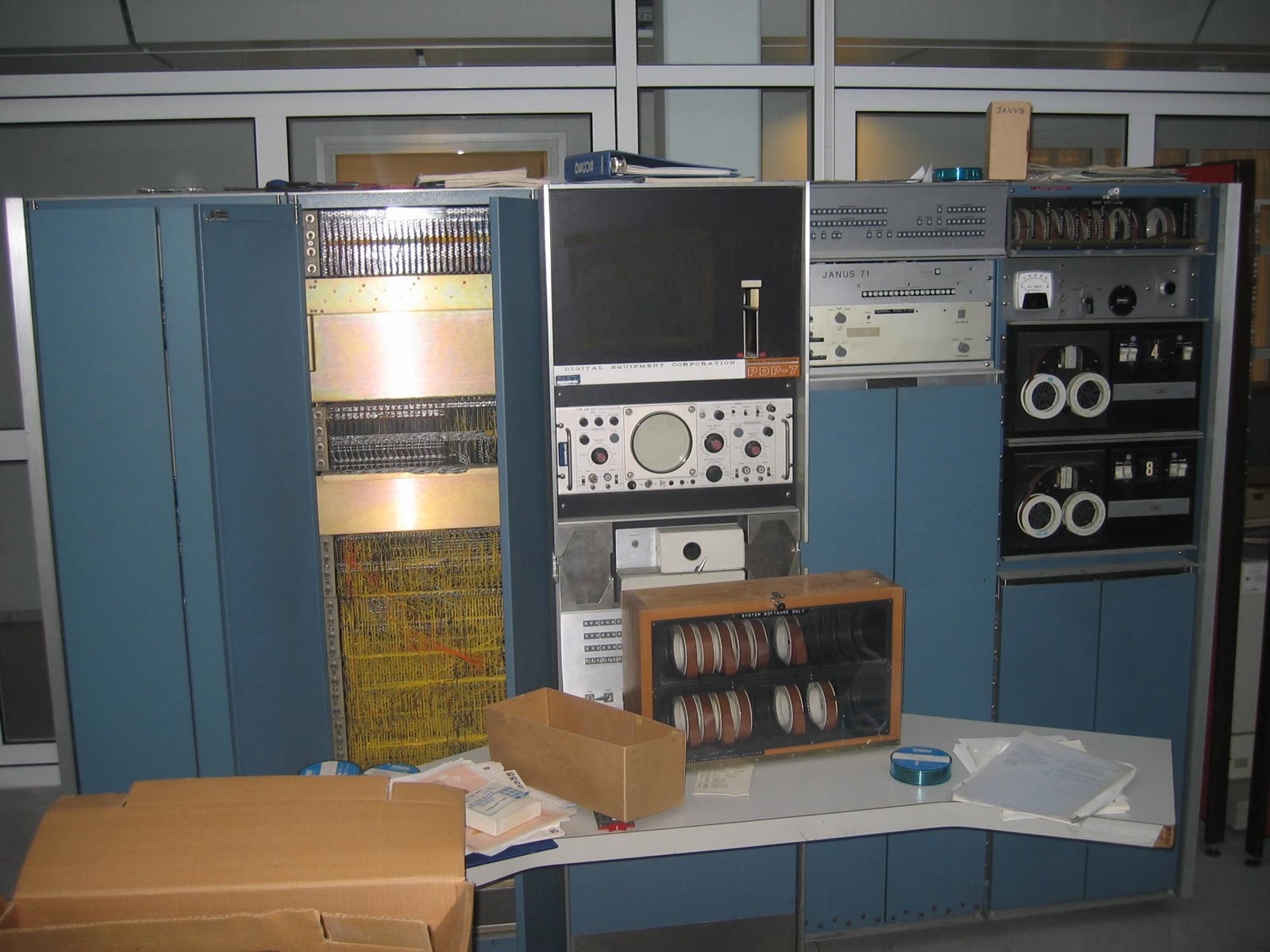 Image: Matiashf (CC BY-SA 3.0), via Wikimedia Commons
- 1969: Unix. Ken Thompson, Dennis Ritchie and colleagues at Bell Labs started Unix on a little-used DEC PDP-7. Its ideas (files, processes, a small kernel plus tools) still shape macOS, iOS, Android and Linux.
- 1981: MS-DOS. IBM licensed Microsoft's disk operating system and released it as PC DOS 1.0 with its first PC.
- 1985: Windows 1.0. Microsoft added a graphical layer on top of MS-DOS on 20 November 1985.
- 1991: Linux. Linus Torvalds first released the Linux kernel on 17 September 1991, a free Unix-like kernel now distributed under the GNU GPL v2.
- 2007 and 2008: phones. iPhone OS shipped with the first iPhone in June 2007. The HTC Dream, announced on 23 September 2008, was the first phone sold with Android.
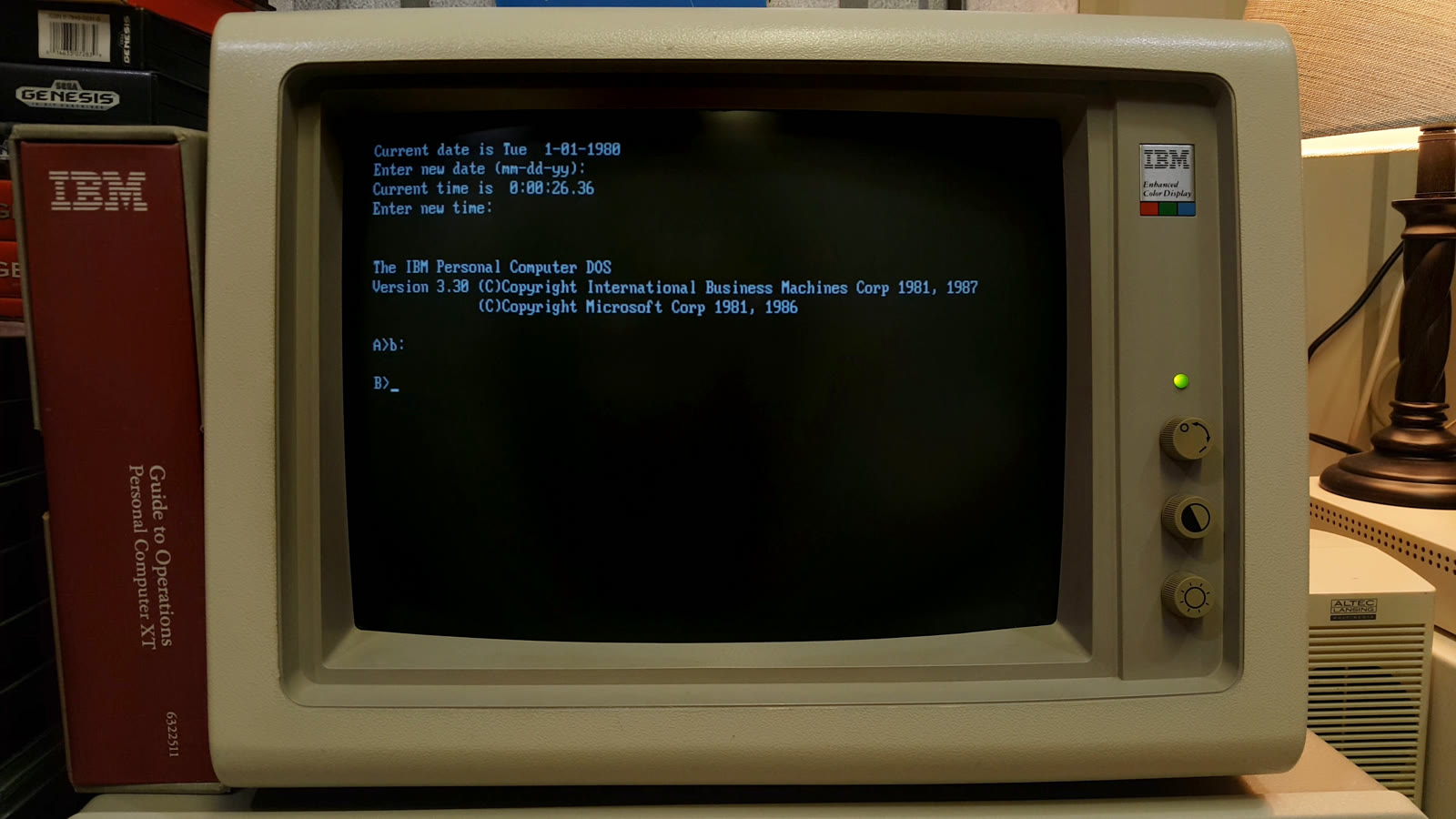 Image: phreakindee (CC0), via Wikimedia Commons
Why does the operating system matter?
- It decides what you can run. Apps are built for an OS, not for a brand of laptop. An iPhone app will not install on Android, and many Windows games do not run on macOS.
- It decides how long a device stays safe. Most OS updates are security fixes. Microsoft ended Windows 10 support on 14 October 2025: those PCs still work, but they only get security patches through paid or enrolled Extended Security Updates, which for consumers run until 12 October 2027.
- It decides speed and battery life. The scheduler and memory manager decide how well an 8 GB laptop copes with 30 browser tabs, which is why Microsoft tunes Windows for low-memory PCs.
- For developers, it is the platform. Every app is written against an OS's interfaces, so the choice of OS decides languages, tools and app stores.
Common misconceptions
- "The OS is the desktop." The desktop or home screen is the shell, the visible top layer. The kernel underneath does the real work, and you never see it.
- "Android isn't Linux." Android runs on the Linux kernel, but it is not a desktop Linux distribution: Google built its own runtime, app model and interface on top.
- "macOS and iOS are unrelated." Both are built on Apple's Darwin core; the difference is mostly in the interface and the frameworks for each device.
- "Updates are just new features." Most monthly updates fix security holes. An OS that has stopped getting them gets riskier every month, even if it looks the same.
- "The OS lives in the hardware." The OS is software stored on your drive and loaded at start-up. The small program that starts it is firmware, a separate layer.
Latest news
- iOS 28: Apple changes how it's built while its CEO presses for faster AI
- Windows 11 8GB RAM: Microsoft says the same PC is now up to 40% faster at multitasking
- Linux vulnerability CVE-2026-98432: the 9.8 TCP bug an AI made into remote root
- MS Paint vulnerability: Microsoft's fix skips Windows Update
- Siri AI developer preview: Apple opens Siri AI to every app in the iOS 27.3 beta
- Apple Watch wrong time after daylight saving? Apple confirms the bug and two fixes
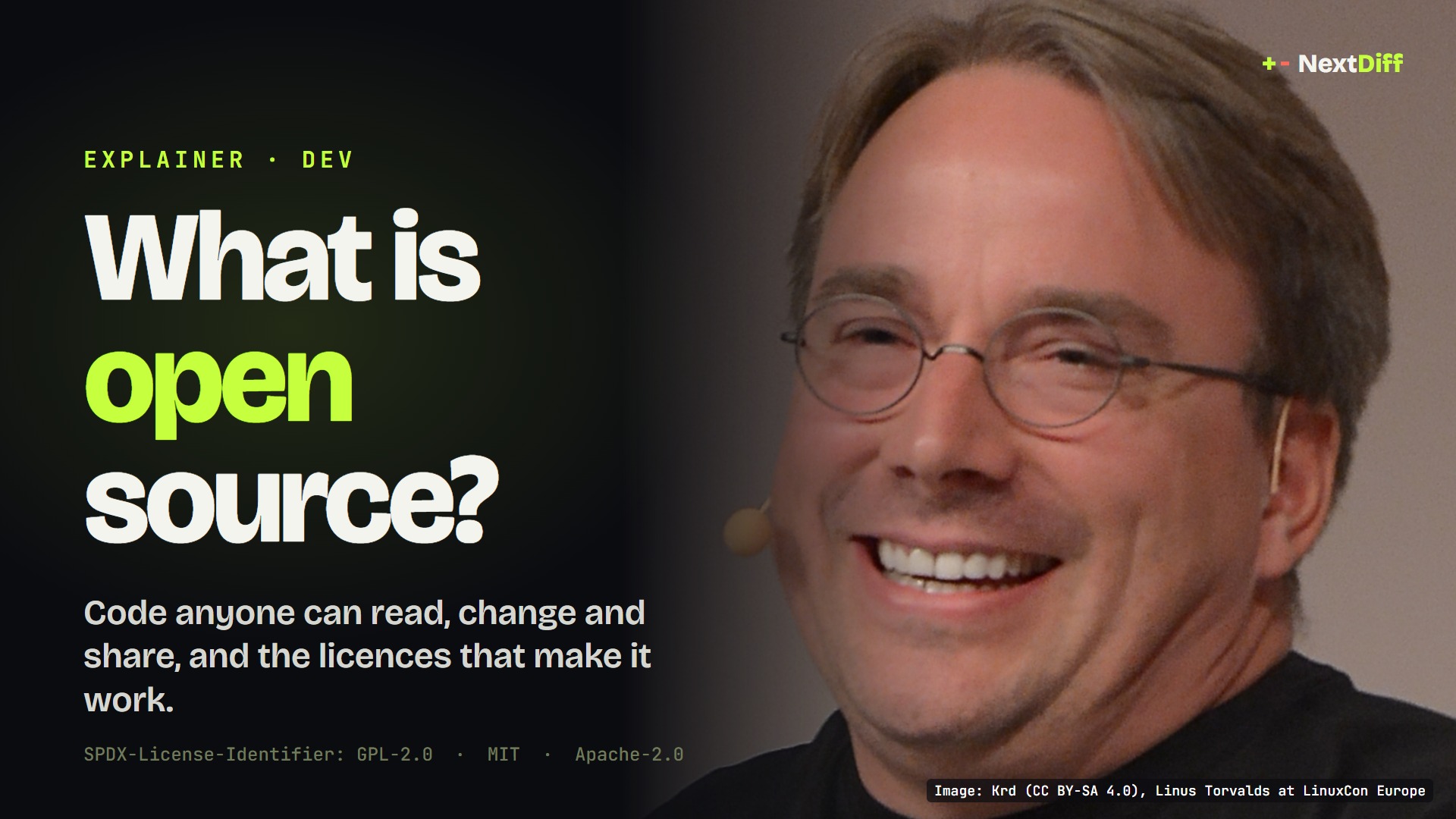
- New to open-source software like Linux and Android? Read: What is open source?
Questions readers ask
- What is an operating system in simple words?
- An operating system is the main program that runs a computer or phone. It controls the hardware and lets every other app use the processor, memory, storage and screen safely, without each app needing its own code for them.
- What are 5 examples of operating systems?
- Android, Windows, iOS, macOS and Linux distributions such as Ubuntu are the five most common. Others include iPadOS, ChromeOS and Huawei's HarmonyOS NEXT.
- What is the kernel in an operating system?
- The kernel is the core of the OS that is always running and has full control of the hardware. It decides which program gets the processor, which memory each program can use and how programs reach devices through drivers.
- Is Android an operating system, and is it Linux?
- Yes, Android is an operating system made by Google. It runs on the Linux kernel, but adds its own runtime, app model and interface, so it is not a desktop Linux distribution.
- Which operating system is used the most?
- Android. StatCounter measured it at 44.56% of worldwide web traffic in October 2026, ahead of Windows at 29.08% and iOS at 17.45%. On desktops alone, Windows leads with about 77%.
+ Sources
- Wikipedia — Operating system
- Microsoft Learn — User mode and kernel mode
- StatCounter Global Stats — Operating system market share worldwide (October 2026)
- StatCounter Global Stats — Desktop operating system market share worldwide
- StatCounter Global Stats — Operating system market share India
- Android Open Source Project — Android architecture
- Apple Developer — Kernel Architecture Overview (Darwin)
- The Linux kernel documentation — README
- Microsoft Support — Windows 10 support has ended on October 14, 2025
- Wikipedia — Kernel (operating system)
- Wikipedia — History of Unix
+ Rate this story
Get stories like this on your phone, the minute they drop.
 Scan with your Android phone

The Weekly Diff launches soon.
Subscribe on YouTubeKeep reading