Brain organoids read Braille: three lab-grown mini brains hit 83% accuracy
A University of Bristol team fed touch-sensor data to living human brain tissue on eight electrodes. One organoid got 61% of letters right; three working together got 83%.
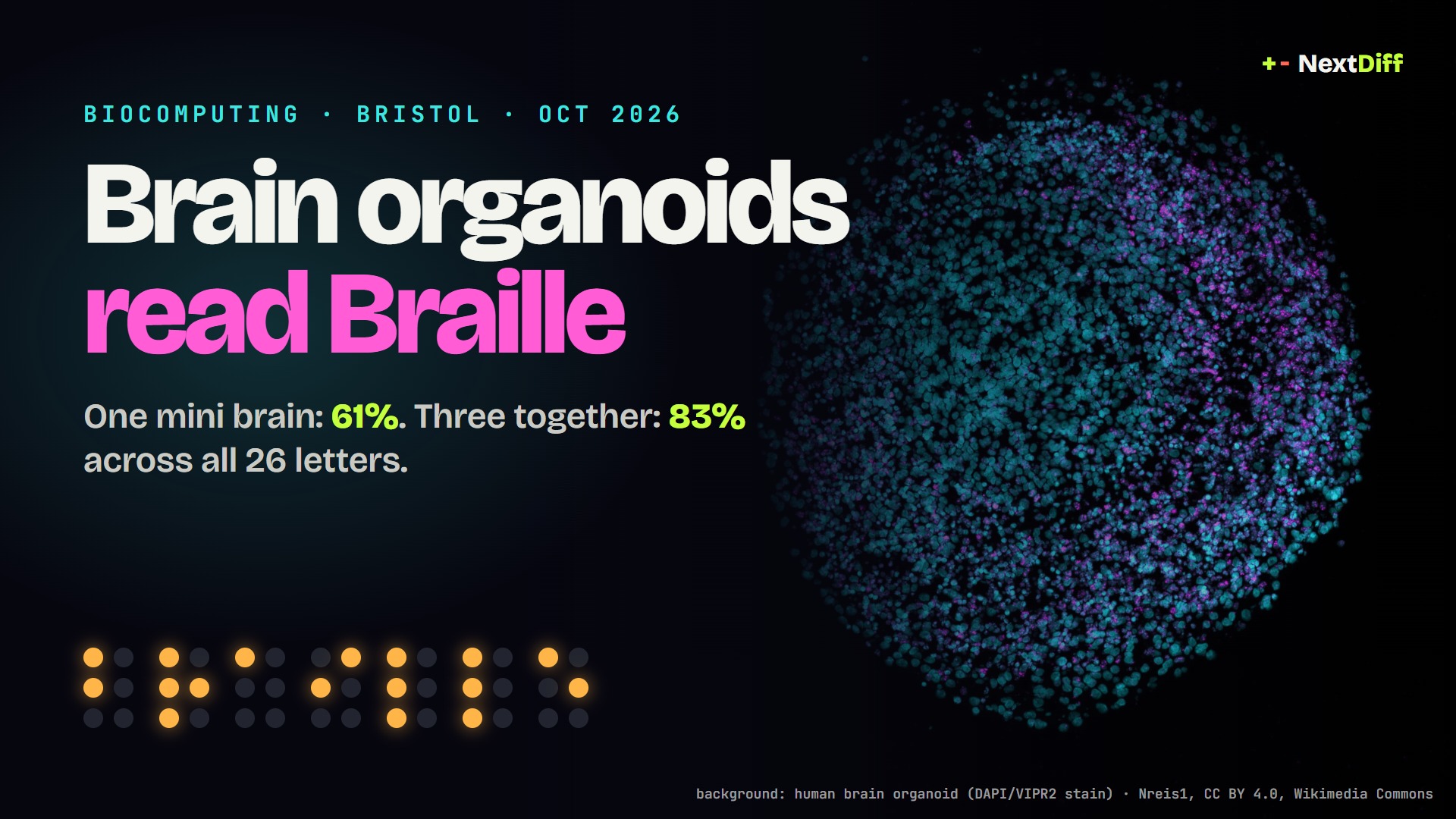
Brain organoids read Braille in a University of Bristol study published on 16 October 2026 in Frontiers in Artificial Intelligence. Touch-sensor data for all 26 letters was turned into electrical pulses for lab-grown human brain organoids. Decoding their responses was 61% accurate with one organoid and 83% with three. The organoids did not learn.
Brain organoids read Braille, sort of, in a new study from the University of Bristol. The team turned a robot's touch-sensor readings of all 26 Braille letters into electrical pulses and fed them into lab-grown balls of living human brain tissue. When they decoded how the tissue fired back, a single organoid pointed to the right letter about 61% of the time. Three organoids pooled together reached about 83%.
The paper, by PhD candidate Tianyi Liu, Hemma Philamore and senior author Benjamin Ward-Cherrier, was published on 16 October 2026 in Frontiers in Artificial Intelligence, in the journal's Organoid Intelligence section. It is peer-reviewed and open access. The point of the work is not a new way to read Braille. The team wanted a reusable recipe for getting real sensor data into living neurons and getting a usable answer back out, which any "computer made of brain cells" will need.
Our 50-second version, with the real lab images and the 83% result:
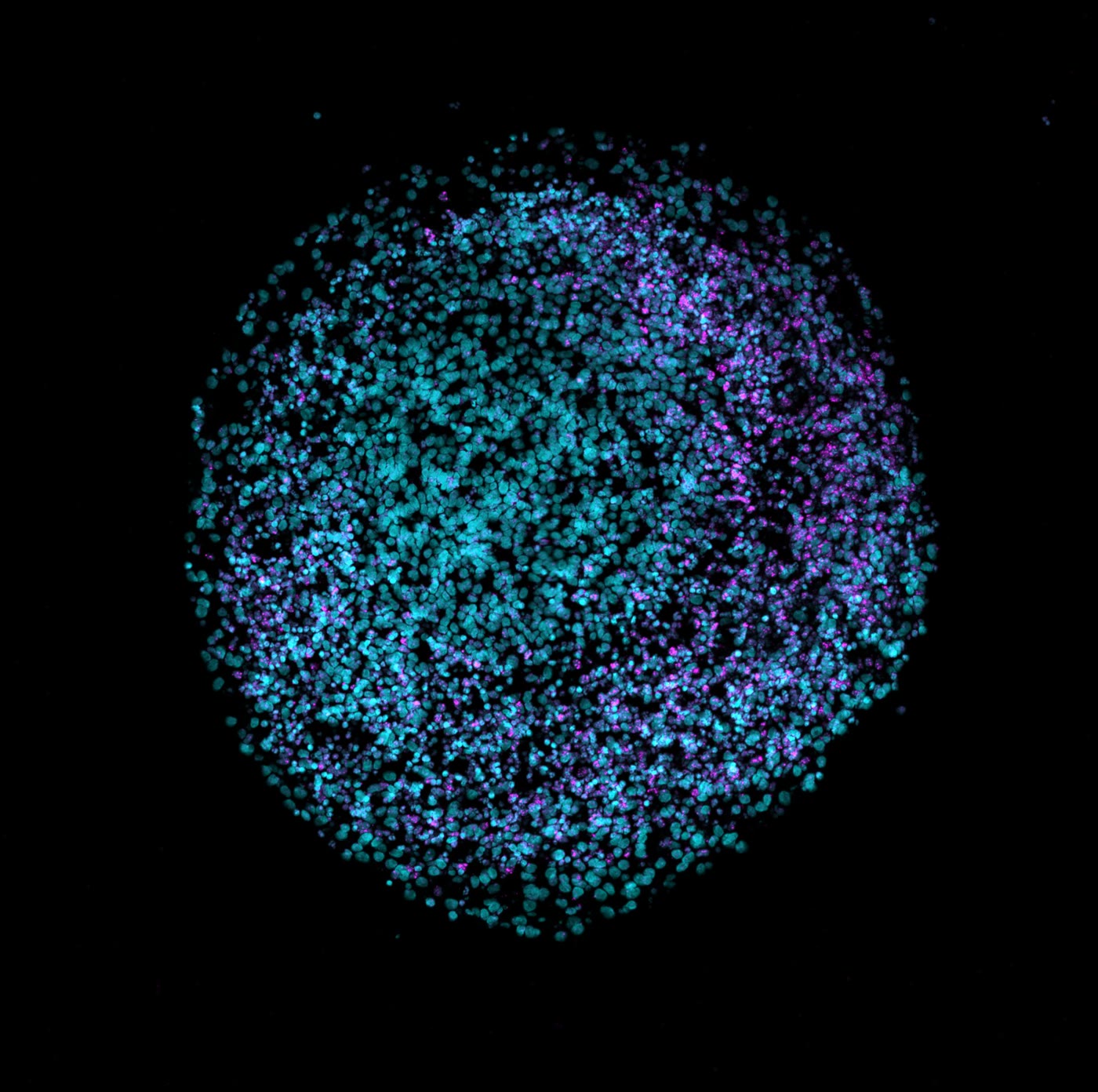 Image: a human brain organoid cross-section (DAPI in teal, VIPR2 in magenta). Nreis1, CC BY 4.0, via Wikimedia Commons. Not from the Bristol study.
What are brain organoids?
Brain organoids are tiny clumps of human brain tissue grown from stem cells. The ones used here were modelled on the forebrain. According to the Frontiers press release, each is less than a millimetre across and holds about 10,000 neurons plus supporting cells. They lack many structures of a real brain, but their neurons connect, fire and respond to electrical stimulation.
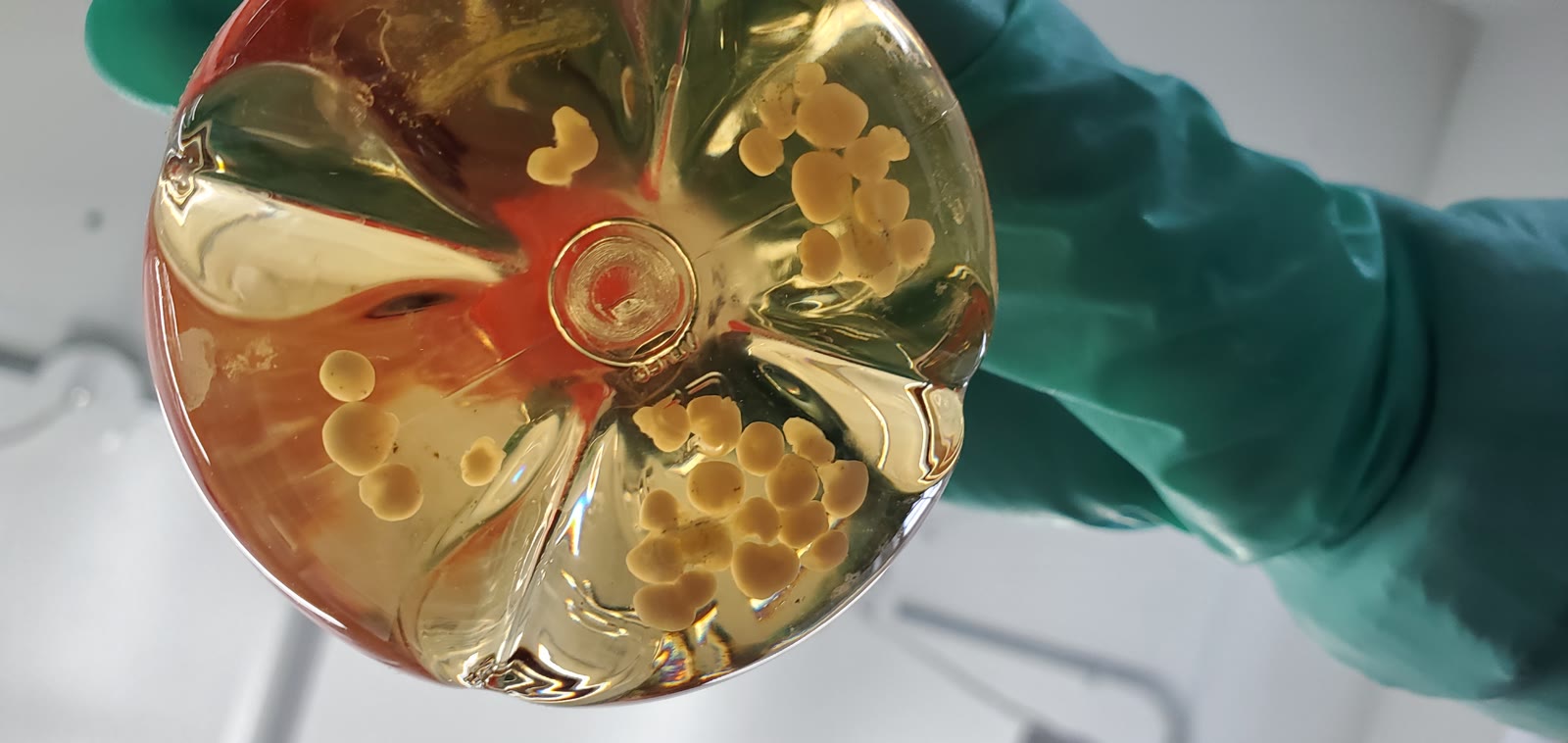 Image: human cerebral organoids in a flask. NIAID, CC BY 2.0, via Wikimedia Commons. Not from the Bristol study.
How did brain organoids read Braille?
The experiment ran in four steps:
- Sense. A Dobot robot arm pressed an Evetac sensor, a touch sensor built around an event camera, onto a 3D-printed board of Braille letters.
- Encode. The touch data for each letter was split into eight regions and turned into eight channels of electrical pulses, varying the number of pulses, their strength, their length and their timing.
- Stimulate. Each pattern was delivered to an organoid sitting on a low-density multielectrode array with just eight electrodes. The organoids were run remotely on Swiss startup FinalSpark's Neuroplatform, which keeps them alive and records their activity.
- Decode. A support vector machine, a simple and decades-old machine-learning classifier, read the spike counts and where the activity was centred, then picked the letter.
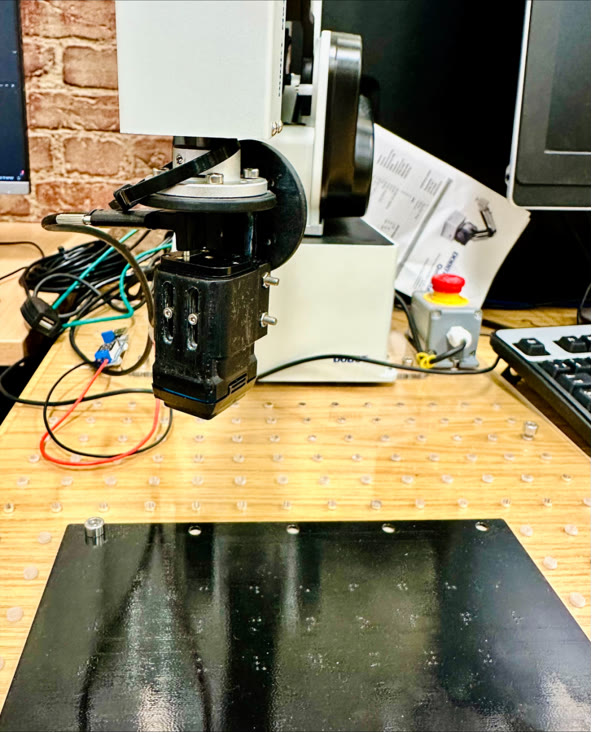 Image: the tactile sensor that scanned the Braille letters. Courtesy of Dr Benjamin Ward-Cherrier, University of Bristol (via Frontiers).
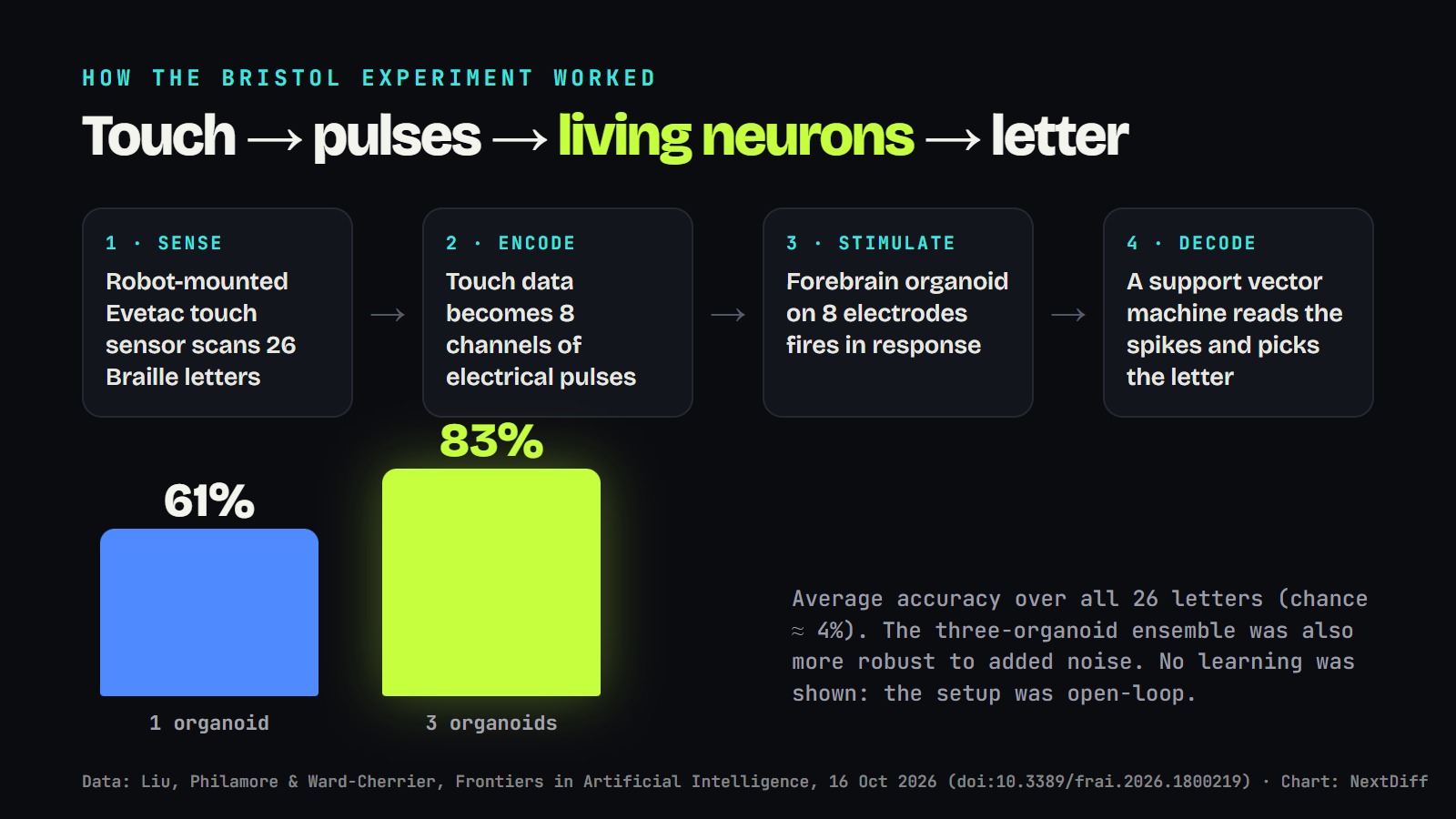 Chart: NextDiff, from data in Liu et al., Frontiers in Artificial Intelligence (2026).
The numbers that matter
- 26 letters, so random guessing would be right about 4% of the time.
- 61% average accuracy with one organoid.
- 83% when the responses of three organoids were combined.
- More robust to noise: when the researchers added different kinds of artificial noise to the Braille signals, the three-organoid ensemble held up better than the same classifier reading the noisy sensor data directly.
"We can take information from a real tactile sensor, turn it into a form that a living neural network can receive," Liu said in the release. The researchers do not yet know why three organoids beat one. Liu suggested that each organoid may have "slightly different network connections, developmental states, and ongoing activity," so they complement each other.
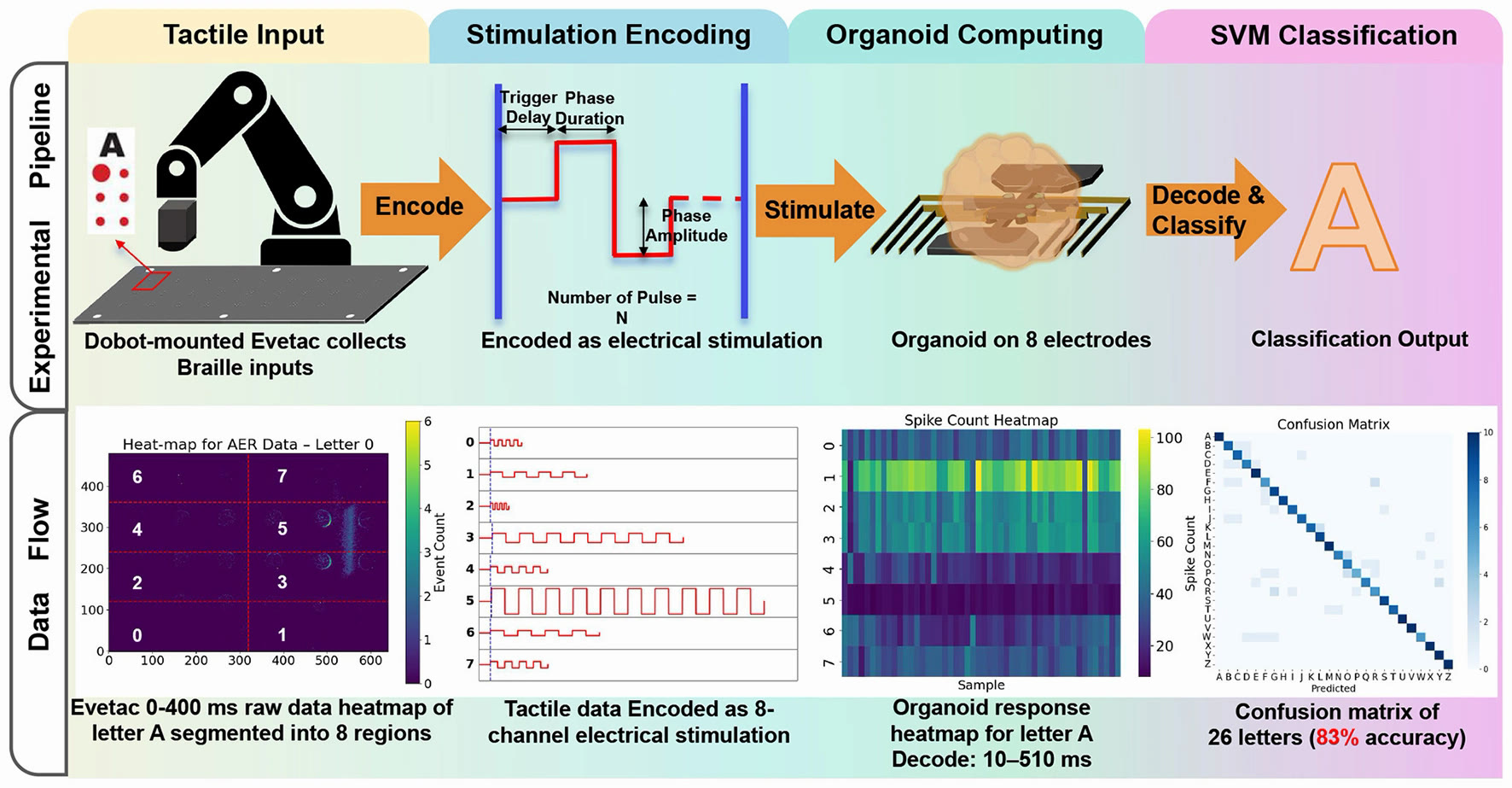 Figure: Liu, Philamore and Ward-Cherrier, Frontiers in Artificial Intelligence (2026), CC BY 4.0.
Why it matters
Energy. The paper points out that the human brain does its work on roughly 20 watts, while silicon chips scaled toward brain-like complexity are projected to need kilowatts or more. That is why biocomputing, also called organoid intelligence or wetware computing, keeps drawing attention as AI's power bill grows. For the silicon side of that race, see our story on Etched and the inference-chip boom.
Studies such as Cortical Labs' DishBrain, which played Pong, showed that cultured neurons can respond to a game. Bristol's contribution is the plumbing: a transferable way to map a real robot sensor onto electrical stimulation that cheap, low-density electrode arrays can deliver.
What's next, and the caveats
- No learning yet. "We did not demonstrate learning or long-term changes in the organoids," Liu said. The system was open-loop: the organoids responded, but nothing in them improved over time.
- Variability. Each organoid behaves differently, which makes a predictable, standardised device hard to build.
- One narrow task. The study used one tactile task, a fixed encoding scheme and a fairly simple measure of neural activity. Much of the "reading" is the job of the encoder and the classifier around the tissue.
Next, the team wants to try textures, edges and other kinds of touch, and to run closed-loop tests where organoids get feedback, to see whether they can adapt through experience.
Questions readers ask
- Can brain organoids read Braille?
- Not on their own. In the Bristol study, a robot's touch sensor read Braille, the data was converted into electrical pulses for the organoids, and a simple machine-learning classifier decoded their responses. With three organoids combined, the right letter came out 83% of the time.
- What is a brain organoid?
- A brain organoid is a tiny ball of human brain tissue grown from stem cells in a lab. The ones in this study were modelled on the forebrain, less than 1 mm across, with about 10,000 neurons plus supporting cells.
- What is organoid intelligence?
- Organoid intelligence (OI) is a research field that uses lab-grown brain organoids as computing elements, wired to electrodes that stimulate them and record their activity. The Bristol paper was published in the Organoid Intelligence section of Frontiers in Artificial Intelligence.
- Did the brain organoids learn to read Braille?
- No. The authors say they did not demonstrate learning or long-term changes in the organoids. The experiment was open-loop; testing whether organoids adapt through feedback is the next step.
- Why use human brain cells for computing?
- Energy. The paper notes that the human brain runs on roughly 20 watts, while scaling silicon chips toward brain-like complexity is projected to need kilowatts or more. Living neural tissue is being explored as a low-power alternative.
+ Sources
- Frontiers in Artificial Intelligence — Encoding tactile stimuli for Braille recognition with organoids (Liu, Philamore, Ward-Cherrier, 2026)
- Frontiers Science News — Mini brain organoids 'reading' Braille marks key step towards biohybrid computing
- Tech Xplore — Mini brain organoids 'read' braille in key step toward biohybrid computing
- Wikimedia Commons — Human Brain Organoid (Nreis1, CC BY 4.0)
- Wikimedia Commons — Human Cerebral Organoids (NIAID, CC BY 2.0)
+ Rate this story
Get stories like this on your phone, the minute they drop.
 Scan with your Android phone


The Weekly Diff launches soon.
Subscribe on YouTubeKeep reading