What is an IPO? How a company goes public, step by step, explained
The S-1, the roadshow, the first-day pop and pre-money vs post-money valuation, with real numbers from SpaceX, Anthropic, OpenAI and Hyundai India.
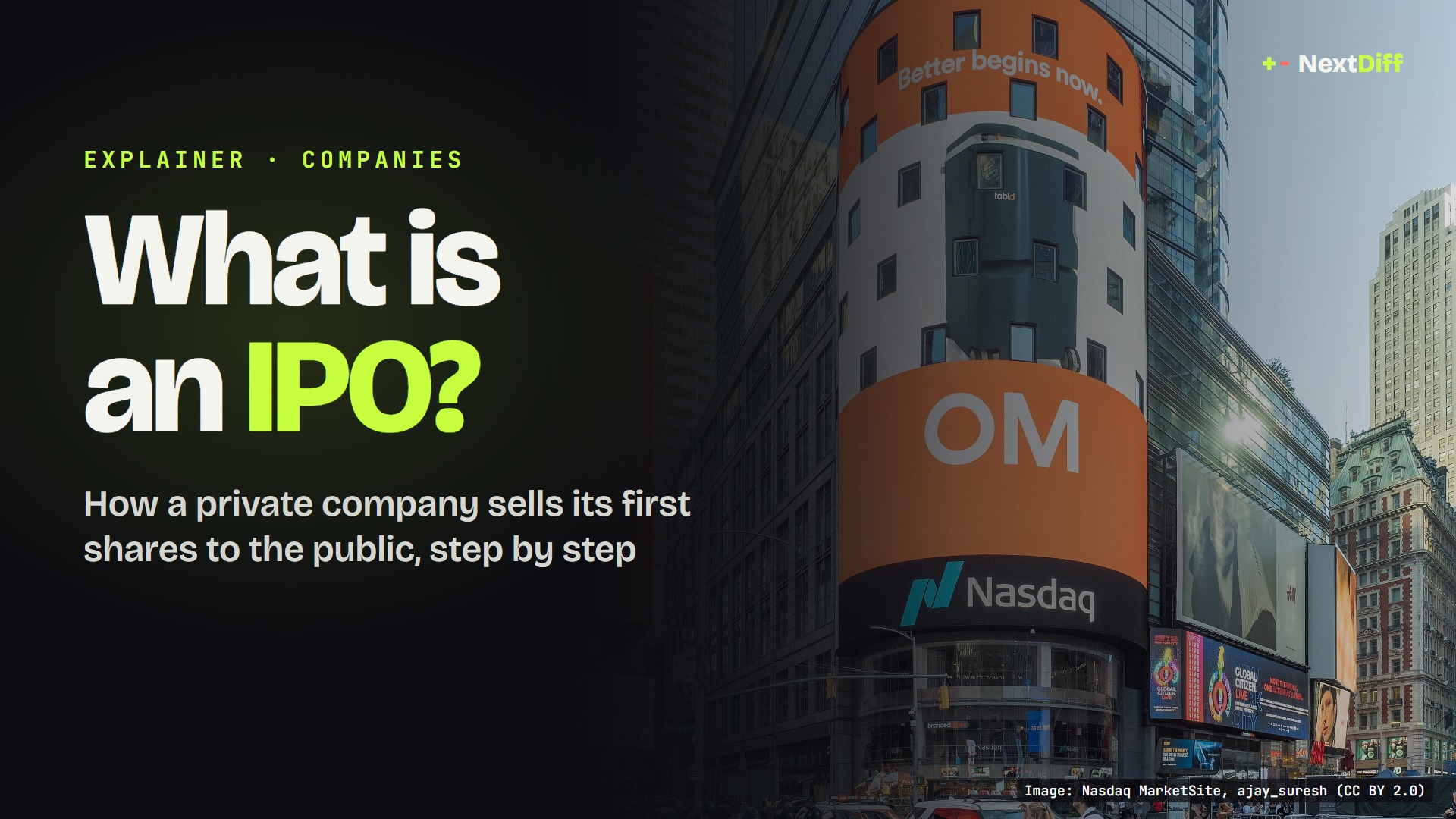
An IPO, or initial public offering, is when a private company first sells its shares to the public. It files disclosures with a regulator, works with banks to set a price, then lists on a stock exchange. Companies do it to raise money and let early investors sell.
What is an IPO? An initial public offering, or IPO, is when a private company first sells its shares to the public, according to the US Securities and Exchange Commission. Banks help set the price, a regulator reviews the disclosures, and the shares then trade on a stock exchange where anyone with a brokerage account can buy them.
Before an IPO, a company's owners are founders, staff and private investors, and its finances stay mostly private. After it, thousands of strangers can own a piece, and the company has to publish its numbers on a schedule. That change is why IPO filings make news: Anthropic's S-1 showed its real revenue and losses for the first time.
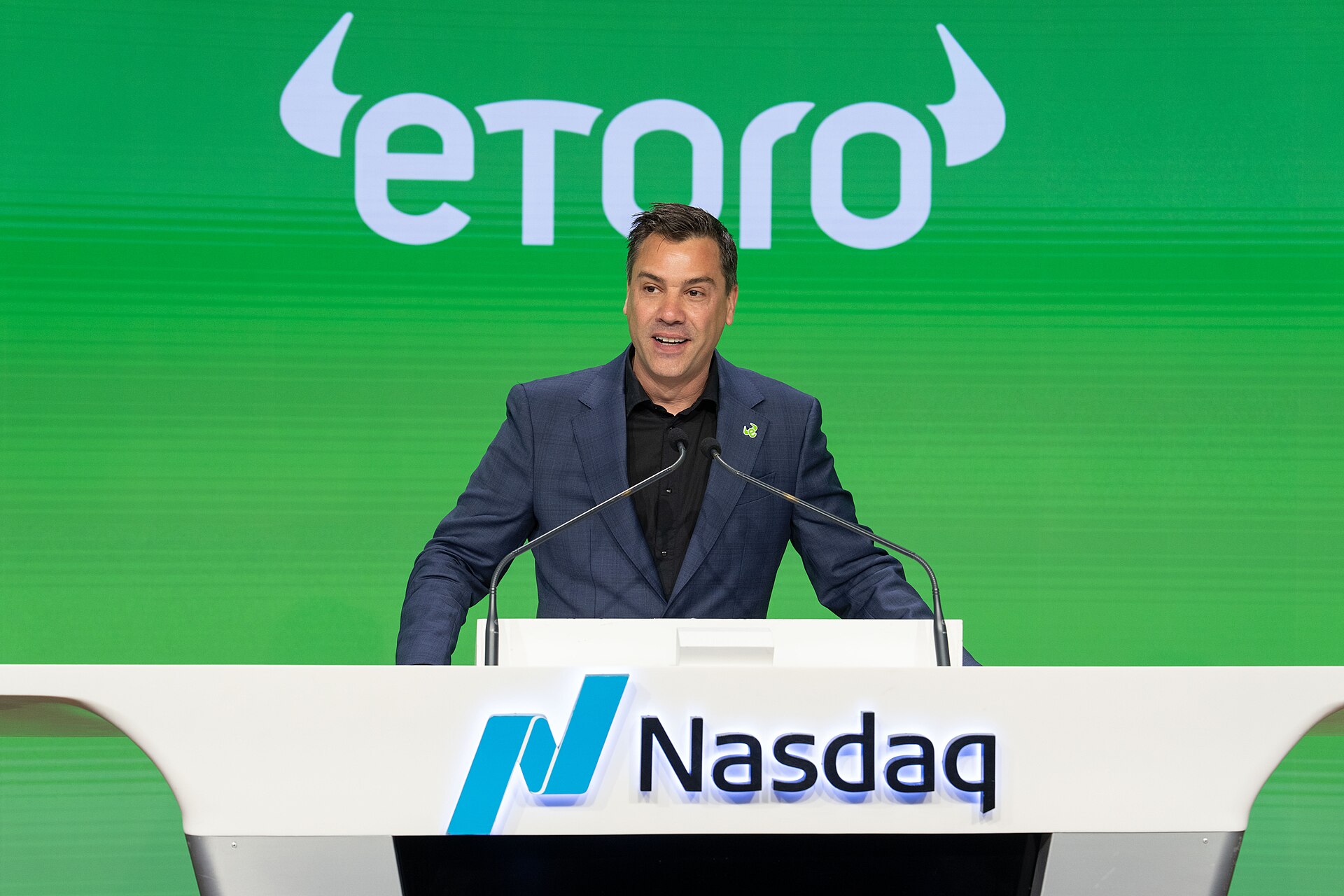 Image: eToro's IPO event at Nasdaq MarketSite, May 15, 2025. Vanja Savic / Wikimedia Commons (CC BY 4.0)
How does an IPO work?
Think of it as a house sale with a very long inspection report. The seller has to disclose every known problem, an agent finds buyers, and the price is settled only once offers are in. The real steps in the US look like this:
- Hire the banks. Investment banks, called underwriters, advise on size and timing and sell the shares. Their fee is a cut of the sale called the gross spread, which can reach 6–8% on some deals.
- File the S-1. This registration statement covers audited financials, how the business makes money, who controls it and the risks. Many companies first file confidentially, as OpenAI did in June 2026.
- Go through SEC review. Staff send comments and the company amends the filing. During this quiet period the company must be careful about anything that could count as promoting the shares. The SEC checks disclosure; it does not decide whether a stock is a good buy.
- Run the roadshow. The company adds a price range, and executives pitch to big investors while banks collect their orders.
- Price the shares. The final offer price is usually set the night before trading, based on that order book.
- Start trading. The shares list on an exchange and the market sets the price from then on.
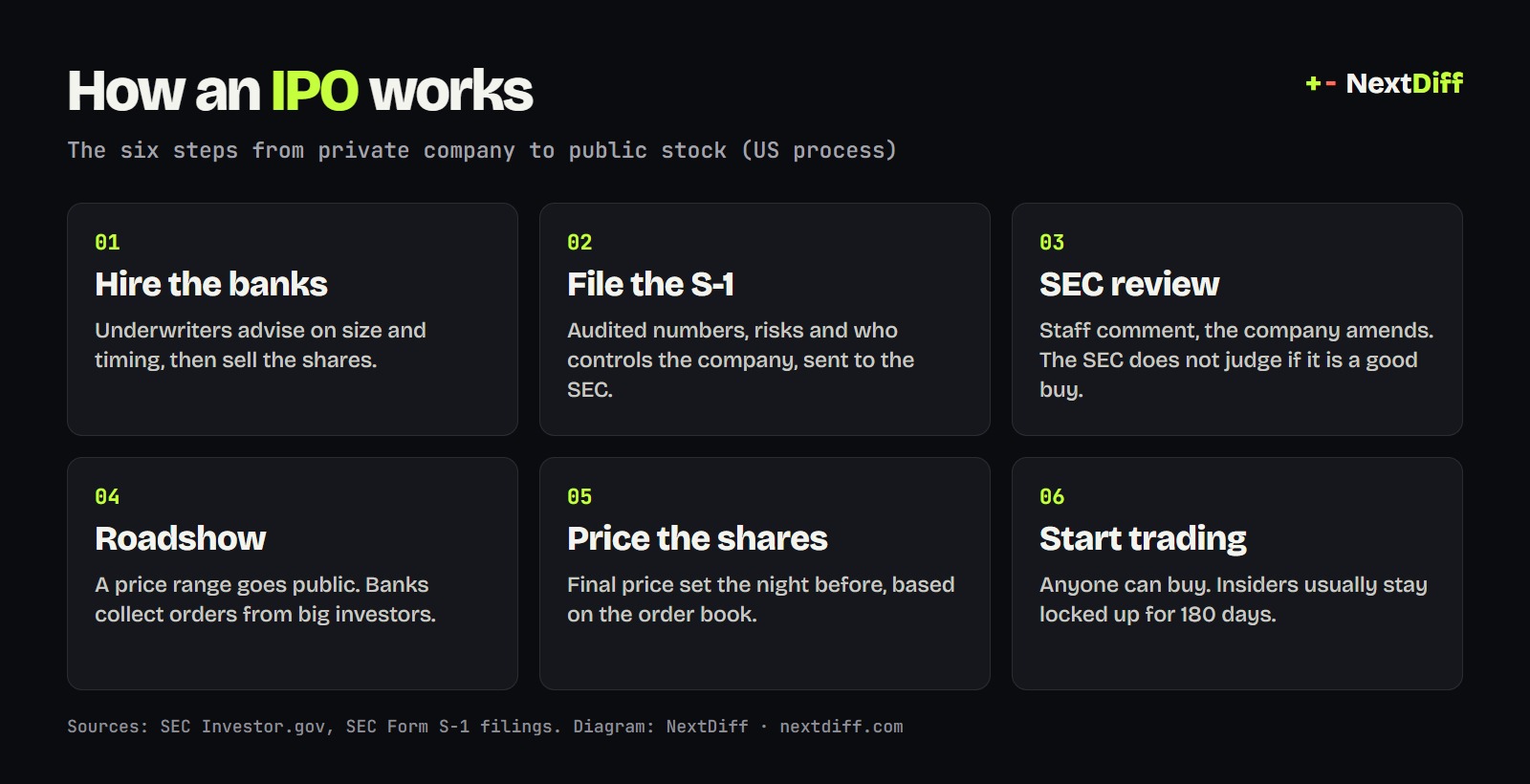 Diagram: NextDiff
After listing, insiders usually can't sell straight away. Lockup agreements stop employees and large shareholders from selling for a set time, most often 180 days. The SEC warns that a stock may drop in anticipation of that date.
What is pre-money vs post-money valuation?
These two terms come up in every funding and IPO story. Pre-money valuation is what a company is worth before new cash arrives. Post-money is that figure plus the cash.
A simple example: a company valued at $900 million pre-money raises $100 million. Its post-money value is $1 billion, and the new investors own 10%. The same sum applies at any scale. OpenAI's bridge round was first reported as $30 billion at a $1.4 trillion pre-money valuation, which works out to $1.43 trillion post-money.
Examples: real IPOs, with numbers
- SpaceX (2026): the largest IPO on record. It sold $75 billion of shares at $135 each and began trading on Nasdaq as SPCX on June 12, 2026, according to Bloomberg, more than double Saudi Aramco's 2019 record.
- Saudi Aramco (2019): the previous record at $29.4 billion raised, ahead of Alibaba's $25 billion in 2014.
- Google (2004): used a Dutch auction, where all successful bidders pay the same price per share, instead of the usual bank-led allocation.
- Facebook (2012): listed on Nasdaq on May 18, 2012, one of the biggest IPOs in technology and internet history.
- Hyundai Motor India (2024): India's largest IPO when it listed, at about ₹27,870 crore. Every share came from the parent company, so Hyundai India itself got no proceeds, and the stock opened at ₹1,934, 1.3% below the ₹1,960 issue price.
- Anthropic (2026): filed a public S-1 on October 26 to list on Nasdaq as ANT, disclosing $16.3 billion of first-half revenue. No price has been set in the filing as of our last report.
IPO vs direct listing vs SPAC
An IPO is not the only way onto an exchange. Here is how the three main routes compare:
| IPO | Direct listing | SPAC merger | |
|---|---|---|---|
| New money raised | Usually yes | Traditionally no | Yes, from the SPAC's cash pool |
| Banks underwrite | Yes | No | Not for the merger itself |
| How price is set | Order book, then the market | Opening trades on the exchange | Negotiated in the merger deal |
| Insider lockup | Usually about 180 days | Often none | Varies by deal |
Spotify's 2018 listing is the textbook direct listing. Its SEC filing said it was not selling any shares and that there were no underwriters. A SPAC is a listed shell company that raises money first and then merges with a private company, taking it public.
How is an IPO different in India?
The steps are similar, but the names and the regulator change. Companies file a draft prospectus, the DRHP, with SEBI, and later a Red Herring Prospectus. A standard mainboard issue keeps at least 35% for retail investors, defined as those bidding up to ₹2 lakh. Your bank blocks the money rather than debiting it, through a system called ASBA, and shares now list within three working days of the issue closing. When retail demand exceeds the quota, allotment goes by lottery.
Why it matters
For companies, an IPO raises money and lets early backers and employees turn paper wealth into something they can sell. Listed shares can also pay for acquisitions. The price is permanent scrutiny: quarterly results, public risk factors and shareholders who can sell at any moment.
For everyone else, the filing is the useful part. A prospectus is one of the few times a fast-growing private company has to put audited numbers on the record. For AI in particular, that is how we learned that Anthropic's headline $80.7 billion loss was mostly a non-cash charge.
Common misconceptions
"IPO stocks always jump on day one." On average they have: Jay Ritter's data on 9,345 US IPOs from 1980 to 2025 shows a 19.0% average first-day gain. But the median was 7.0%, and 29.5% closed the first day flat or down.
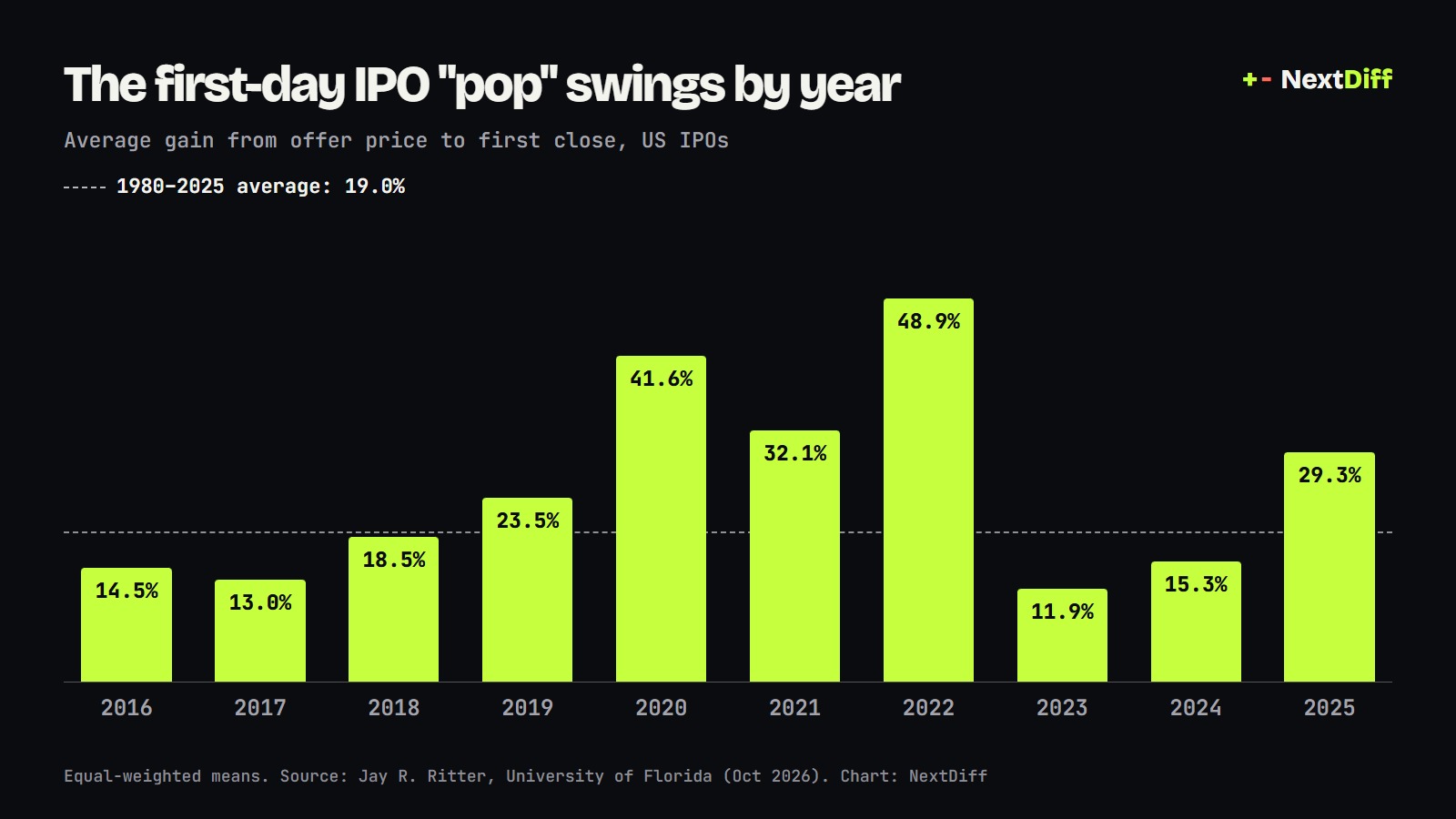 Chart: NextDiff, from Jay R. Ritter, University of Florida
"The pop is what ordinary buyers earn." That gain is measured from the offer price, and most people can only buy once trading starts, often well above it.
"All the money goes to the company." Only new shares raise money for the company. When existing owners sell, as in Hyundai India's case, the cash goes to them.
"SEC or SEBI approval means it's a safe investment." Regulators check disclosure rules. They don't vouch for the business or the price.
Latest news
- Anthropic IPO valuation: investors now talk $1T to $1.3T, down from a $2T target
- OpenAI IPO: funding target cut to $20B and valuation to $1.25T as AI stocks slide
- Anthropic IPO: S-1 shows $16.3B revenue, $80.7B loss and ticker ANT
This is a general explainer, not investment advice. Disclosure: NextDiff uses Anthropic's Claude in parts of its publishing workflow.
Questions readers ask
- What is an IPO in simple terms?
- An IPO is the first time a private company sells its shares to the public. After the sale, the shares trade on a stock exchange, and anyone with a brokerage account can buy or sell them.
- How does an IPO work?
- A company hires investment banks, files a registration statement such as the S-1 with the regulator, answers the regulator's comments, markets the shares to investors on a roadshow, sets a final price and starts trading on an exchange.
- What is an IPO in stocks?
- In stock market terms, an IPO is the moment a company's shares first become available to the public. The offer price is set before trading starts, and the market price after that moves with supply and demand.
- What is the difference between pre-money and post-money valuation?
- Pre-money valuation is what a company is worth before new investment. Post-money valuation is the pre-money value plus the new cash. A company worth $900 million that raises $100 million has a $1 billion post-money valuation.
- Why do companies go public?
- Mainly to raise money for growth and to let founders, employees and early investors eventually sell their shares. Public shares can also be used to pay for acquisitions. The cost is ongoing public disclosure and scrutiny.
+ Sources
- SEC Investor.gov — Initial Public Offering (IPO)
- SEC Investor.gov — Initial Public Offerings: Lockup Agreements
- SEC Investor.gov — Quiet Period
- Jay R. Ritter, University of Florida — Initial Public Offerings: Updated Statistics
- Spotify Technology S.A. — SEC filing on its direct listing (Form FWP, 2018)
- Wikipedia — Initial public offering (largest IPOs, Google's Dutch auction, gross spread)
- Wikipedia — Special-purpose acquisition company
- Wikipedia — Pre-money valuation
- Autocar Professional — Hyundai India IPO: shares start trading at Rs 1,934, a discount of 1.3%
- Anand Rathi — SEBI IPO application guidelines
- Business Today — SEBI keeps 35% retail quota intact
- Fortune — Anthropic's IPO prospectus
- Bloomberg Law — SpaceX IPO raises $75 billion in biggest debut of all time
- IPOScoop — SpaceX (SPCX) raises $75 billion in biggest IPO in history
- Wikipedia — Initial public offering of Facebook
+ Rate this story
Get stories like this on your phone, the minute they drop.
 Scan with your Android phone
The Weekly Diff launches soon.
Subscribe on YouTubeKeep reading