Uber data breach: hackers took drivers' license data through AI vendor Fireworks AI
At least 7,870 US drivers were hit after attackers got into Fireworks AI, the same AI inference provider whose leaked key led to Cursor's October breach.
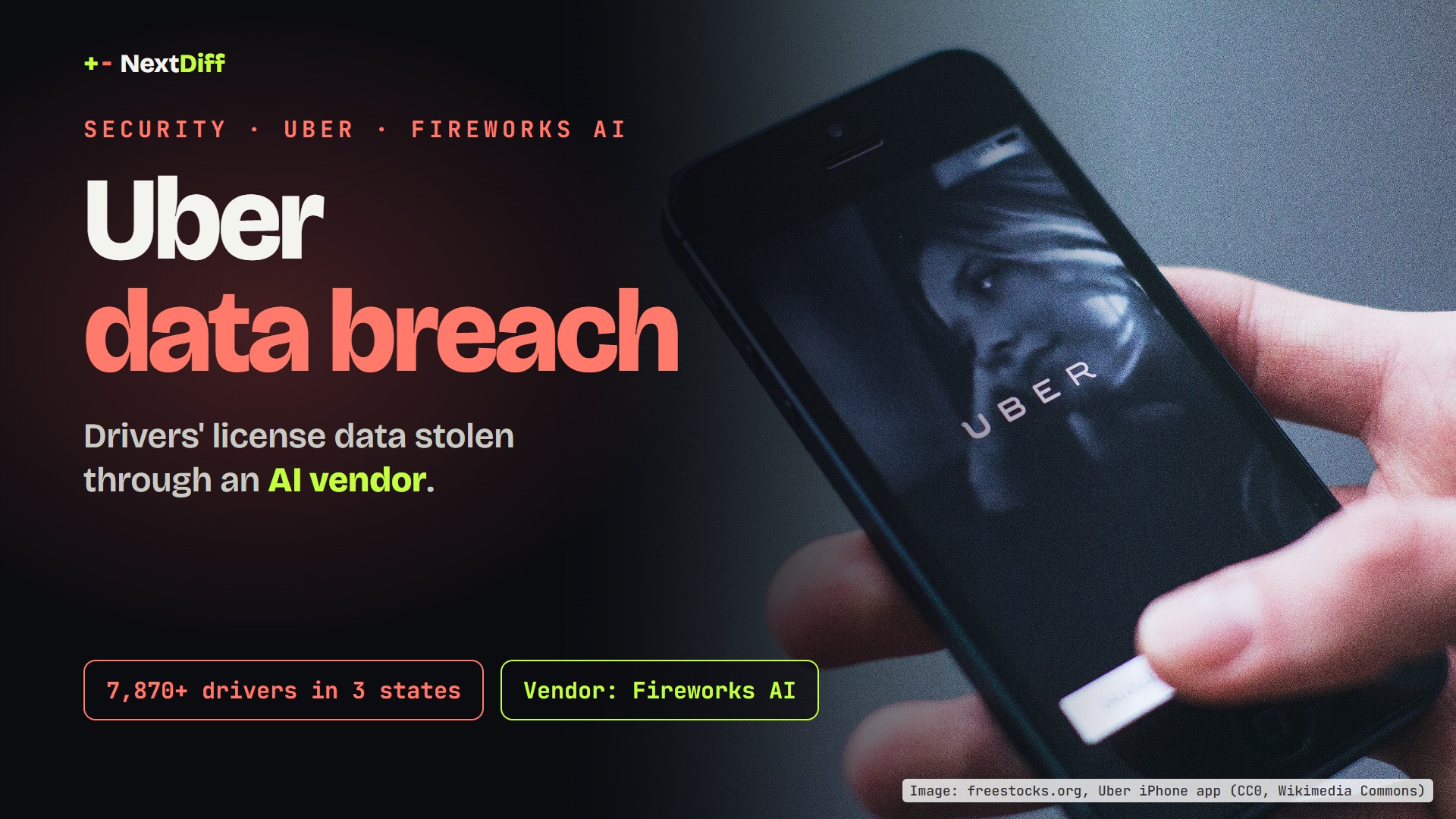
Uber confirmed on 13 November 2026 that hackers stole driver's license information on thousands of US drivers through Fireworks AI, a third-party AI inference provider breached in October. Filings show at least 7,870 drivers in three states. Cursor separately traced its October breach to a key exposed by Fireworks, showing how AI vendors widen companies' attack surface.
The latest Uber data breach did not start at Uber. Hackers took driver's license information on thousands of US Uber drivers from Fireworks AI, a company that runs AI models for other businesses, TechCrunch reported on 13 November. State breach notices show at least 7,870 drivers affected in three states, and the total is expected to grow. The same vendor's breach has now been linked to a separate incident at the AI coding company Cursor.
Our 24-second version:
 Image: freestocks.org, Uber iPhone app (CC0, Wikimedia Commons)
What happened in the Uber data breach?
Uber told TechCrunch it was "a security incident impacting one of our third-party vendors, Fireworks.ai." Uber's own notice letter, filed with the California attorney general, gives the sequence:
- 9 October: a service provider told Uber that "an unauthorized third party had compromised the service provider's internal credentials." Uber says it immediately cut its data connections to that provider.
- 13 October: Uber's investigation confirmed that Uber data had been accessed.
- 10 November: the notice letters to drivers are dated.
Breach filings seen by TechCrunch count 2,567 affected drivers in Massachusetts, 3,430 in South Carolina and 1,873 in Rhode Island. Illinois and California residents were also notified, without public counts yet. Uber has not given a national total. It says it has "not identified any misuse" of the data and is offering identity monitoring through Cyberscout, a TransUnion company, with enrolment open for 90 days from the letter.
Uber has not explained why driver's license details were reachable through an AI vendor's systems, or exactly which other data fields were taken; the template letter on file leaves the data types blank. TechCrunch calls this Uber's second known breach of 2026, after a hacking group claimed data from Uber Freight in August.
How did hackers get in? Two incidents at Fireworks AI
Fireworks AI sells fast, cheap access to open AI models through an API. Companies send it prompts and data, and it runs the models on its GPUs. That makes it a trusted pipe for a lot of customer data. Its two public security bulletins describe two separate events:
- 6 October: Fireworks detected "unauthorized use of internal Fireworks credentials." Environment variables in evaluation jobs for "a limited number of customer accounts" were accessed, and API keys stored there were captured. Fireworks rotated employee keys on 9 October and revoked more customer keys and tokens on 10 October (bulletin).
- 23–24 October: a third-party cloud provider hosting Fireworks' research machines was breached, and the intruder ran an unauthorized workload on development machines. A 9 November update says billing and shipping addresses, invoices, secrets for some accounts, and partial model weights and datasets for some customers were accessed.
Fireworks blames a financially motivated group that sells stolen access to large language models, a practice security researchers call "LLMjacking." It says it is working with Palo Alto Networks' Unit 42 and has told law enforcement.
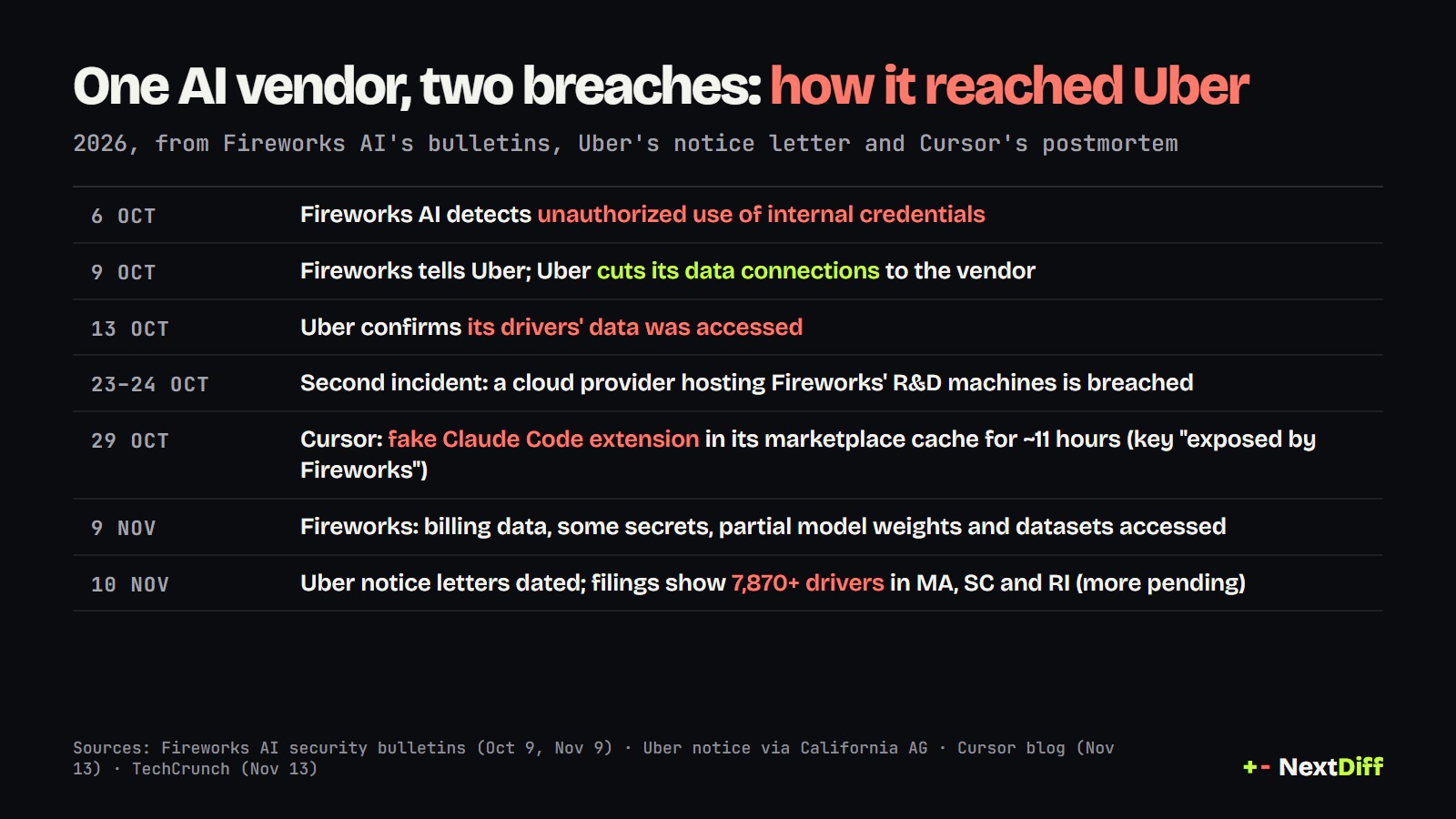 NextDiff graphic. Sources: Fireworks AI bulletins, Uber notice letter (California AG), Cursor, TechCrunch
Where does Cursor fit?
On 13 November Cursor published a postmortem of its own October breach and named the starting point plainly: an access key Cursor had issued to Fireworks. "The key was exposed by Fireworks," Cursor wrote. With it, the attacker copied coding-agent traces for fewer than 0.05% of users (those without Privacy Mode) and, on 29 October, slipped malicious copies of the Claude Code extension into Cursor's extension marketplace cache for about 11 hours, BleepingComputer reported. Cursor revoked the key and moved all of its AI inference off Fireworks.
Neither company has said which of the two Fireworks incidents exposed Cursor's key, so treat the Uber and Cursor cases as linked by the vendor, not necessarily by the same intrusion. The Register reported that Notion said fewer than 1% of its workspaces may be affected.
Why it matters: your AI vendor is now part of your attack surface
For a decade, "third-party risk" meant payroll providers, CRMs and cloud storage. This breach shows the new category: AI inference providers that receive a company's raw data and hold its keys. Three lessons stand out for anyone who ships software:
- Send the minimum. If an AI job does not need a full driver's license record, strip or tokenise it before it leaves your systems.
- Treat keys you give vendors as yours to rotate. Cursor's exposure came from a key it issued; short-lived, narrowly scoped credentials limit what a stolen one can do.
- Ask vendors where secrets live. Fireworks' first incident exposed keys stored in job environment variables, a common and risky habit.
It echoes the supermarket fridge hack earlier this month: attackers rarely need a clever exploit when an over-trusted connection is already open.
What should Uber drivers do now?
If you drove for Uber in the US, watch your mail and email for a notice letter. Enrol in the Cyberscout monitoring within the 90-day window if you get one, consider a free credit freeze with Equifax, Experian and TransUnion, and be wary of calls or texts that quote your license number to sound official. A law firm announced a class-action investigation on 14 November; no lawsuit outcome exists yet.
What's next
Expect the driver count to rise as more state filings appear, and watch for Fireworks naming more affected customers. NextDiff will update this story when Uber gives a total or confirms the full list of data taken.
 Image: HaeB, Uber offices, Mission Bay (CC BY-SA 4.0, Wikimedia Commons)
Questions readers ask
- What happened in the Uber data breach?
- Hackers accessed driver's license information on thousands of US Uber drivers through Uber's third-party AI vendor, Fireworks AI. Fireworks told Uber on 9 October 2026 that its internal credentials had been compromised, and Uber confirmed on 13 October that its data was accessed.
- How many Uber drivers were affected?
- State filings show at least 7,870: 2,567 in Massachusetts, 3,430 in South Carolina and 1,873 in Rhode Island. Illinois and California drivers were also notified, and Uber has not released a national total.
- Is the Uber data breach in 2026 the same as the 2022 Uber hack?
- No. The 2022 breach was an attacker tricking an Uber contractor, and the 2016 breach exposed 57 million users. The 2026 breach came through an outside AI vendor, Fireworks AI, and mainly affects drivers' license data.
- What is Fireworks AI?
- Fireworks AI is a company that runs open AI models for other businesses through an API. Customers including Uber, Cursor and Notion sent it data or gave it keys, which is why its October 2026 breaches reached them.
- What should Uber drivers do after the breach?
- Look out for Uber's notice letter, enrol in the free Cyberscout monitoring within 90 days, consider a credit freeze at the three US credit bureaus, and be suspicious of calls or texts that quote your license number.
+ Sources
- TechCrunch — Uber confirms hackers stole thousands of drivers' license information in data breach
- California AG — Uber Technologies data breach notice
- Fireworks AI — October 2026 security incident
- Fireworks AI — October 2026 security incident update
- Cursor — An update on our recent security incident
- BleepingComputer — Cursor confirms security breach led to malicious Claude Code extension
- The Register — Fireworks AI breach, Notion and Cursor
+ Rate this story
Get stories like this on your phone, the minute they drop.
 Scan with your Android phone
The Weekly Diff launches soon.
Subscribe on YouTubeKeep reading