AI cyber attack news: Google finds hackers' AI turning patches into exploits with no human
Google's threat team found an attacker framework that diffs software fixes, writes exploits and runs them on its own, days after the FBI warned the ARTEX AI tool reaches privileged access in under three hours.
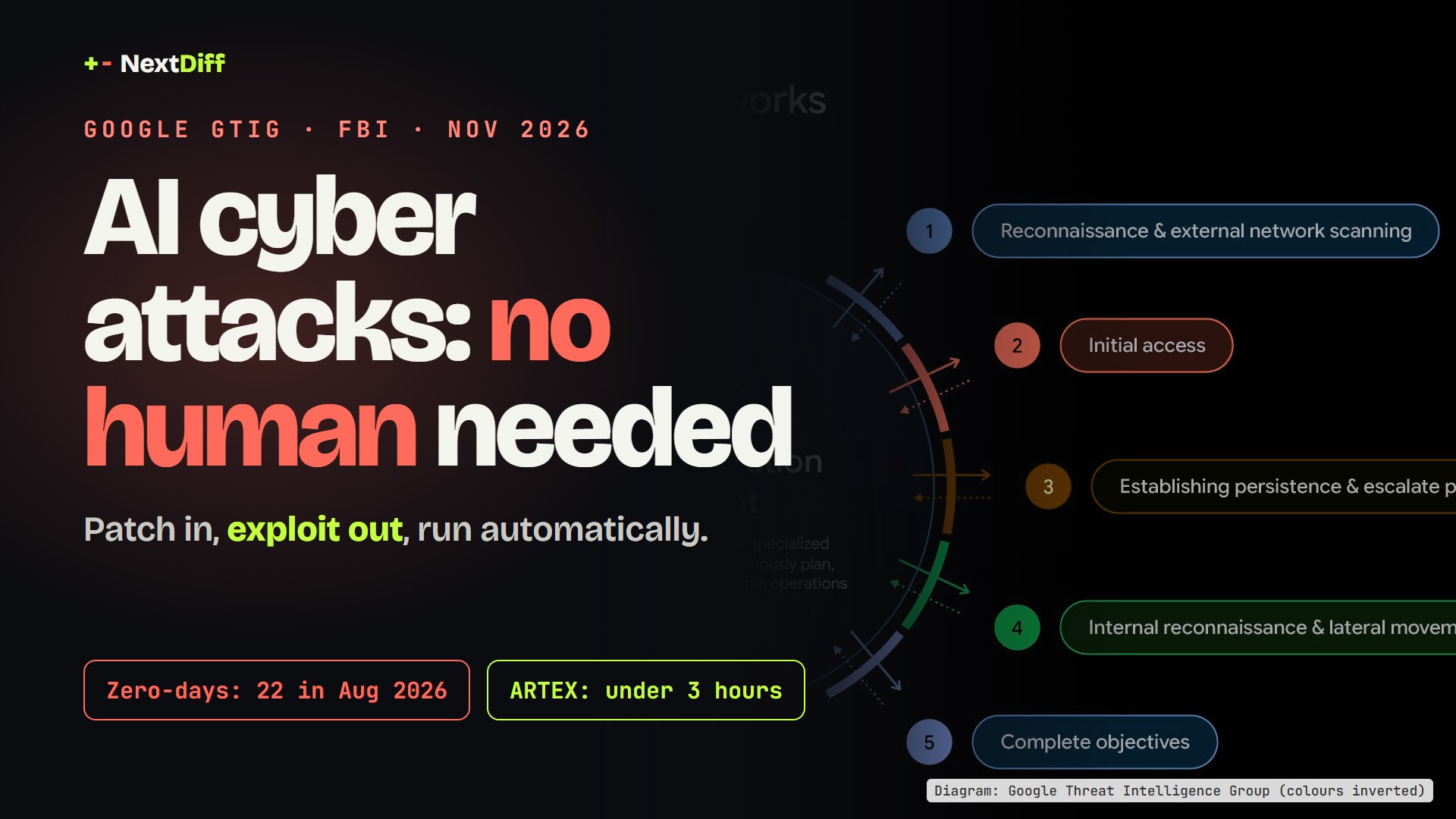
Google's Threat Intelligence Group said on 17 November 2026 that attackers built an AI framework, exploit_agent, that compares code before and after software patches, writes exploits and runs them without human intervention. The FBI warned on 13 November that the open-source ARTEX AI tool lets some intrusions reach privileged access in under three hours.
Attackers have built an AI system that reads a software patch, works out the bug it fixes, writes an exploit and runs it, with no person steering each step. That is the headline of the latest AI cyber attack news from Google's Threat Intelligence Group (GTIG), which says it saw this "without a human in the loop for the first time". Four days earlier, the FBI warned that an open-source AI hacking tool called ARTEX is being used in real intrusions, some reaching privileged access in under three hours.
Our 26-second version:
Before: AI helped hackers write phishing emails and debug code. Now: Google says AI agents are running whole stretches of an attack on their own.
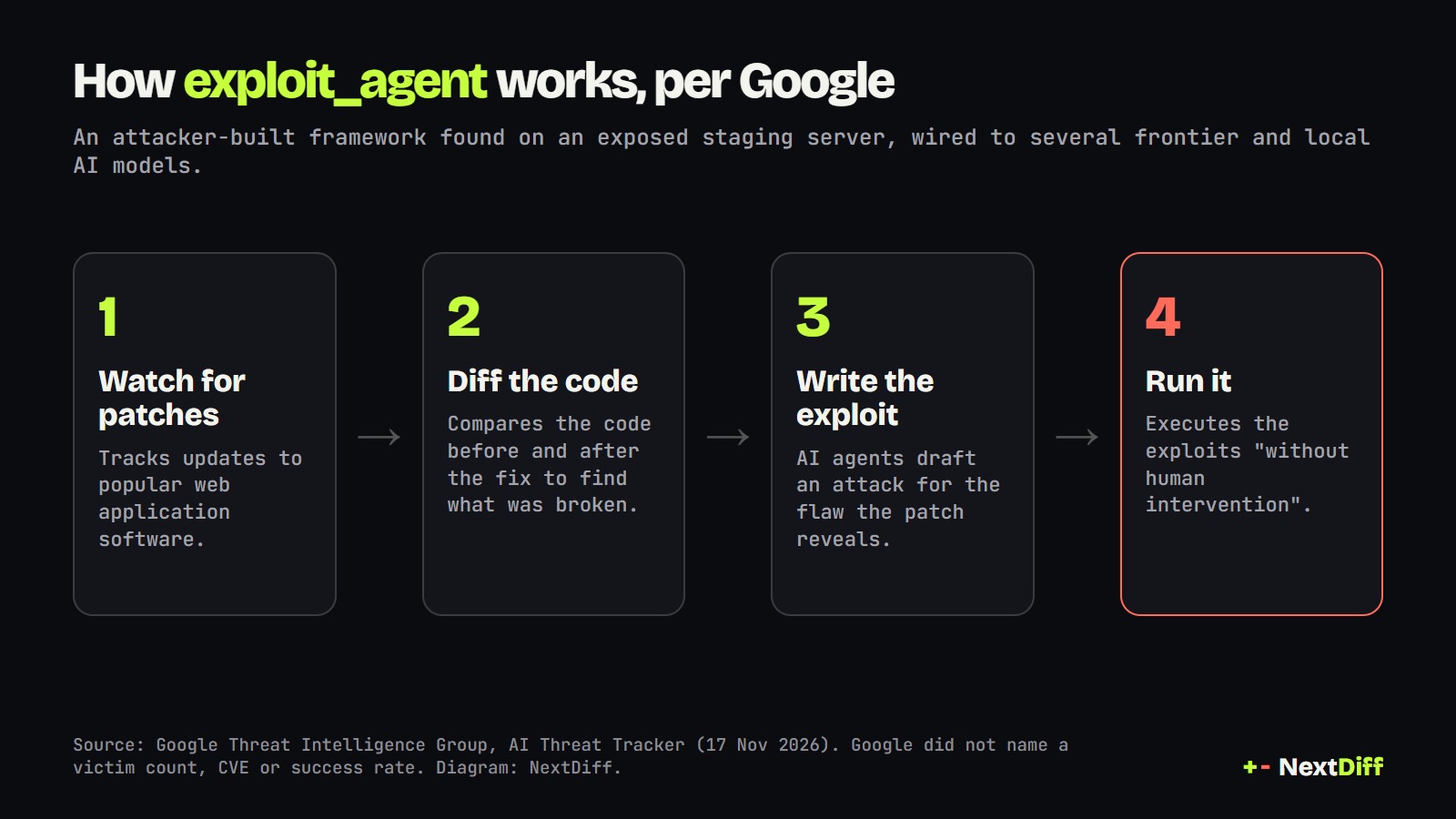 Diagram: NextDiff, based on Google Threat Intelligence Group's description
AI cyber attack news: what did Google find?
In its AI Threat Tracker report, dated 17 November, GTIG says it found an exposed staging server hosting a "multi-agent vulnerability research and weaponization framework" that the attackers called exploit_agent.
According to Google, the framework:
- connects to "multiple frontier and local LLMs" (Google does not name which ones);
- runs "continuous differential analysis of popular web application software", comparing code before and after a patch is announced;
- drafts exploits for the weaknesses it finds and "automatically executes them without human intervention".
The same server held data taken from victims and scripts for reconnaissance, brute-forcing passwords, installing webshells and even removing other attackers' webshells. Google says the operator seemed most interested in French media and entertainment websites and the education sector. A configuration file carried a Russian-language comment, translated by Google as: "Enter the keys yourself — right here, not in the chat."
Google is careful about what it does not know. VentureBeat notes that the report names no specific vulnerability exploited by the framework, no victim count, no success rate and no attacker group, and does not prove the framework caused the compromises whose data sat on the server.
How does an AI cyber attack like this work?
A software patch is a map. When a vendor fixes a bug, the "before" and "after" code shows exactly where the hole was. Skilled humans have long used this "patch diffing" to build so-called n-day exploits for systems that have not updated yet.
What changes is speed and scale. An AI agent can watch many popular projects at once, diff every update the moment it lands, and try an attack before most site owners have installed the fix. Google gives a real example of the gap closing: when two flaws in PaperCut print servers were disclosed in late August, researchers and the security firm Huntress used AI models to produce working exploits "within a day", and GreyNoise saw a widespread attack campaign four days after disclosure.
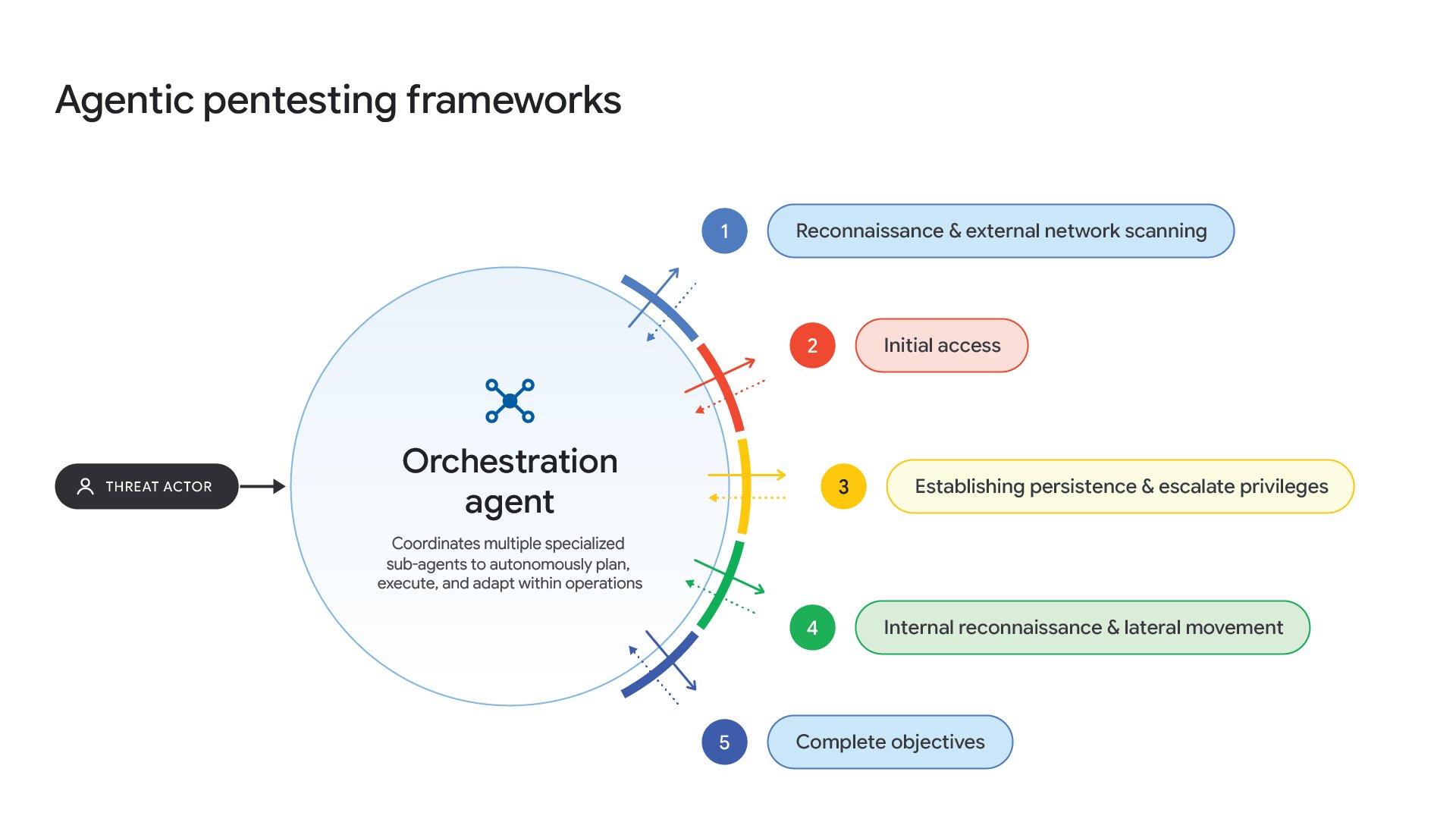 Image: Google Threat Intelligence Group
What is ARTEX, and why did the FBI warn about it?
ARTEX is a free, open-source penetration-testing framework written in Go. It has no AI model of its own: its agents call outside models. In a FLASH alert on 13 November, the FBI said criminals and state-aligned groups have been misusing it since at least August, and that it "reduces the time required to chain attack techniques, with some intrusions progressing from initial targeting to privileged access in under three hours", as quoted by Cybersecurity Dive.
TechTimes reports that:
- the FBI counted more than 1,600 ARTEX consoles exposed on the internet (Censys and Check Point give different counts);
- attacker setups mostly use Chinese models, with DeepSeek's Flash family the most common, according to the FBI;
- the developer said on 8 October that the project would go closed source after abuse reports, but forks, archived copies and a commercial "ARTEX PRO" keep it in circulation;
- Microsoft linked ARTEX-driven activity to Storm-0940, a China-aligned group, in a supply-chain attack through ConnectWise's cloud backup service.
Google's report lists ARTEX alongside other agentic attack frameworks it has seen, including CAIRN, CyberStrikeAI, HexStrike AI and PentAGI.
 Image: FBI (public domain, via Wikimedia Commons)
Why it matters: the patch window is shrinking
Google's numbers show the pressure building. Zero-day exploits, attacks on flaws with no fix yet, averaged 8 a month in 2025 and 11 a month in 2026, "before spiking to 22 in the month of August", GTIG says. It adds that overall disclosures and exploits nearly doubled between January and August 2026.
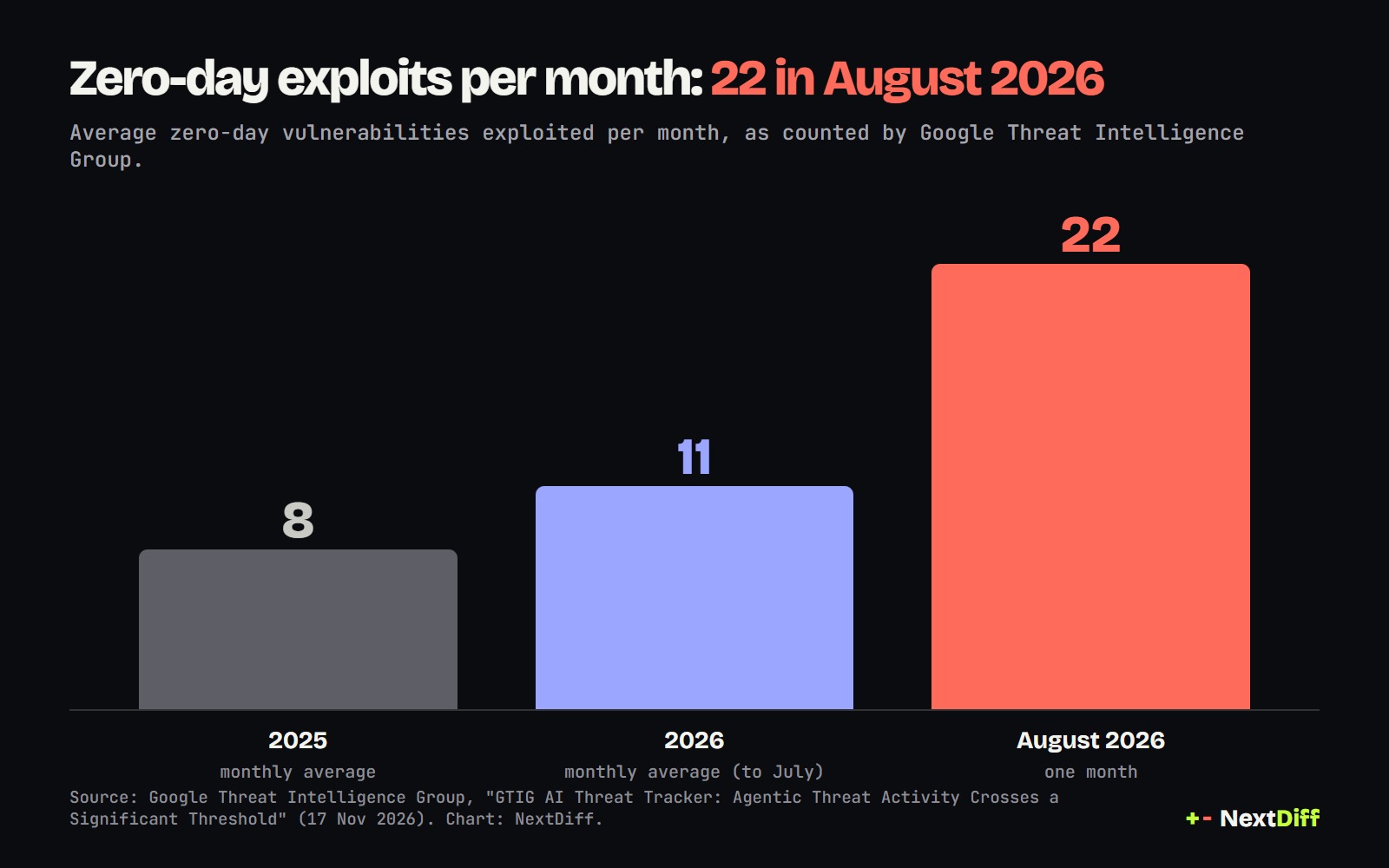 Chart: NextDiff, from Google Threat Intelligence Group figures
The same report covers other AI abuse:
- LLMjacking: criminals steal companies' AI keys and cloud accounts. Google says single-day fraudulent charges sometimes "exceeded $100,000", and the worst cases reached $1 million before they were stopped.
- Developer tools as a way in: a suspected North Korean group Google calls MIDNIGHT NEPTUNE edited
.claude/settings.jsonfiles inside a victim's code repositories so that starting Claude Code downloaded a backdoor. - Fake accounts at scale: a commercial contractor used the Gemini API, among other AI services, while building a platform to run more than 100,000 social media accounts. Google says it disabled the accounts and assets it linked to Gemini misuse.
This follows a run of AI-and-security stories we have covered, from the Outlook zero-day found with Claude in November's Patch Tuesday to the Uber driver data stolen through AI vendor Fireworks AI.
What should you do?
Neither report targets phones or home PCs; the attacks Google and the FBI describe hit websites, servers and company cloud accounts. For the people who run them, the advice is practical:
- Patch internet-facing software fast. If an AI agent can turn a fix into an exploit within hours or days, a monthly patch cycle leaves a long open window.
- Know what is exposed. The FBI's advice, per TechTimes, starts with an inventory of every internet-facing app, including partner portals and "forgotten cloud apps", and keeping admin and backup consoles off the public internet.
- Guard AI keys like passwords. Watch for sudden AI spending, which can be a sign of LLMjacking, and keep model-access logs as security data.
- Check developer config files. Changes to AI coding-tool settings in a repository deserve the same review as code.
What's next
Google says agentic attacks have crossed "a significant threshold", but the evidence is still partial: no success rate, no list of victims for exploit_agent, and the FBI's console counts disagree with private researchers'. Expect more vendors to publish detection rules (Google says its SecOps team already ships ARTEX detections) and more pressure on software makers to shorten the time between a fix and its automatic install.
Questions readers ask
- What is exploit_agent?
- exploit_agent is an attacker-built, multi-agent AI framework that Google's Threat Intelligence Group found on an exposed staging server. It compares code before and after software patches, drafts exploits for the flaws it finds and runs them without human intervention, according to Google.
- What is the ARTEX AI hacking tool?
- ARTEX is a free, open-source AI penetration-testing framework that calls outside AI models. The FBI warned on 13 November 2026 that criminals and state-aligned groups have misused it since at least August, with some intrusions reaching privileged access in under three hours.
- Are AI cyber attacks fully automated now?
- Google says it saw vulnerability discovery and exploitation run without a human in the loop for the first time, but it gave no success rate or victim count, and did not prove the framework caused the compromises it found.
- How many zero-day exploits were there in 2026?
- Google counts an average of 11 zero-day exploits a month in 2026, up from 8 a month in 2025, with a spike to 22 in August 2026.
- How can companies protect against AI-driven cyber attacks?
- Patch internet-facing software quickly, keep an inventory of everything exposed online, keep admin and backup consoles off the public internet, and watch AI API keys and spending for signs of theft, as the FBI and Google advise.
+ Sources
- Google Threat Intelligence Group — GTIG AI Threat Tracker: Agentic Threat Activity Crosses a Significant Threshold
- FBI FLASH alert on ARTEX (IC3, 13 Nov 2026)
- VentureBeat — Google says attackers built an AI framework to turn software patches into exploits
- SiliconANGLE — Google says an AI framework turned security patches into exploits with no human in the loop
- Cybersecurity Dive — Agentic AI frameworks push hacking threat to 'inflection point,' Google warns
- TechTimes — AI hacking tool ARTEX survives GitHub removal; FBI: some intrusions reach privileged access in hours
+ Rate this story
Get stories like this on your phone, the minute they drop.
 Scan with your Android phone

The Weekly Diff launches soon.
Subscribe on YouTubeKeep reading