Gemini 4 Argon benchmarks: where it beats GPT-6 Astra and Claude, and where it doesn't
Google's own numbers put Argon ahead on 13 of 19 tests at a fifth of Astra's price. Coding is still the gap, and an independent ranking is cooler.
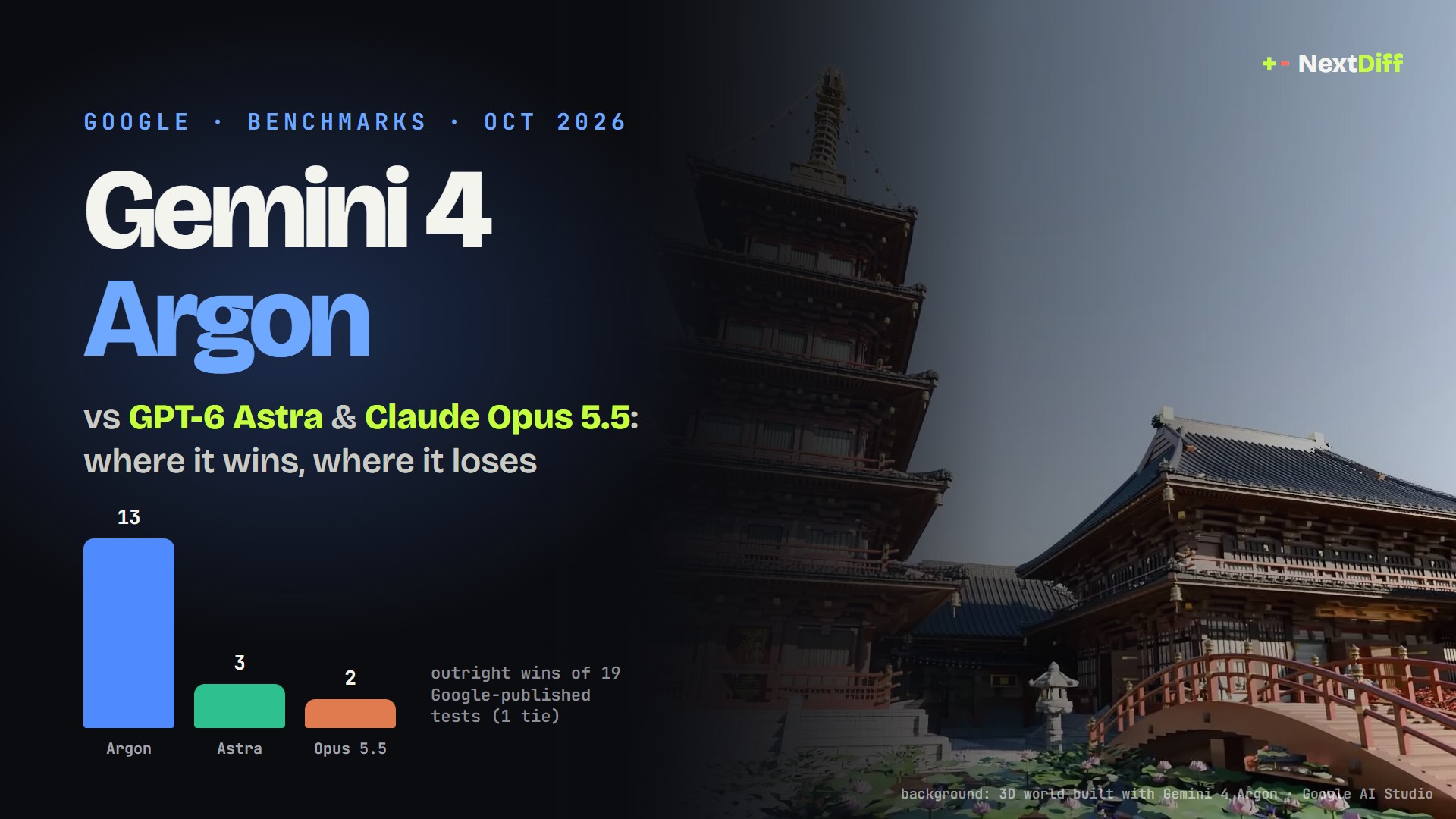
Google's Gemini 4 Argon, announced on September 30 and opened to developers on October 13, 2026, leads 13 of 19 benchmarks Google published against GPT-6 Astra and Claude Opus 5.5. Its biggest leads are in automation, finance, legal work and long context. It trails on two coding tests and costs $2/$10 per million tokens.
Google's new flagship model, Gemini 4 Argon, now has a full benchmark table, and it is the most complete head-to-head Google has published against OpenAI and Anthropic. On the 19 tests Google chose, Argon has the top score on 13, ties on one and loses five. The Gemini 4 Argon benchmarks show something specific: it is strongest at long, multi-step agent work such as automation, finance, legal review and reasoning over huge contexts. It is not the clear winner at writing code. It is also much cheaper than OpenAI's flagship.
New to LLMs? Read: What is an LLM?
New to AI agents? Read: What are AI agents?
Google announced Argon on September 30, first giving it to vetted cyber defenders. On October 13 it opened the model to developers in Google AI Studio and the Gemini API (model id gemini-4-argon), and to AI Pro and Ultra subscribers in the Gemini app.

Our 55-second version, with the benchmark bars and real footage of Argon-built games:
What is Gemini 4 Argon?
Argon is the first Gemini 4 model, and Google describes it as built for "your hardest problems": long jobs that run for hours, not quick chat answers. Three changes matter most, according to Google's developer guide:
- 1M-token output. Input, thinking and output now share one 1-million-token window. Earlier Gemini models capped output at 64K tokens. Argon can return a whole multi-file refactor, a test suite or a long proof in one pass.
- Thinking levels. Developers set
thinking_levelto low, medium (the default) or high, trading speed and cost for depth. - Managed agents. Argon can run inside Google's hosted Antigravity agent harness, which searches the web, writes and runs code, checks its own work and calls MCP tools from a single API call.
Google says it used Argon internally before launch. It reports a quantum-computing subroutine 40% better than the best published baseline, more than 300 TiB of memory freed across its fleet, and large C/C++-to-Rust migrations, including over 800,000 lines of the Fuchsia Zircon kernel. These are Google's own claims and have not been independently checked.
Gemini 4 Argon benchmarks: the full table
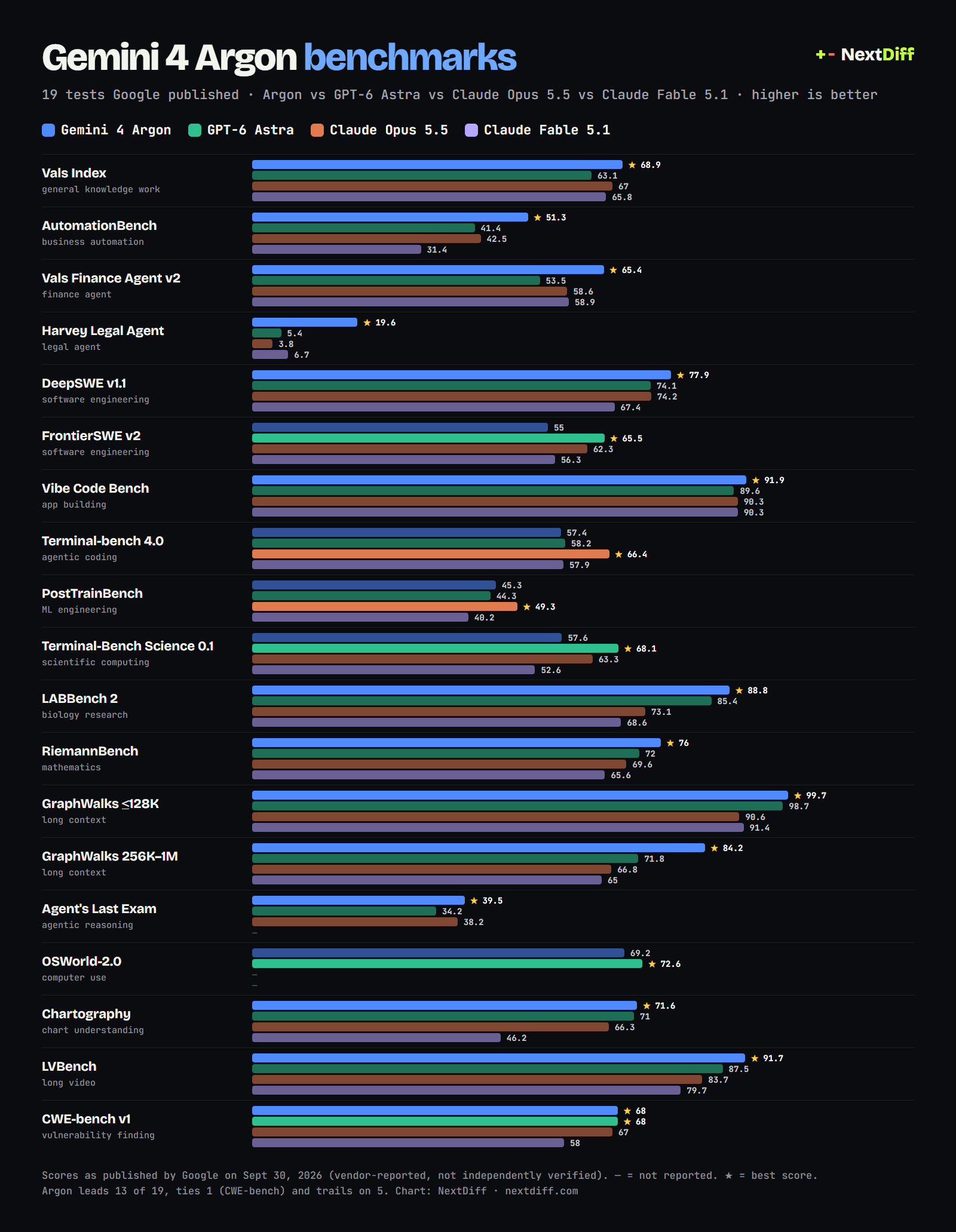
Here are all 19 scores Google published, set against OpenAI's GPT-6 Astra and Anthropic's Claude Opus 5.5 and Claude Fable 5.1. Higher is better. These are vendor-reported numbers, compiled by DataCamp from Google's release. Google picked the tests.
| Benchmark | What it tests | Gemini 4 Argon | GPT-6 Astra | Claude Opus 5.5 | Claude Fable 5.1 |
|---|---|---|---|---|---|
| Vals Index | general knowledge work | 68.9 | 63.1 | 67.0 | 65.8 |
| AutomationBench | business automation | 51.3 | 41.4 | 42.5 | 31.4 |
| Vals Finance Agent v2 | finance agent | 65.4 | 53.5 | 58.6 | 58.9 |
| Harvey Legal Agent | legal agent | 19.6 | 5.4 | 3.8 | 6.7 |
| DeepSWE v1.1 | software engineering | 77.9 | 74.1 | 74.2 | 67.4 |
| FrontierSWE v2 | software engineering | 55.0 | 65.5 | 62.3 | 56.3 |
| Vibe Code Bench | app building | 91.9 | 89.6 | 90.3 | 90.3 |
| Terminal-bench 4.0 | agentic coding | 57.4 | 58.2 | 66.4 | 57.9 |
| PostTrainBench | ML engineering | 45.3 | 44.3 | 49.3 | 40.2 |
| Terminal-Bench Science 0.1 | scientific computing | 57.6 | 68.1 | 63.3 | 52.6 |
| LABBench 2 | biology research | 88.8 | 85.4 | 73.1 | 68.6 |
| RiemannBench | mathematics | 76.0 | 72.0 | 69.6 | 65.6 |
| GraphWalks (up to 128K) | long context | 99.7 | 98.7 | 90.6 | 91.4 |
| GraphWalks (256K–1M) | long context | 84.2 | 71.8 | 66.8 | 65.0 |
| Agent's Last Exam | agentic reasoning | 39.5 | 34.2 | 38.2 | — |
| OSWorld-2.0 | computer use | 69.2 | 72.6 | — | — |
| Chartography | chart understanding | 71.6 | 71.0 | 66.3 | 46.2 |
| LVBench | long video | 91.7 | 87.5 | 83.7 | 79.7 |
| CWE-bench v1 | vulnerability finding | 68 | 68 | 67 | 58 |
Where Argon wins clearly
The gaps are widest on work that is long and messy. On AutomationBench, Argon scores 51.3 against 42.5 for Opus 5.5. On Harvey's legal agent benchmark, every model scores low, but Argon's 19.6 is about three times Fable 5.1's 6.7. On GraphWalks at 256K to 1M tokens, which tests whether a model can follow links through a huge document, Argon scores 84.2 and Astra 71.8. That fits the 1M-token design. Argon also leads on long video (LVBench), charts and biology research.
Where it loses
Coding is mixed. Argon wins DeepSWE and Vibe Code Bench, but Claude Opus 5.5 wins Terminal-bench 4.0 by nine points (66.4 vs 57.4), and GPT-6 Astra wins FrontierSWE v2 by ten (65.5 vs 55.0). Astra also leads on scientific computing and on OSWorld-2.0, which tests operating a real desktop. If your main job is hard agentic coding in a terminal, the Claude and OpenAI flagships are still strong picks.
What independent testers say
Third-party results are cooler than Google's table. Artificial Analysis, which runs the same tests on every model, gives Argon a score of 53 on its Intelligence Index, ranking it 8th of 216 models. Running its full test suite on Argon costs about $1.99 per index task. Early hands-on testers praise its long-task and 3D work, and some report weaker spots in coding and 3D physics.
How much does Gemini 4 Argon cost?
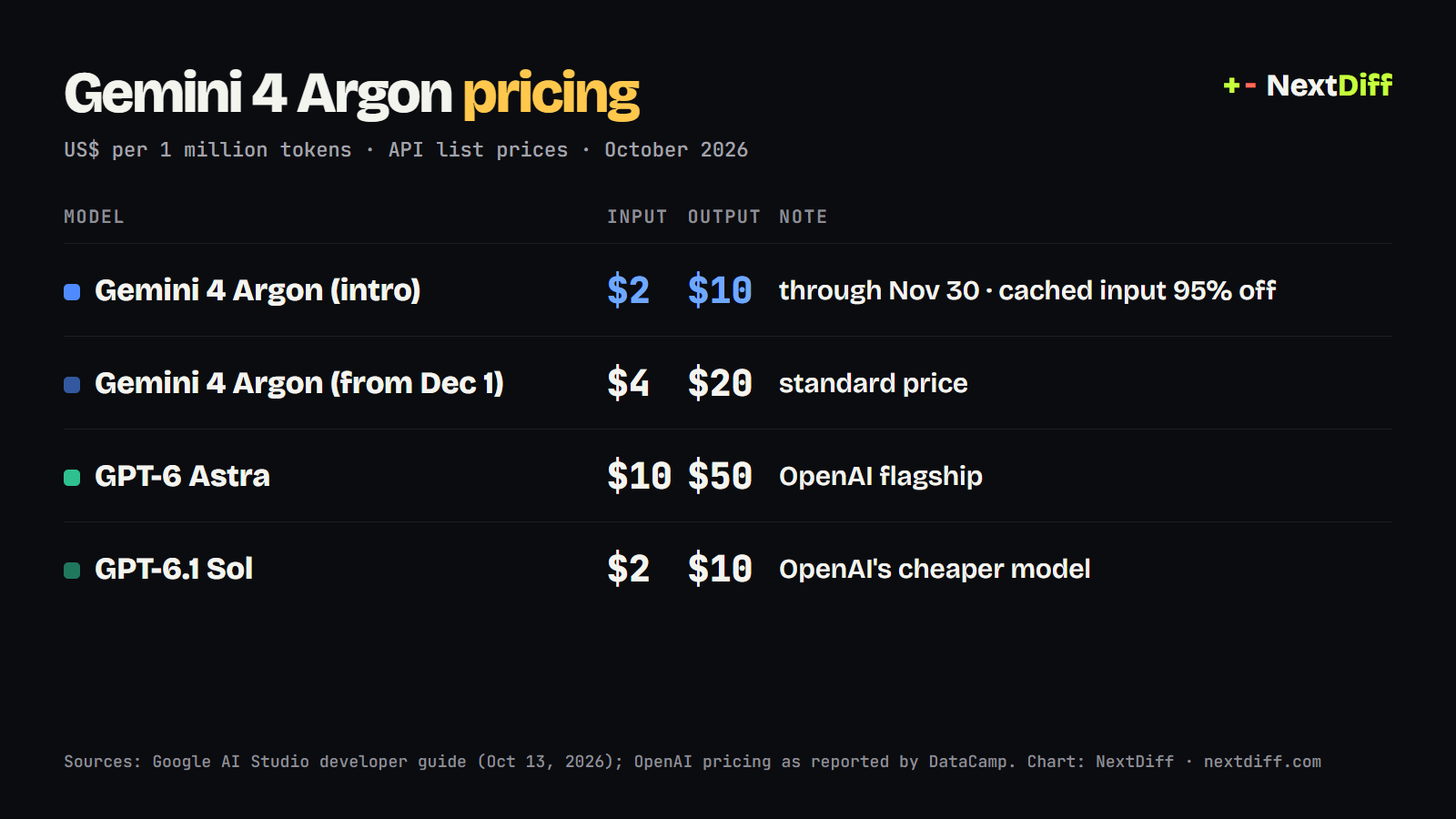
Price is where Argon stands out. Through November 30, the Gemini API charges an intro rate of $2 per million input tokens and $10 per million output tokens, and cached input is 95% off. From December 1 the price is $4 in and $20 out. OpenAI's GPT-6 Astra lists at $10 in and $50 out, so Argon's intro price is a fifth of Astra's. Even after the increase it is less than half. OpenAI's cheaper GPT-6.1 Sol matches Argon's intro price.
What is it useful for? Real examples
Google's launch material shows where it expects Argon to pay off:
- Codebase maintenance. Google says Argon migrated libraries such as re2 and libgav1 to Rust; the libgav1 port ran 2.7x faster. DeepMind also used it for large-scale cleanup in Chromium.
- Security. Through Wiz's Scan for Good program, Argon found a critical flaw in widely used healthcare software. That is why defenders got it first.
- Finance and legal documents. Argon can work through dense folders of PDFs, ledgers and filings and turn them into dashboards or redlines. DeepMind showed it untangling 500-page chemistry patents.
- Robotics. On the robotics side, Google reports 87% on the ERQA embodied-reasoning test. It also reports real-world task success rising from 56% to 75%, with completion time down from 35 to 24 seconds.
- Everyday tasks. In the Gemini app, Argon gives more direct answers, shows progress updates on long jobs and connects to more than 40 apps.
Gemini 4 Argon builds 3D games in Google AI Studio
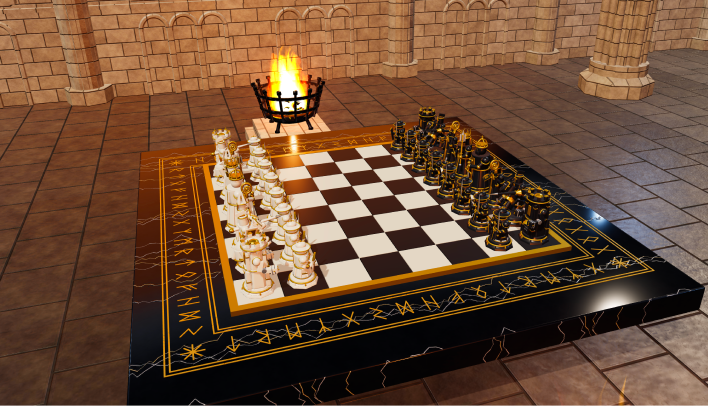
The most fun part of the launch is in the browser. Google's Argon builders showcase has playable apps that Argon built, and anyone can remix them in AI Studio Build. They include Wizard Chess 3D in a Gothic cathedral, Argon Tennis with webcam motion controls, a snow-plowing planet game and a GPU fur simulation. In Desk Racer, a Google engineer gave Argon photos of a real desk, and it built a miniature racing game on that desk.

Google's 3D games guide also shows procedural worlds, such as this Japanese temple built in Three.js:

Developers can test prompts in the Google AI Studio Playground, where Google's guide pre-loads gemini-4-argon. Don't confuse this with Google Playground, the consumer AI game maker we covered last week. Playground also runs on Gemini models, but Google hasn't said it uses Argon.
More from Google on Argon
The diff
Before Argon, Gemini answers stopped at 64K tokens, and Google's next flagship was months late. Now Google has a model that, by its own numbers, leads most of the agent tests developers care about, writes up to a million tokens and costs far less than GPT-6 Astra. The open questions are coding, where Claude Opus 5.5 and Astra still win key tests, and whether independent results catch up with Google's table. Artificial Analysis ranks Argon 8th, so the "best model" crown depends on your workload.
Questions readers ask
- Is Gemini 4 Argon better than GPT-6 Astra and Claude Opus 5.5?
- On the 19 benchmarks Google published, Gemini 4 Argon has the best score on 13, ties on one and trails on five. Claude Opus 5.5 wins Terminal-bench 4.0 and PostTrainBench. GPT-6 Astra wins FrontierSWE v2, Terminal-Bench Science and OSWorld-2.0. Independent ranker Artificial Analysis places Argon 8th of 216 models.
- How much does Gemini 4 Argon cost?
- In the Gemini API, Gemini 4 Argon costs $2 per million input tokens and $10 per million output tokens through November 30, 2026, with cached input 95% off. From December 1 it costs $4 input and $20 output per million tokens.
- How can I use Gemini 4 Argon?
- Developers can use the model id gemini-4-argon in the paid tier of the Gemini API, in Google AI Studio (including the Playground) and in Android Studio. Google AI Ultra subscribers can also use it in AI Studio and Antigravity, and AI Pro and Ultra subscribers get it in the Gemini app.
- What is Gemini 4 Argon's context window and output limit?
- Gemini 4 Argon has a unified 1-million-token window shared by input, thinking and output in the Gemini API. It can generate far more than the 64K-token output cap of earlier Gemini models by using background long-decode requests.
- Is Gemini 4 Argon used in Google Playground?
- Google has not said that its consumer Google Playground game maker uses Argon. Developers can try Argon in the separate Google AI Studio Playground, and Google's Argon showcase has playable 3D games built with it, such as Wizard Chess 3D and Desk Racer.
+ Sources
- Google — Gemini 4 Argon: Built to solve your hardest problems
- Google AI Studio — Gemini 4 Argon: Developer Guide
- Google AI Studio — Gemini 4 Argon Builders Showcase
- Google AI Studio — Building 3D Games and Procedural Worlds with Gemini 4 Argon
- Google — Gemini 4 Argon availability in the Gemini app
- Google Developers Blog — Gemini 4 Argon for robotics
- Google Cloud — Gemini 4 Argon available on Google Cloud
- DataCamp — Gemini 4 Argon benchmarks and comparison
- Artificial Analysis — Gemini 4 Argon
+ Rate this story
Get stories like this on your phone, the minute they drop.
 Scan with your Android phone
The Weekly Diff launches soon.
Subscribe on YouTubeKeep reading