Flock cameras: Proton's new map shows 214,000 Flock devices in service across the US
Built from Flock's own records, which a researcher found exposed, the map lists 335,701 devices. Flock tried to take the original down; Proton put it back up on Swiss servers.
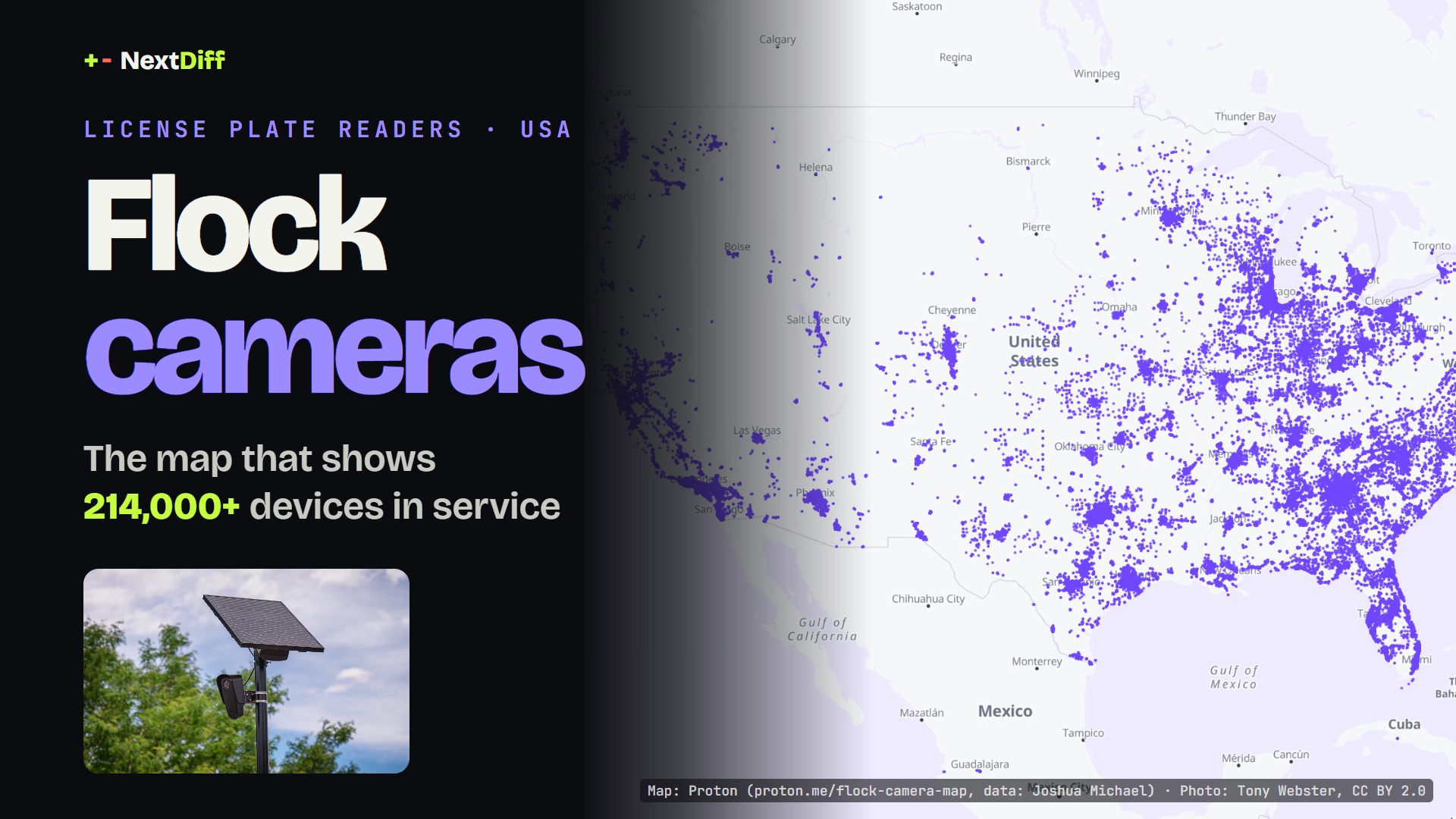
Proton now hosts a public map of Flock cameras, the license plate readers used by US police and businesses. Built from a December 2025 snapshot of Flock's own records that researcher Joshua Michael found exposed, it lists 335,701 devices, 214,073 in service, after Flock tried to take the original map down in September 2026.
Flock cameras are suddenly on everyone's screen. Proton, the Swiss company behind Proton Mail and Proton VPN, now hosts a public Flock camera map that lets anyone in the US type a ZIP code and see the license plate readers around them. Flock Safety had already tried to get the original version of the map taken down. The data comes from Flock's own records, not from volunteers spotting poles, and it shows a network far bigger than the company's public numbers.
Our 45-second version:
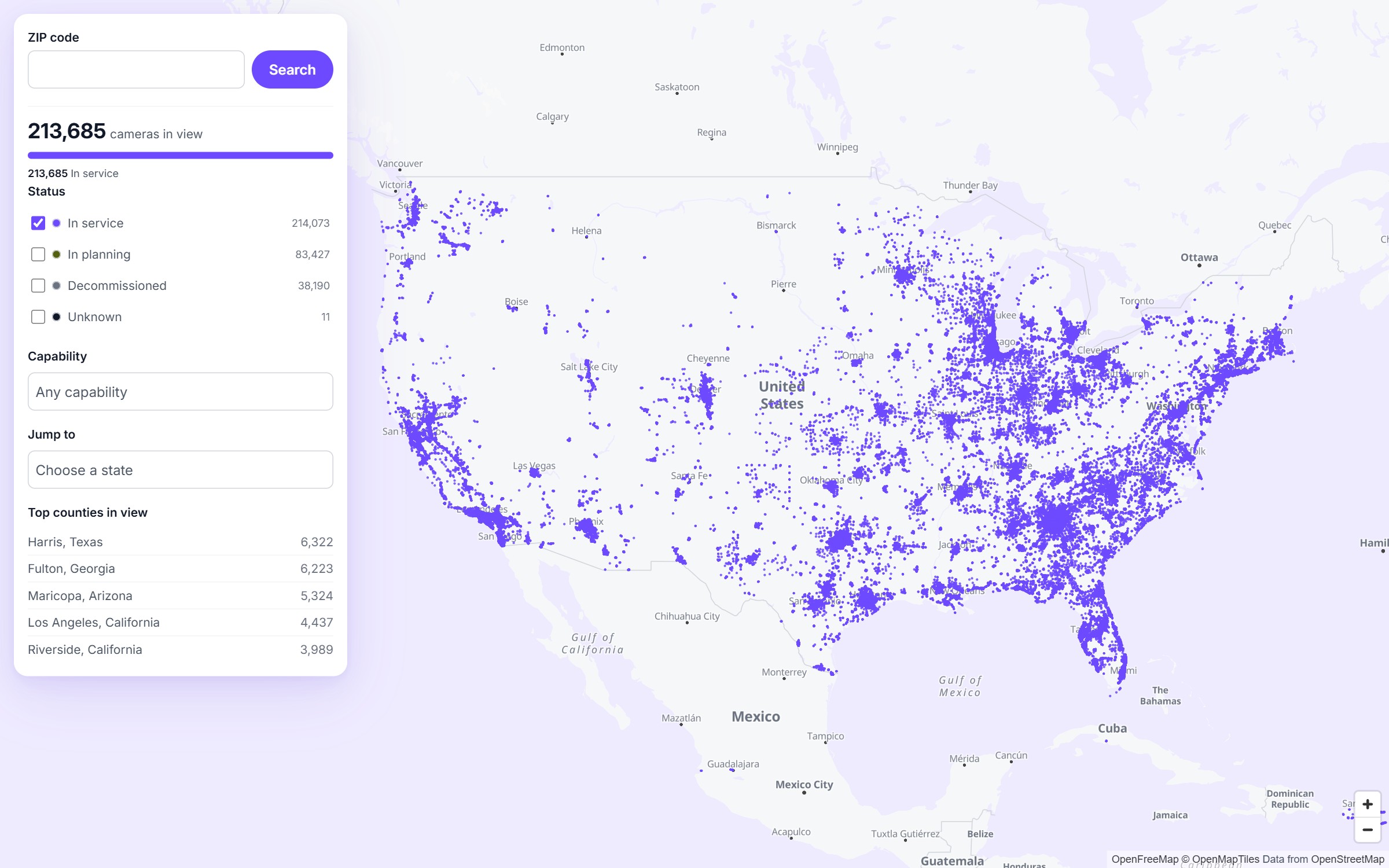 Image: Proton, Flock camera map (proton.me/flock-camera-map), data from researcher Joshua Michael
What are Flock cameras?
Flock Safety, based in Atlanta, sells automated license plate readers (ALPRs) to police departments, cities, homeowners' associations and businesses. The best-known model, the Falcon, is a small black camera on a pole, often with its own solar panel. It photographs every passing car, not just cars linked to a crime.
According to Flock's own explainer, the cameras record the plate plus the car's make, model, colour and visible details such as bike racks, trailers or toolboxes. Flock says they do not use facial recognition and are "not general-purpose surveillance systems designed to identify people." Each sighting becomes a searchable record: plate, place and time.
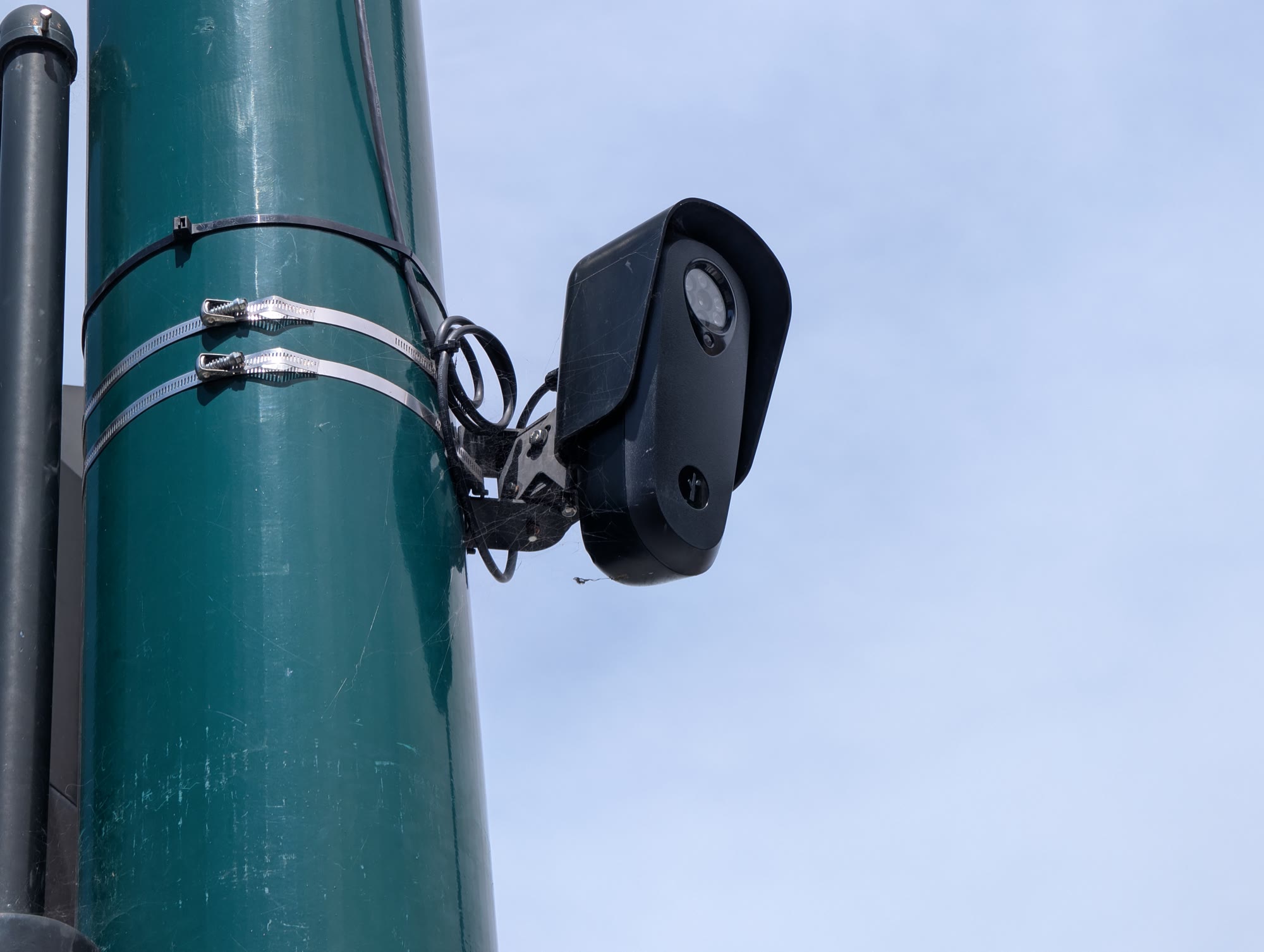 Image: RailTypes via Wikimedia Commons (CC0)
Proton says Flock's network handles "more than 20 billion vehicle reads a month across 49 states." Flock also sells Raven, an acoustic sensor that listens for gunshots, and pan-tilt-zoom cameras.
What does the Flock camera map show?
The map is built on an inventory that cybersecurity researcher Joshua Michael pulled from Flock's systems. It lists 335,701 Flock device locations. Proton's map breaks them down by status:
- In service: 214,073
- In planning: 83,427
- Decommissioned: 38,190
Across all statuses, Proton and The Intercept say the inventory holds more than 170,000 cameras and over 130,000 other Flock devices, including about 27,000 acoustic sensors. Flock has publicly cited around 120,000 cameras. Proton puts the real camera count about 40% higher.
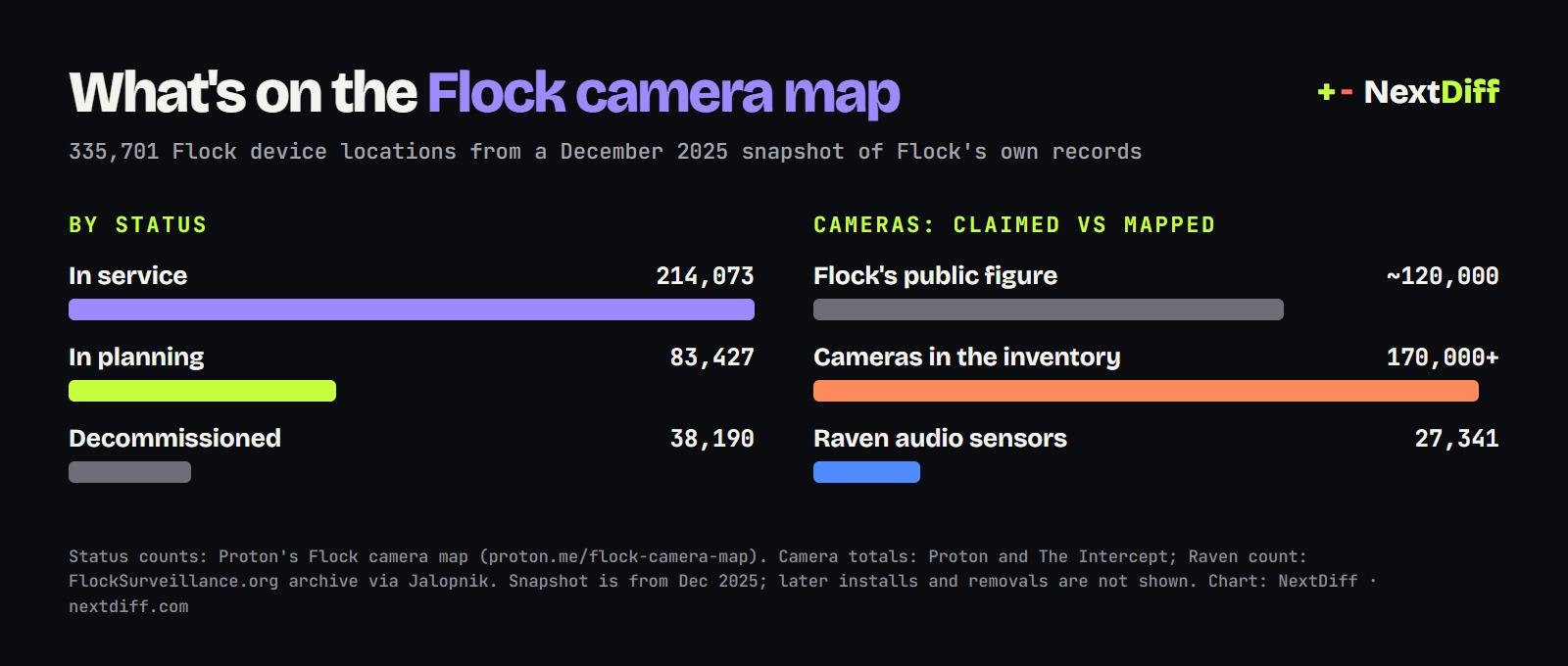 Chart: NextDiff, from Proton, The Intercept and Jalopnik figures
The densest areas on the map are big metro counties. Harris County, Texas (Houston) tops Proton's list with 6,322 in-service devices, just ahead of Fulton County, Georgia (Atlanta) with 6,223, then Maricopa County, Arizona, with 5,324. A five-mile circle around downtown Atlanta alone shows more than 5,000.
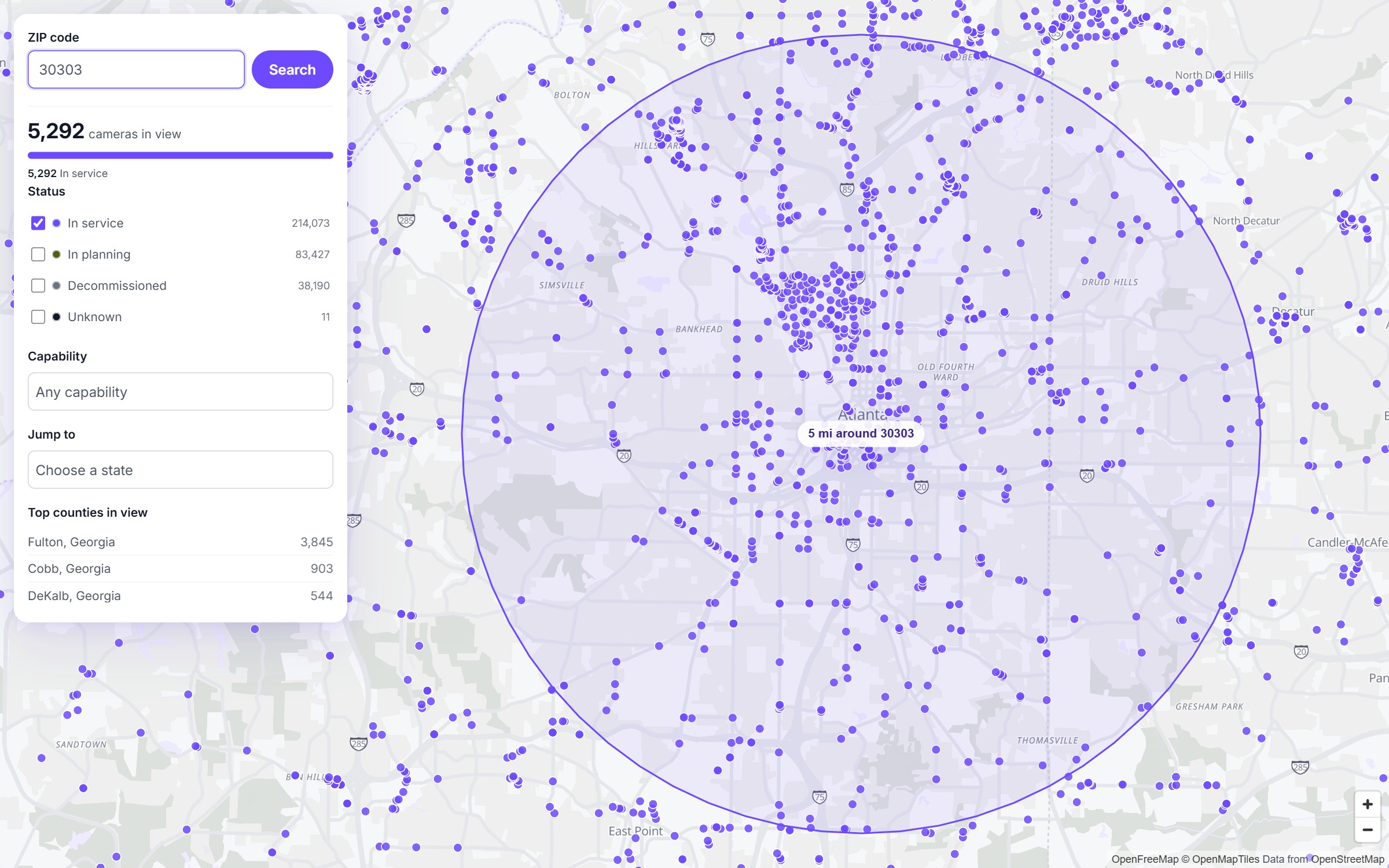 Image: Proton, Flock camera map (proton.me/flock-camera-map)
The Intercept checked the data by visiting six random Arizona locations on the map. A Flock camera stood at every one.
How did a researcher get Flock's own data?
In November 2025, Michael found that Flock's servers exposed an access token that anyone could get without logging in. The Intercept reports he used it to query ArcGIS, the third-party mapping platform Flock uses, and pull device locations. He emailed Flock on 13 November 2025, followed up twice, got a reply that the company was "internally triaging" it, and then heard nothing more. He archived the data in December and published it at FlockSurveillance.org on 23 September 2026.
Flock appears to have closed the hole. In January 2026, it wrote that "Flock has never been hacked, and there has not been a leak of Flock information." CyberInsider reports that Flock later found "anomalous activity" involving the token but said its forensic review found no impact on customer data.
Why did Flock try to take the map down?
On 24 September, brand-protection firm Doppel filed a trademark complaint on Flock's behalf, saying the site's use of "Flock Safety" could confuse customers. Jalopnik found the site offline by 28 September. Michael says Flock also sent him a cease-and-desist letter threatening a lawsuit and told customers it had notified law enforcement. Proton then rebuilt the map on its own Swiss servers. Proton says it doesn't host or distribute the raw dataset itself, only the map.
Why it matters
The map turns an abstract debate into something you can check from your sofa. People can now see how many plate readers sit on their commute. Plate-reader searches have been misused: a Washington Post review cited by Proton found at least 50 officers accused or charged with misusing license plate readers, with Flock's system involved in 46 of those cases. In August, Flock CEO Garrett Langley apologised for misuse and recommended that agencies cut data retention from 30 days to seven, WECT reported. Each customer still sets its own retention period.
It also echoes this week's other privacy story: Google can now use Gmail and Photos data for ads. In both cases, the change only became visible because someone published the details.
Caveats and what's next
- It's a snapshot. The data is from December 2025. Cameras added or removed since then are missing.
- "Cameras in view" counts devices. The map's counter includes non-camera Flock hardware, so read it as devices, not cameras alone.
- The legal fight isn't over. Flock has not said whether it will go after Proton.
If you want to know about the cameras near you, ask your city or police department where they are, how long they keep plate records, which agencies can search them, and how they audit those searches.
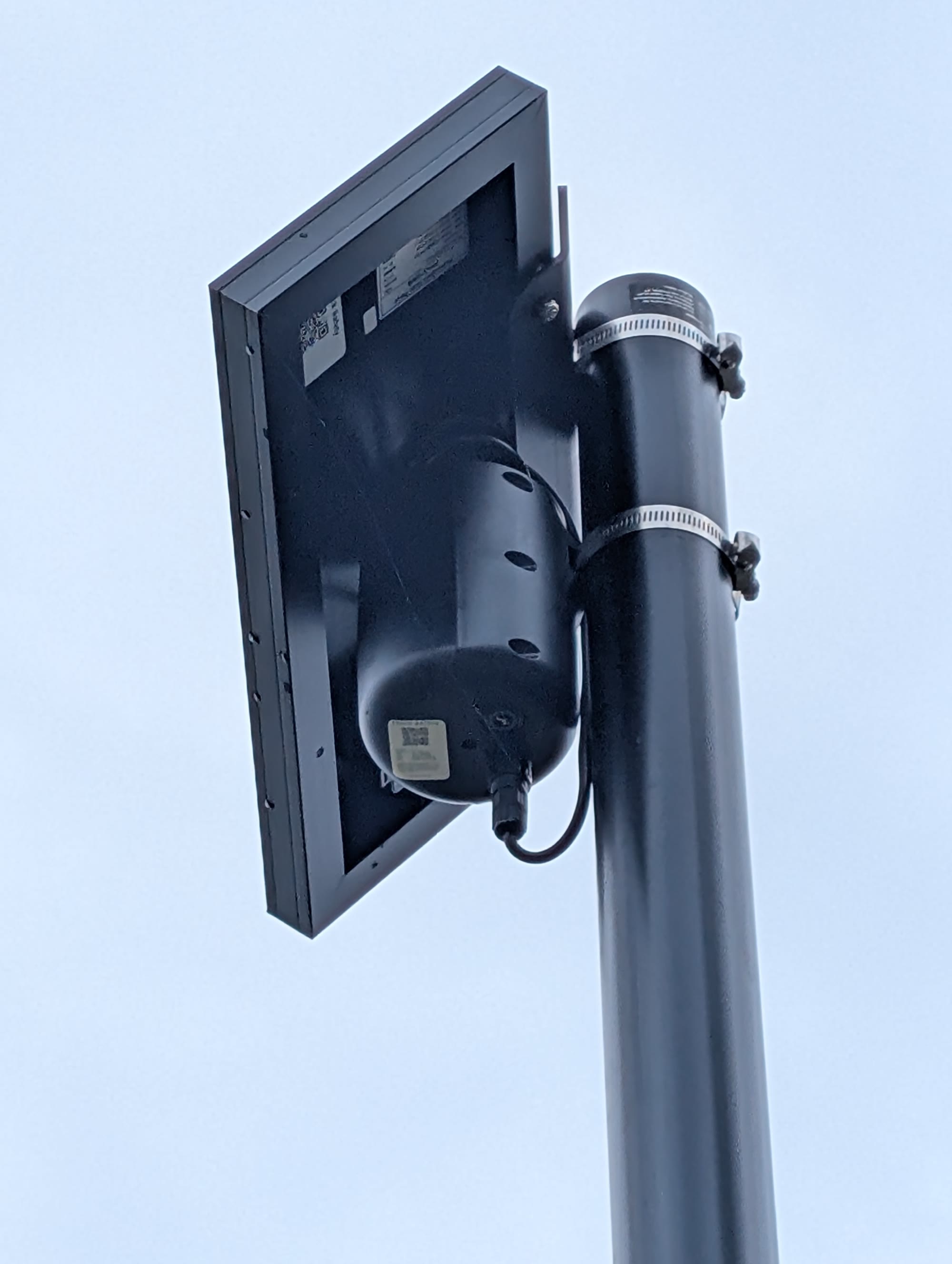 Image: Kobenon via Wikimedia Commons (CC0)
Questions readers ask
- What are Flock cameras?
- Flock cameras are automated license plate readers sold by Flock Safety to police, cities, HOAs and businesses. They photograph every passing car and log the plate, make, model, colour and features like roof racks, with the time and place. Flock says they don't use facial recognition.
- Is there a map of Flock cameras near me?
- Yes. Proton hosts a free Flock camera map at proton.me/flock-camera-map where you type a US ZIP code to see nearby Flock devices. It uses a December 2025 snapshot, so recent changes are missing. DeFlock is a separate, crowdsourced map.
- How many Flock cameras are there?
- The leaked inventory behind Proton's map lists more than 170,000 Flock cameras and over 130,000 other Flock devices, 335,701 locations in all. Flock has publicly cited about 120,000 cameras.
- How long do Flock cameras keep data?
- Each customer sets its own retention period. In August 2026 Flock recommended cutting the default from 30 days to seven; records saved as evidence in an investigation can be kept longer.
- Why did Flock want the camera map taken down?
- On 24 September 2026, Doppel filed a trademark complaint on Flock's behalf against FlockSurveillance.org, saying the name could confuse customers. The researcher also says Flock sent a cease-and-desist letter. Proton then hosted the map on Swiss servers.
+ Sources
- Proton — Flock camera map
- The Intercept — Map of 300,000 Flock devices (24 Sept 2026)
- CyberInsider — Proton hosts map of 300,000 Flock devices amid legal threats
- Jalopnik — Flock forces website showing camera locations to shut down
- Flock Safety — What do Flock cameras actually capture?
- WECT — Flock Safety CEO apologizes for license plate reader misuse
- Cybernews — Flock surveillance map moves to Proton after takedown attempt
+ Rate this story
Get stories like this on your phone, the minute they drop.
 Scan with your Android phone

The Weekly Diff launches soon.
Subscribe on YouTubeKeep reading