How does Starlink work? Satellites, the flat dish and lasers, explained
A flat dish, about 11,000 satellites 550 km up and lasers between them: why SpaceX's internet feels like broadband when old satellite internet felt like dial-up.
Starlink is SpaceX's satellite internet. A flat phased-array dish links by radio to one of about 11,000 satellites orbiting roughly 550 km up, which relay traffic to fibre-connected ground stations or along laser links. Orbiting 65 times closer than geostationary satellites cuts latency to about 33 ms, making video calls and gaming usable.
Starlink is SpaceX's satellite internet service. So how does Starlink work? A flat dish on your roof talks by radio to whichever of roughly 11,000 small satellites is passing overhead, about 550 km up. That satellite relays your data to a ground station on fibre, or along laser links to other satellites, so you get broadband almost anywhere.
Our 28-second version:
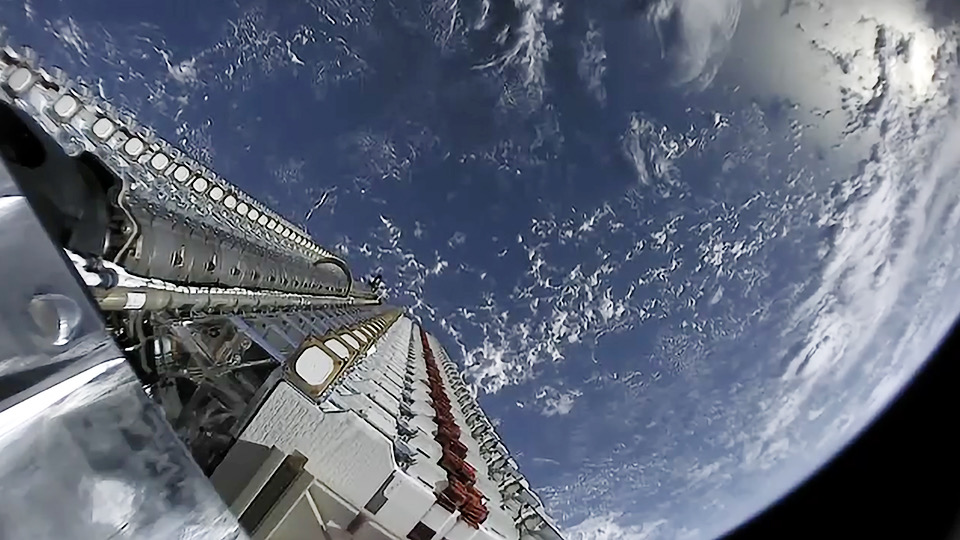 Image: SpaceX (CC0, via Wikimedia Commons). Sixty Starlink satellites stacked in orbit before deployment, May 2019.
How does Starlink work?
Think of it as a cell network turned upside down. With mobile data, the towers stand still and your phone moves between them. With Starlink, your dish stays put and the "towers" fly over at about 27,000 km/h, so each satellite is in view for only a few minutes. The network keeps handing your connection from one satellite to the next.
One web request takes four hops, according to SpaceX's own architecture diagram:
- Dish to satellite. Your user terminal sends the request by Ku-band radio to a satellite in view.
- Satellite onward. The satellite beams it down over Ka-band to a gateway, a ground station on fibre. If no gateway is in range, as over oceans or polar regions, it passes the data along optical inter-satellite links (lasers between satellites, rated at 100 Gbps+) until one is.
- Gateway to the internet. The gateway sends traffic over leased fibre to a point of presence (PoP), where Starlink connects to the wider internet.
- Back again. The website's reply makes the same trip in reverse.
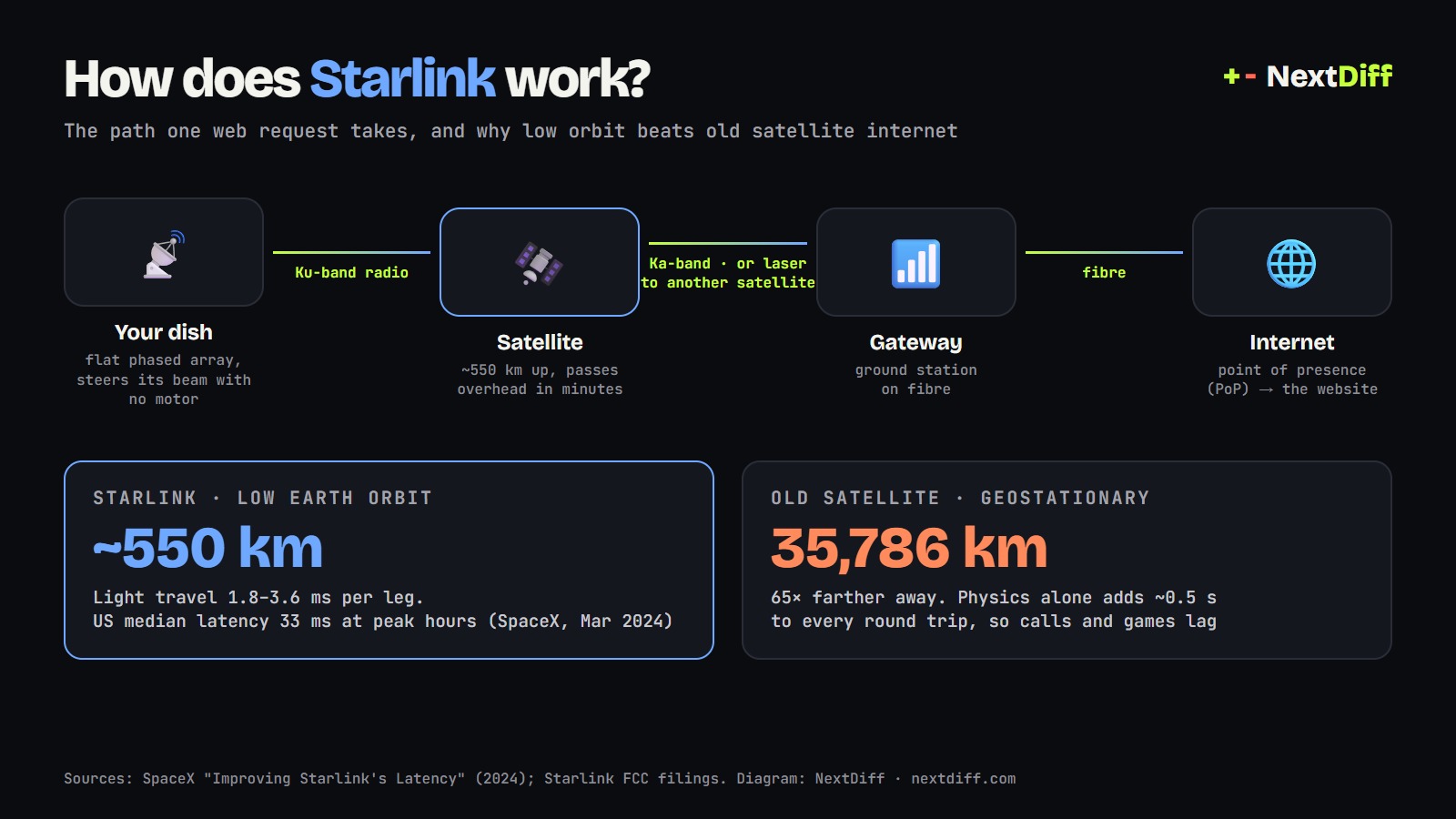 Diagram: NextDiff, based on SpaceX's "Improving Starlink's Latency" (2024).
The dish has no moving parts to aim
A normal satellite dish must point at one fixed spot in the sky. Starlink's dish can't do that, because its satellites never stay in one place. Instead it is a phased array: a grid of many tiny antennas that steer the radio beam electronically by shifting the timing of each one's signal. The beam follows a satellite across the sky and jumps to the next one with no motor. That is why the dish is a flat rectangle, not a bowl.
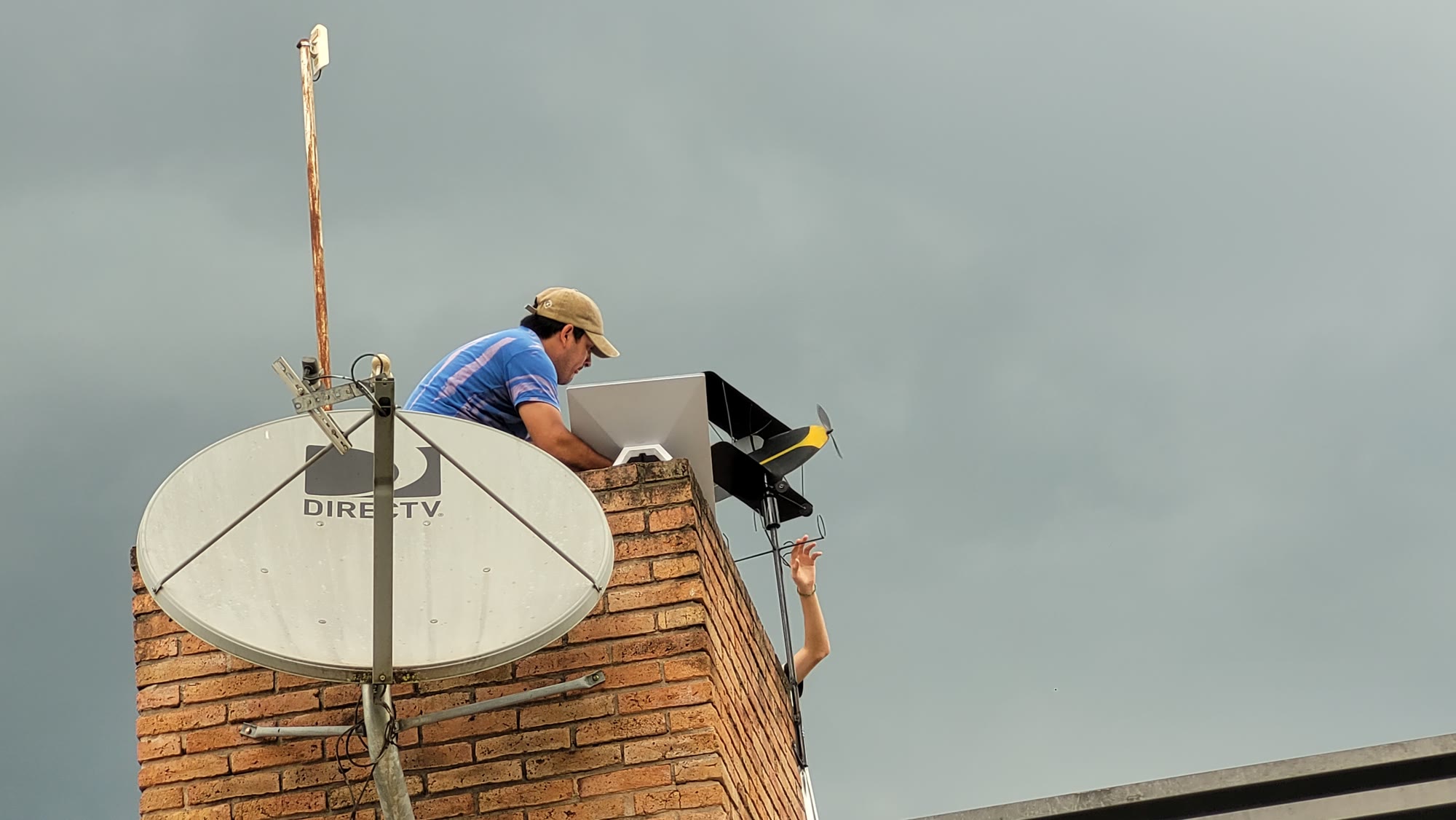 Image: Horacio Cambeiro (CC BY 4.0, via Wikimedia Commons). A Starlink flat dish going up next to an old geostationary TV dish in Misiones, Argentina.
Why low orbit matters: Starlink vs old satellite internet
Older satellite internet uses a few large geostationary satellites parked 35,786 km above the equator. They seem fixed in the sky, which makes aiming simple. But the distance is huge: light alone needs about half a second to make a round trip up and down twice. Video calls stutter and online games are close to unplayable.
Starlink's satellites orbit about 65 times closer. SpaceX says light travel takes just 1.8–3.6 ms per leg, usually under 10 ms for the round trip. In March 2024 it reported a US median latency of 33 ms during evening peak hours, down from 48.5 ms, with a stated goal of 20 ms. The trade-off is scale. Each low satellite covers a small patch of Earth and is soon out of view, so you need thousands of them, not three.
| Starlink (low Earth orbit) | Geostationary satellite internet | Fibre broadband | |
|---|---|---|---|
| Distance to the signal path | ~550 km up | 35,786 km up | a cable in the ground |
| Typical latency | tens of milliseconds (33 ms US median, 2024) | ~600 ms+ | ~5–20 ms |
| Satellites needed | thousands (~11,000 in orbit) | a handful | none |
| Works where | almost anywhere with a clear sky view | most places with a sky view | only where cable is laid |
| Main weakness | crowding at busy times, sky obstructions, cost | lag | not available in remote areas |
Examples: who uses Starlink, with numbers
- Homes in rural areas. This is the core market. Starlink broadband is available in about 160 countries and territories, and Wikipedia's tally, citing SpaceX, puts it at 13.6 million subscribers as of 30 September 2026. SpaceX thanked "2.6M+ customers" in March 2024, so the base has grown about fivefold in two and a half years.
- Vehicles, boats and planes. Flat-panel dishes work on the move, on RVs, ships and airliners.
- Phones with no dish. The Starlink direct-to-cell service lets ordinary phones send texts, and increasingly use data, via satellites where no tower reaches, starting with T-Mobile in the US.
- Disaster zones and remote sites. A dish and a power source can bring a whole area online in hours.
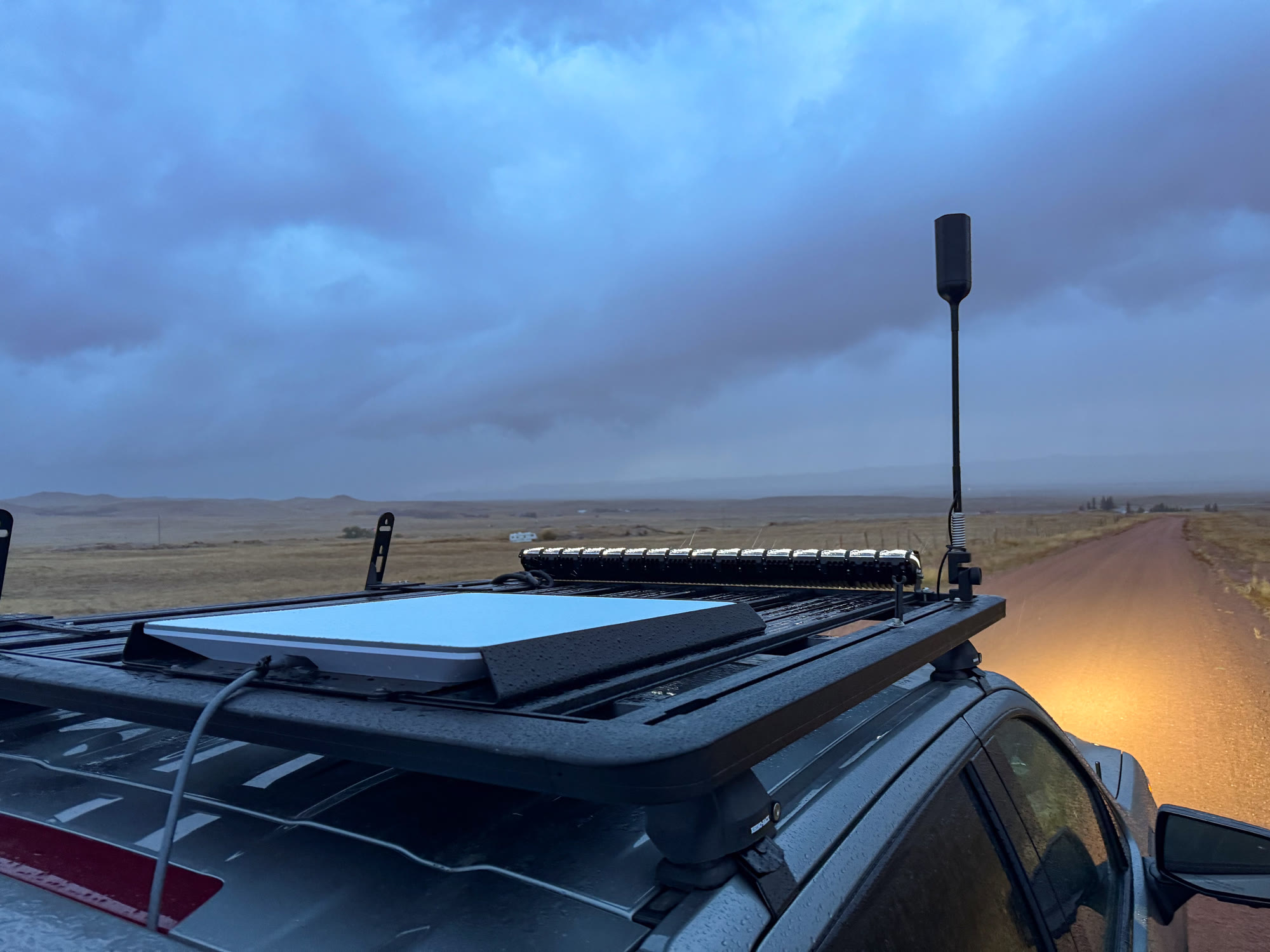 Image: Tony Webster (CC BY 2.0, via Wikimedia Commons). A flat-panel Starlink dish on a truck roof rack.
Why it matters, and who it's for
Hundreds of millions of people live where laying fibre or building towers never made business sense. Starlink makes the satellite the cell tower, so coverage depends on having a clear view of the sky, not on cables. For India, the question is price. As of October 2026, reports say Starlink has its GMPCS licence and IN-SPACe authorisation but is still waiting on spectrum and final security clearance. It has not announced Indian prices. Elon Musk has promised "affordable" pricing to compete with Jio and Airtel, both of which are also launching satellite services.
Common misconceptions
- "Satellite internet is always laggy." That was true of geostationary systems. Low orbit cuts the distance by about 65 times, and latency with it.
- "The dish needs to point at one satellite." It points at a patch of sky and steers its beam electronically between many satellites.
- "It works anywhere, even indoors." It needs a clear view of the sky. Trees, walls and roofs block the signal.
- "Lasers make it faster than fibre." Light in a vacuum is faster than in glass, but SpaceX says laser routing can add latency when traffic takes a longer path. Fibre still wins on latency where it exists.
- "Starlink trains are UFOs." The bright line of dots people film after a launch is a fresh batch of satellites raising their orbits. It fades within days.
 Image: Dktue (CC0, via Wikimedia Commons). A Starlink "train" crossing the sky above Tübingen, Germany.
Latest news
- Watching the sky? Starlink satellites often cross the frame during events like the Orionid meteor shower.
- SpaceX also builds the Starship lander at the heart of NASA's Moon plans: see our Artemis update.
- Elon Musk's other big hardware bet this month: the Tesla Roadster 2026 and its 'flying' demo.
Questions readers ask
- How does Starlink work in simple terms?
- A dish on your roof sends data by radio to a Starlink satellite passing overhead about 550 km up. The satellite relays it to a ground station connected to the internet, or to other satellites by laser, and the reply comes back the same way.
- How does Starlink work at home?
- You place the dish outside with a clear view of the sky and plug it into the Starlink router. The dish finds satellites automatically and the router gives you normal Wi-Fi inside the house.
- Does Starlink work in bad weather?
- Mostly yes. Heavy rain or snow can weaken the radio signal and slow it down or cause brief drops, and dishes have heaters to melt snow. Trees and buildings blocking the sky cause more problems than weather does.
- Is Starlink faster than fibre?
- Usually not. Fibre has lower latency and more consistent speeds where it is available. Starlink's advantage is coverage: it works in places fibre and mobile towers do not reach.
- Is Starlink available in India?
- Not yet, as of October 2026. Reports say Starlink has its GMPCS licence and IN-SPACe authorisation but is still waiting for spectrum and final security clearance, and it has not announced Indian prices.
+ Sources
- SpaceX — Improving Starlink's Latency (2024)
- Wikipedia — Starlink (satellite count, subscribers, orbits)
- Wikipedia — Geostationary orbit
- Wikipedia — Phased array
- Outlook Business — Starlink India prices may be far lower than "dummy" preview
- Khaleej Times — Musk vows affordable Starlink in India
- Handley (UCL), HotNets 2018 — Delay is Not an Option: Low Latency Routing in Space
+ Rate this story
Get stories like this on your phone, the minute they drop.
 Scan with your Android phone


The Weekly Diff launches soon.
Subscribe on YouTubeKeep reading