Orionid meteor shower 2026 peaks tonight: best time to watch from India
Halley's Comet dust lights up the pre-dawn sky on 21–22 October, but a bright Moon means the real show starts only after moonset, around 2:30 AM IST in most cities.
The Orionid meteor shower 2026 peaks on the night of 21–22 October, NASA says, with 10 to 20 meteors an hour from a dark site. The meteors are dust from Halley's Comet. A Moon about 80% lit hides faint ones, so in India the best window is after moonset, roughly 2:30 to 5 AM IST.
The Orionid meteor shower 2026 peaks tonight, on the night of 21–22 October, according to NASA. Under a dark sky you can expect 10 to 20 shooting stars an hour. This year has a catch, though: a bright Moon. From India, the best viewing starts only after the Moon sets, which is between about 2:20 and 2:50 AM IST in most big cities, and lasts until the sky starts to brighten at around 5 AM.
Our 43-second version, with the best viewing times:
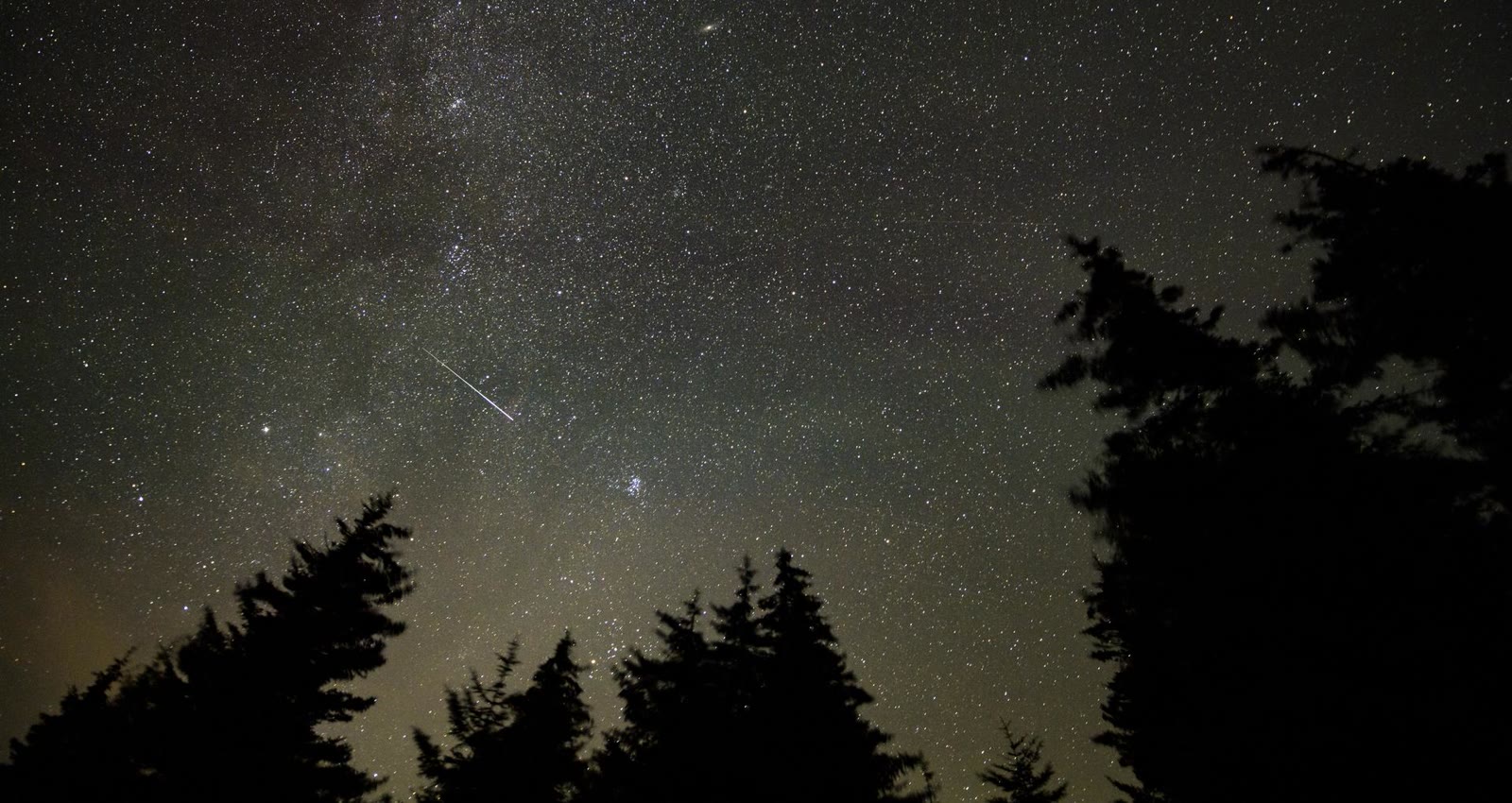 A meteor over Spruce Knob, West Virginia, during the 2021 Perseids. Image: NASA/Bill Ingalls (public domain)
When is the Orionid meteor shower 2026 peak?
NASA puts the peak on the night of 21–22 October, with the shower active from 2 October to 7 November. The American Meteor Society also lists 21–22 October, and the International Meteor Organization gives a peak rate (ZHR) of about 20 an hour.
The Orionids have a broad maximum, so the nights just before and after are almost as good. EarthSky's prediction puts the exact peak a little later, early on 23 October UTC, which makes the night of 22–23 October a good backup if tonight is cloudy.
Best time to watch from India
The Moon is the problem this year. It is a waxing gibbous, about 80% lit on the peak night (full Moon is on 26 October), and its glare drowns out the fainter meteors. NASA's own advice is to watch in the hours before dawn, after the Moon has set.
We worked out the moonset and dawn times for six Indian cities on the morning of 22 October. The "dark window" runs from moonset until astronomical dawn, when the sky starts to brighten.
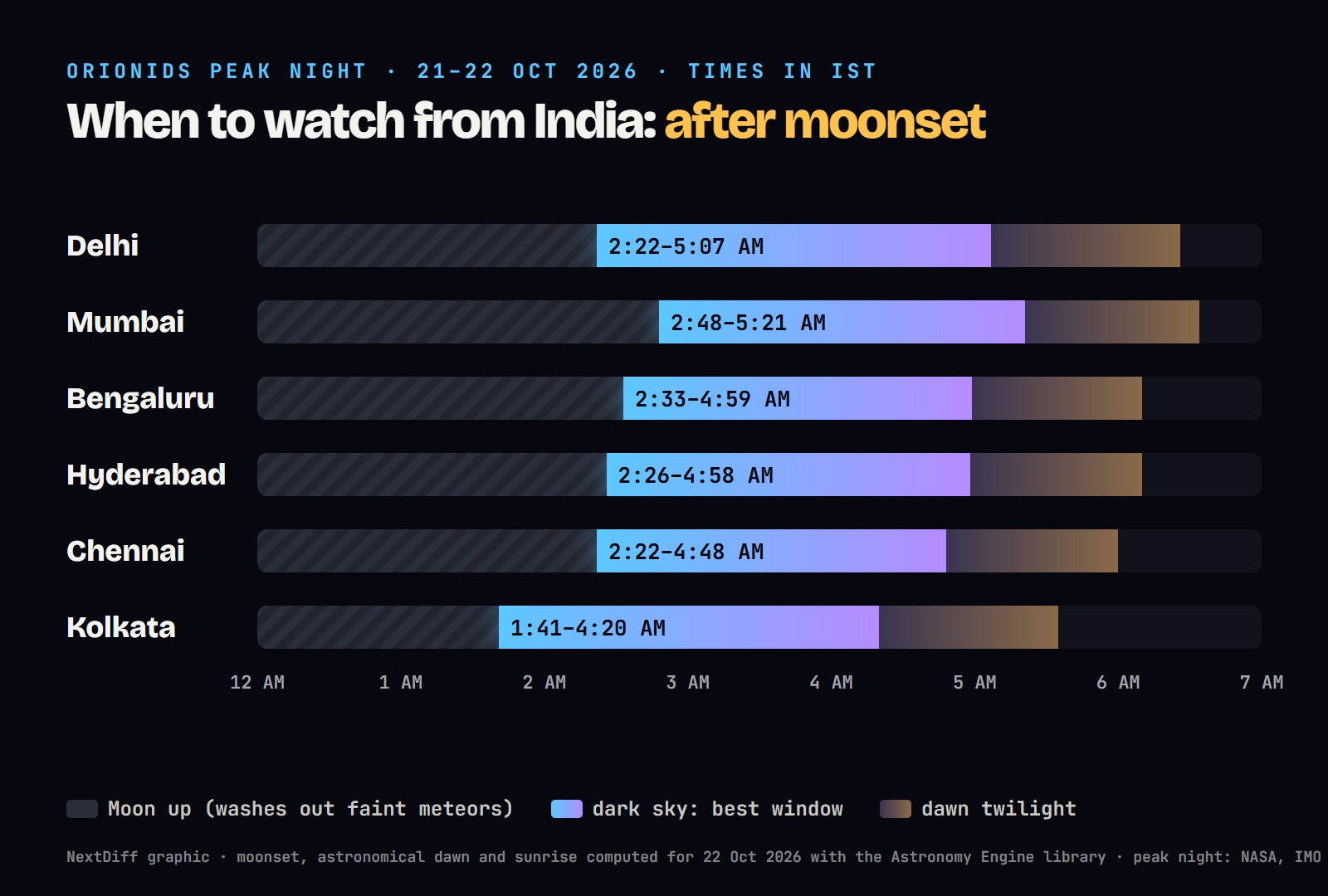 NextDiff graphic. Times computed with the open-source Astronomy Engine library.
| City | Moonset (IST) | Dark sky until | Sunrise |
|---|---|---|---|
| Delhi | 2:22 AM | 5:07 AM | 6:26 AM |
| Mumbai | 2:48 AM | 5:21 AM | 6:34 AM |
| Bengaluru | 2:33 AM | 4:59 AM | 6:10 AM |
| Hyderabad | 2:26 AM | 4:58 AM | 6:10 AM |
| Chennai | 2:22 AM | 4:48 AM | 6:00 AM |
| Kolkata | 1:41 AM | 4:20 AM | 5:35 AM |
That gives most of India about two and a half hours of dark sky. If you miss tonight, the Moon sets about an hour later each night, so the dark window shrinks: on the morning of 23 October Delhi's moonset is about 3:20 AM.
Where to look
Face east. The meteors appear to come from a point called the radiant, just north of Betelgeuse, the bright orange star in Orion. NASA's sky chart shows it for around 2 AM on 22 October.
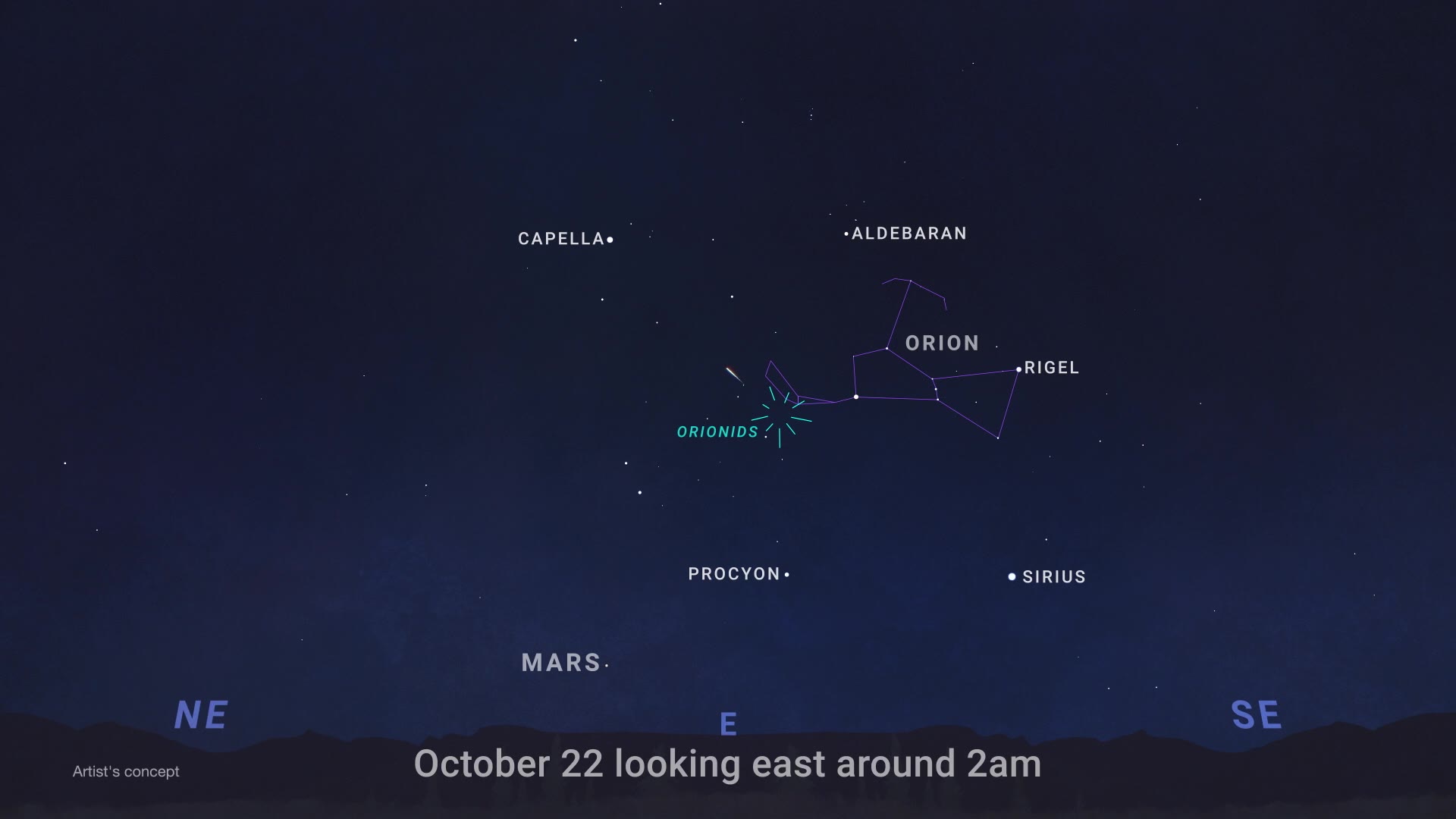 NASA's chart is drawn for mid-northern latitudes; from India, Orion stands a little higher in the east. Image: NASA/JPL-Caltech, "What's Up: October 2026"
You don't need to stare at the radiant. NASA notes that meteors look longer and more dramatic 45 to 90 degrees away from it, so take in a wide patch of sky.
A quick checklist:
- Get away from street lights. Even a dark rooftop beats a lit balcony.
- Lie back on a mat or reclining chair so your neck doesn't give up first.
- Give your eyes about 30 minutes in the dark, and avoid looking at your phone.
- No telescope or binoculars: they show too little sky. Your eyes are the right tool.
- Check the cloud forecast before you plan a long drive.
How does a meteor shower work?
Every shooting star in this shower is a speck of dust from Halley's Comet. Each time Halley swings past the Sun, roughly every 76 years, it sheds dust along its orbit. Earth crosses that trail of debris every October.
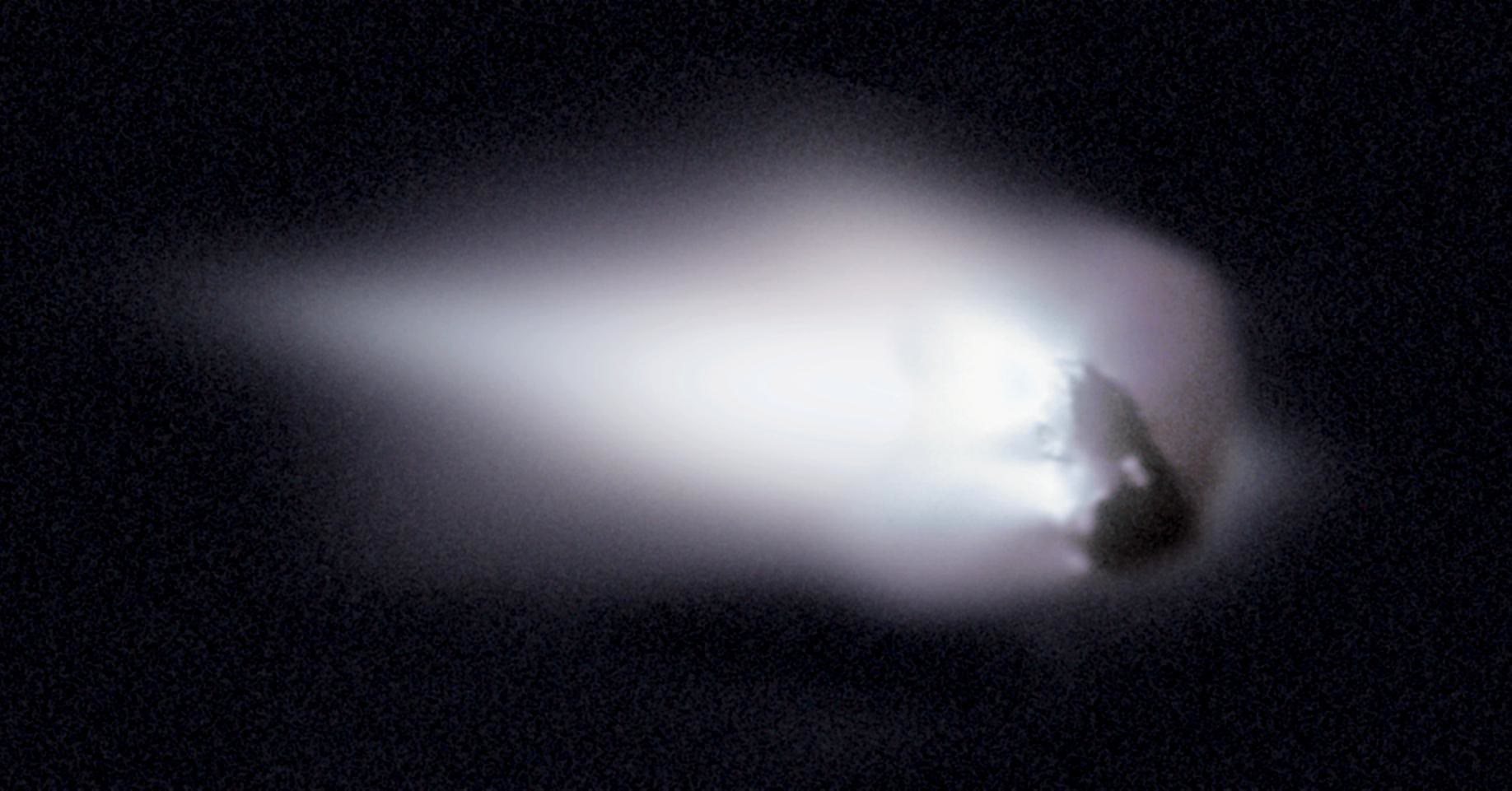 Halley's Comet nucleus, seen by the Giotto spacecraft in 1986. Image: NASA/ESA/Giotto Project
The grains hit the upper atmosphere at about 66 kilometres per second (41 miles per second), according to NASA. That is fast enough to heat the air around them until it glows, which is the streak you see. Because the Orionids are so fast, some leave glowing trails that linger for a few seconds, and now and then one flares into a fireball.
Halley itself was last seen from Earth in 1986 and won't come back to the inner solar system until 2061. Its dust, though, shows up every year. If you liked this, read how ESA's Euclid telescope found a new comet by accident.
Why it matters, and what to expect
Meteor showers are among the few sky events you can watch with no gear at all, from almost anywhere. The Orionids are a medium-strength shower: in a normal year the IMO expects 10 to 20 meteors an hour at best, and that number assumes a perfectly dark sky with the radiant overhead. From a city with moonlight you may see only a handful an hour.
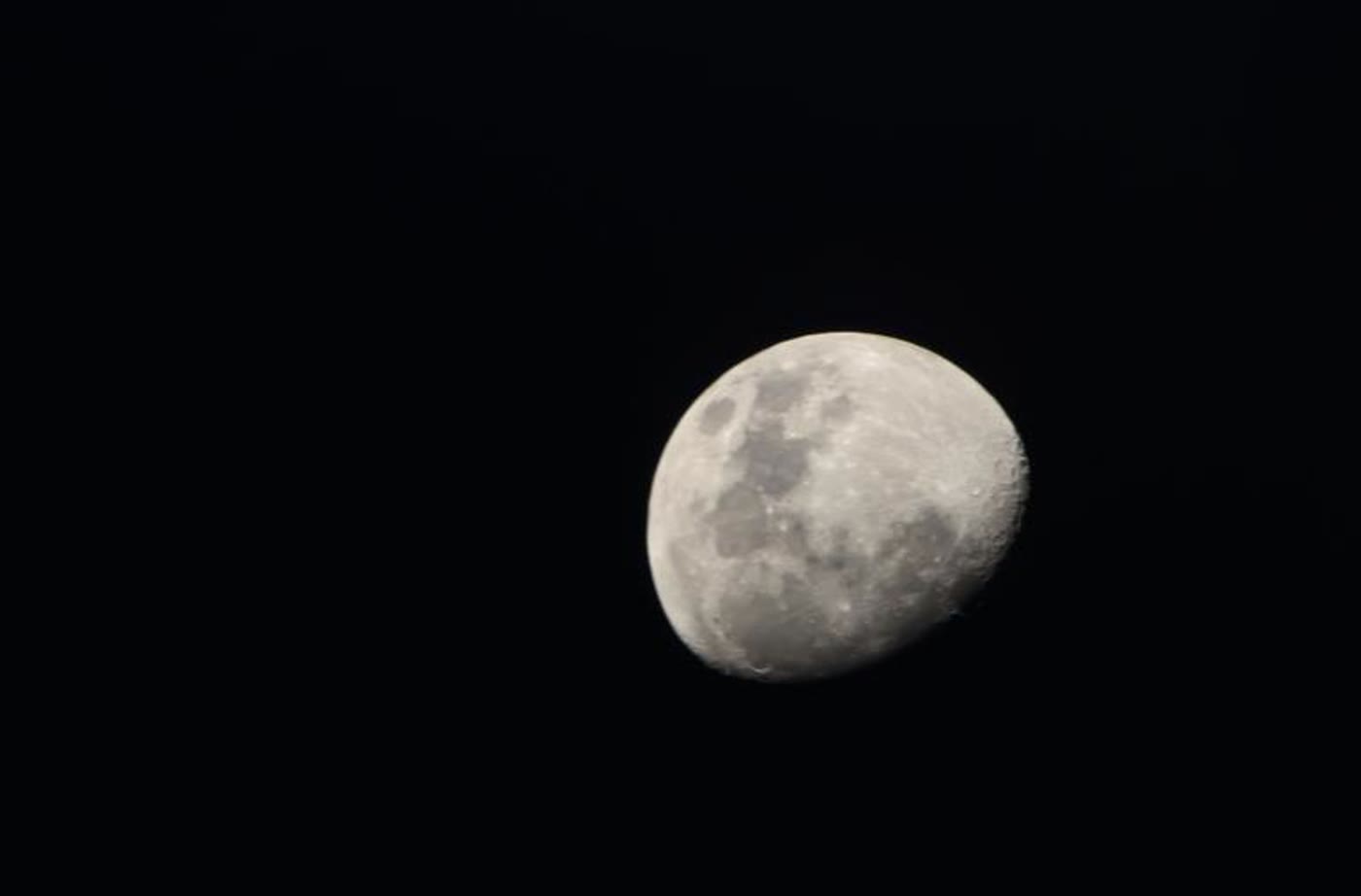 A waxing gibbous Moon, photographed from the International Space Station. Image: NASA
So set expectations: go late, go dark, and be patient. Ten quiet minutes with nothing can be followed by two meteors in a row.
What's next
The shower keeps going until 7 November at lower rates. The next big one is the Geminids in mid-December, usually the strongest shower of the year. Halley's other debris stream gives the Eta Aquariids in May.
Questions readers ask
- When is the Orionid meteor shower 2026 peak?
- NASA puts the peak on the night of 21–22 October 2026. The shower is active from 2 October to 7 November, and the night of 22–23 October is also good.
- What time can I see the Orionid meteor shower in India?
- After moonset and before dawn. On 22 October the Moon sets around 2:20–2:50 AM IST in Delhi, Mumbai, Bengaluru, Hyderabad and Chennai (1:41 AM in Kolkata), and the sky stays dark until about 4:20–5:20 AM.
- Which direction should I look for the Orionids?
- Face east, towards the constellation Orion. The radiant is just north of the bright star Betelgeuse, but meteors can appear anywhere, so scan a wide area of sky.
- How many meteors per hour will the Orionids show?
- About 10 to 20 an hour from a dark site, according to NASA and the International Meteor Organization. A bright Moon and city lights will cut that number in 2026.
- Do I need a telescope to see the Orionid meteor shower?
- No. Meteors move fast across large areas of sky, so your naked eyes work best. Find a dark spot and let your eyes adjust for about 30 minutes.
+ Sources
- NASA — Orionids (meteors and meteorites)
- NASA/JPL — What's Up: October 2026 skywatching tips
- American Meteor Society — Meteor shower calendar 2026–2027
- International Meteor Organization — Meteor shower calendar
- EarthSky — Orionid meteor shower 2026
- Space.com — How to see the Orionid meteor shower 2026 peak
- Business Today — Orionid meteor shower peaks on October 21–22: plan a skywatching night in India
+ Rate this story
Get stories like this on your phone, the minute they drop.
 Scan with your Android phone


The Weekly Diff launches soon.
Subscribe on YouTubeKeep reading