Euclid new comet: ESA telescope finds C/2026 S1 by accident, 1.3 billion km away
A Helsinki PhD student's software caught a moving streak in Euclid's dark-matter survey images. The Minor Planet Center confirmed it as a new comet on 8 October.
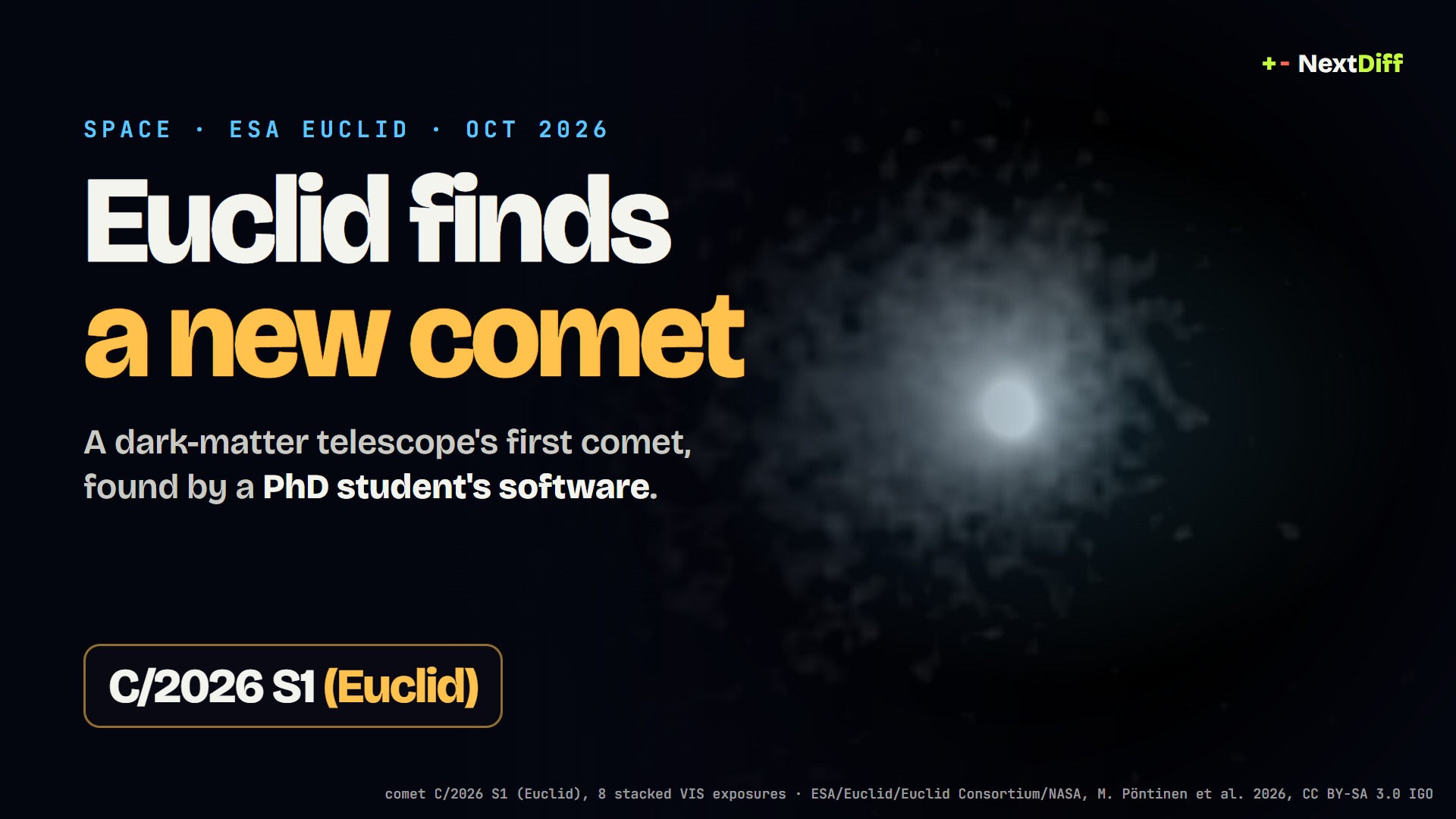
ESA said on 19 October 2026 that its Euclid space telescope found its first new comet, C/2026 S1 (Euclid), in images from 16 to 24 September. University of Helsinki PhD student Mikko Pöntinen's software spotted it about 1.3 billion km from Earth. The Minor Planet Center confirmed it on 8 October.
Europe's Euclid space telescope was built to map dark matter, not to hunt comets. It found one anyway. The European Space Agency says Euclid has made its first discovery of a previously unknown comet, now named C/2026 S1 (Euclid). The new comet turned up in images taken between 16 and 24 September 2026, about 1.3 billion kilometres from Earth, and the International Astronomical Union's Minor Planet Center confirmed it on 8 October. ESA announced the find on 19 October.
The person behind it is Mikko Pöntinen, a PhD student at the University of Helsinki. He wrote the software that spotted the comet as a streak in Euclid's pictures.
Our 48-second version, with the real Euclid images of the comet:
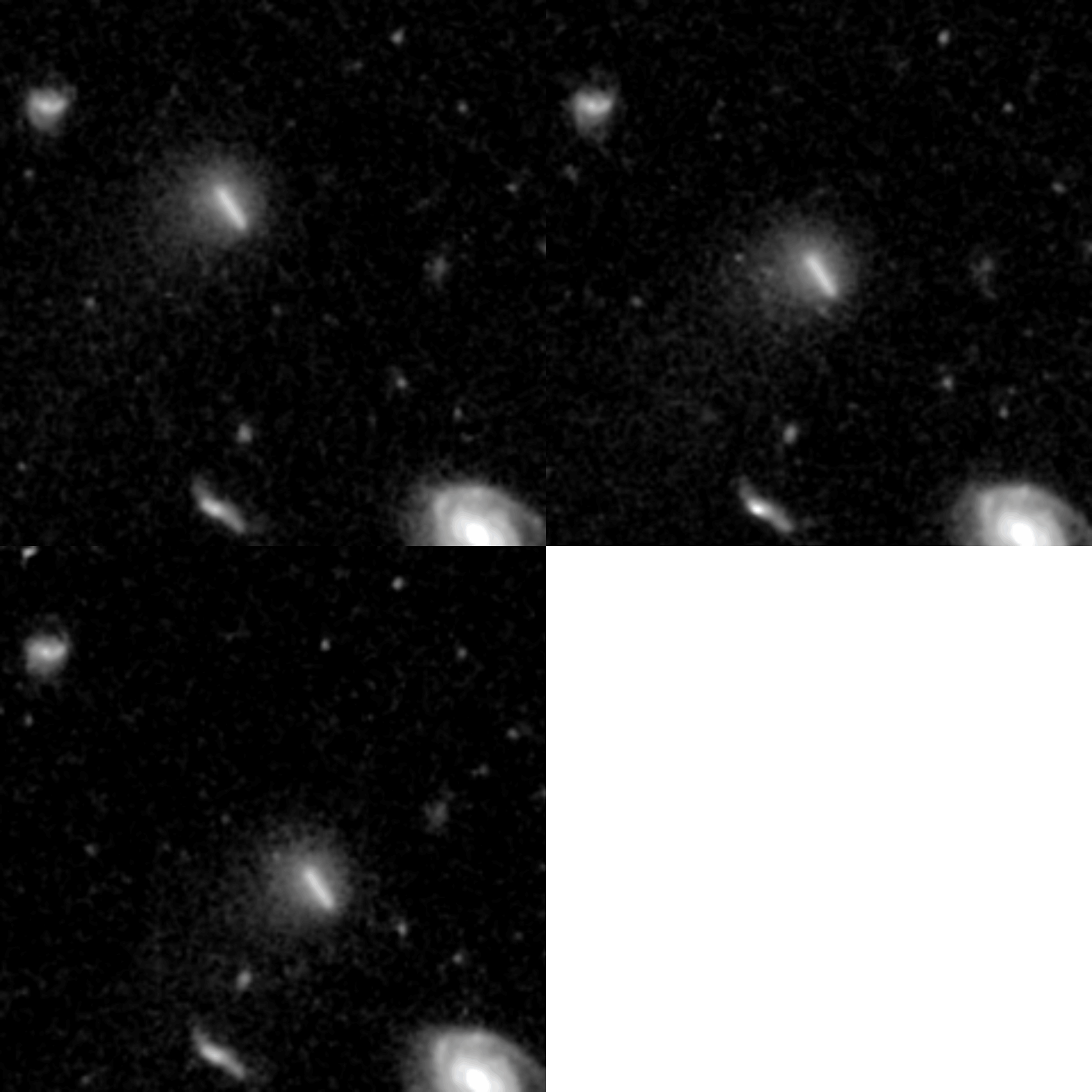 Image: ESA/Euclid/Euclid Consortium/NASA, M. Pöntinen et al. 2026 (CC BY-SA 3.0 IGO). Three exposures taken on 17 September 2026, each 560 seconds long.
How did Euclid find a new comet?
Euclid photographs huge patches of sky to measure the shapes of billions of distant galaxies. Most of what it sees sits still. A comet does not.
Pöntinen works for the Solar System Objects Science Working Group of the Euclid Consortium. He built moving-object detection software to pick out small Solar System bodies in Euclid's images. In the Euclid Deep Field North, it flagged an object that had smeared into a short line across several long exposures. "I was excited to see my software flag a 'streak' smeared across several images – the result of a fast-moving object," Pöntinen said in ESA's release.
He then predicted where the object should be in other image sets and found it again. In total it appeared in five fields of view and 16 exposures. Up close, the streak was wrapped in a fuzzy cloud. That cloud is a coma, the gas and dust a comet sheds as its ice warms. It meant the object was an active comet, not an asteroid.
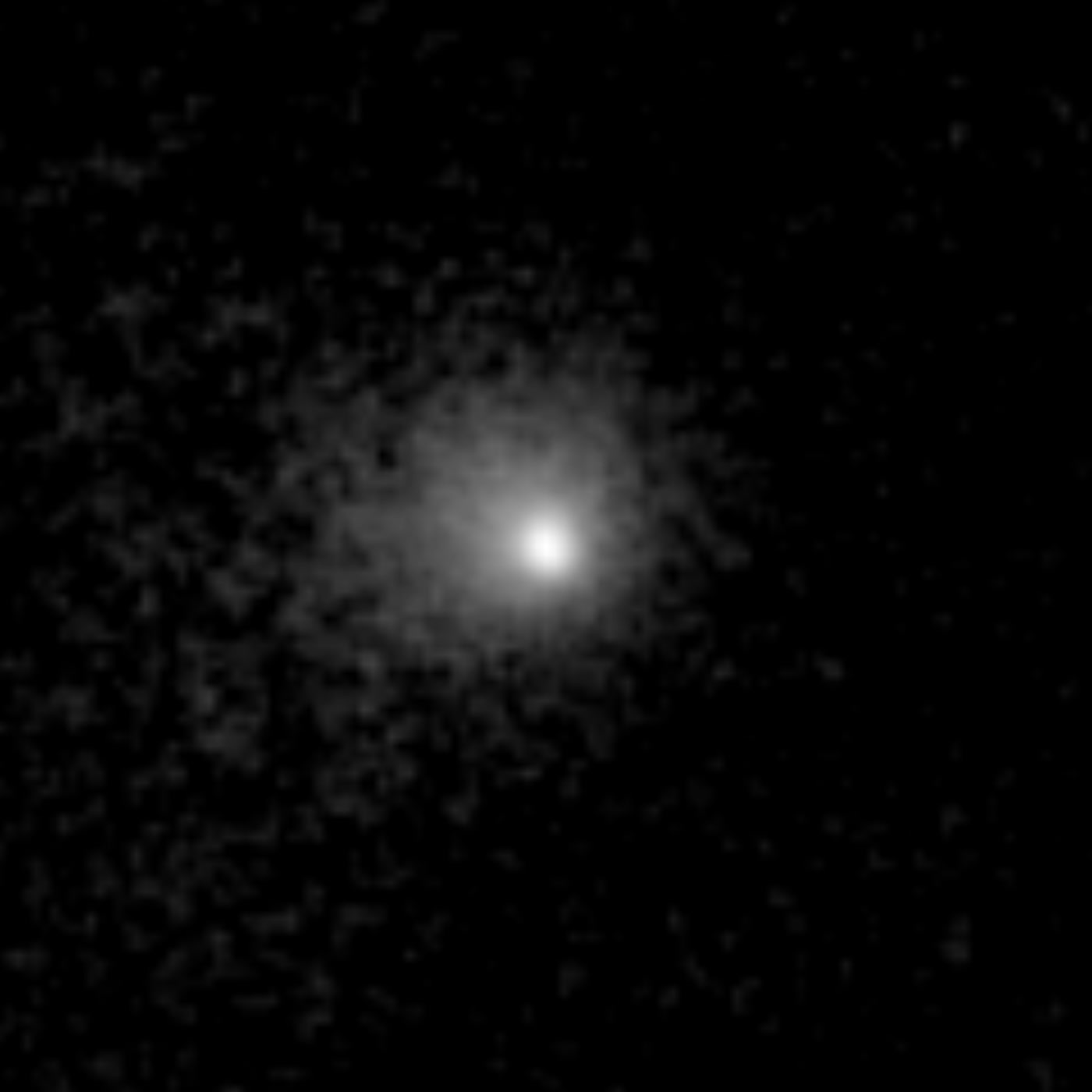 Image: ESA/Euclid/Euclid Consortium/NASA, M. Pöntinen et al. 2026 (CC BY-SA 3.0 IGO). Eight 89.5-second exposures aligned on the comet, with background objects removed.
The team checked catalogues of known comets and asteroids and found no match. Pöntinen reported it to the Minor Planet Center as a new comet (MPEC K26/TE6). Ground-based astronomers added follow-up observations, and the centre confirmed it on 8 October.
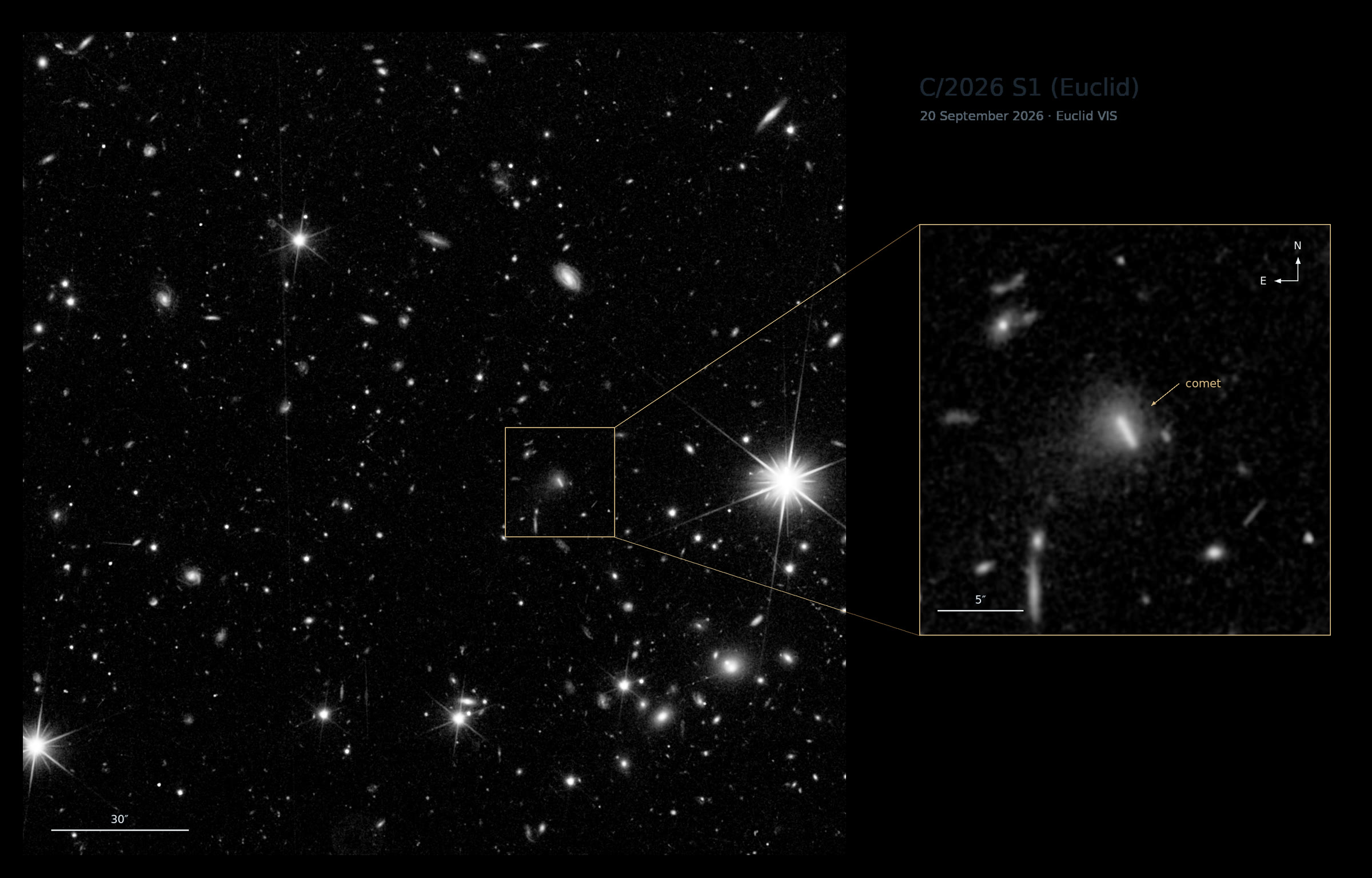 Image: ESA/Euclid/Euclid Consortium/NASA, M. Pöntinen et al. 2026 (CC BY-SA 3.0 IGO). Taken on 20 September 2026.
What does C/2026 S1 (Euclid) mean?
Comet names follow IAU rules, and each part tells you something:
- C/ marks a non-periodic comet, one whose orbit takes more than 200 years.
- 2026 is the year of discovery.
- S is the half-month code. S covers 16 to 30 September.
- 1 means it was the first comet found in that half-month.
- (Euclid) names the discoverer, here the telescope.
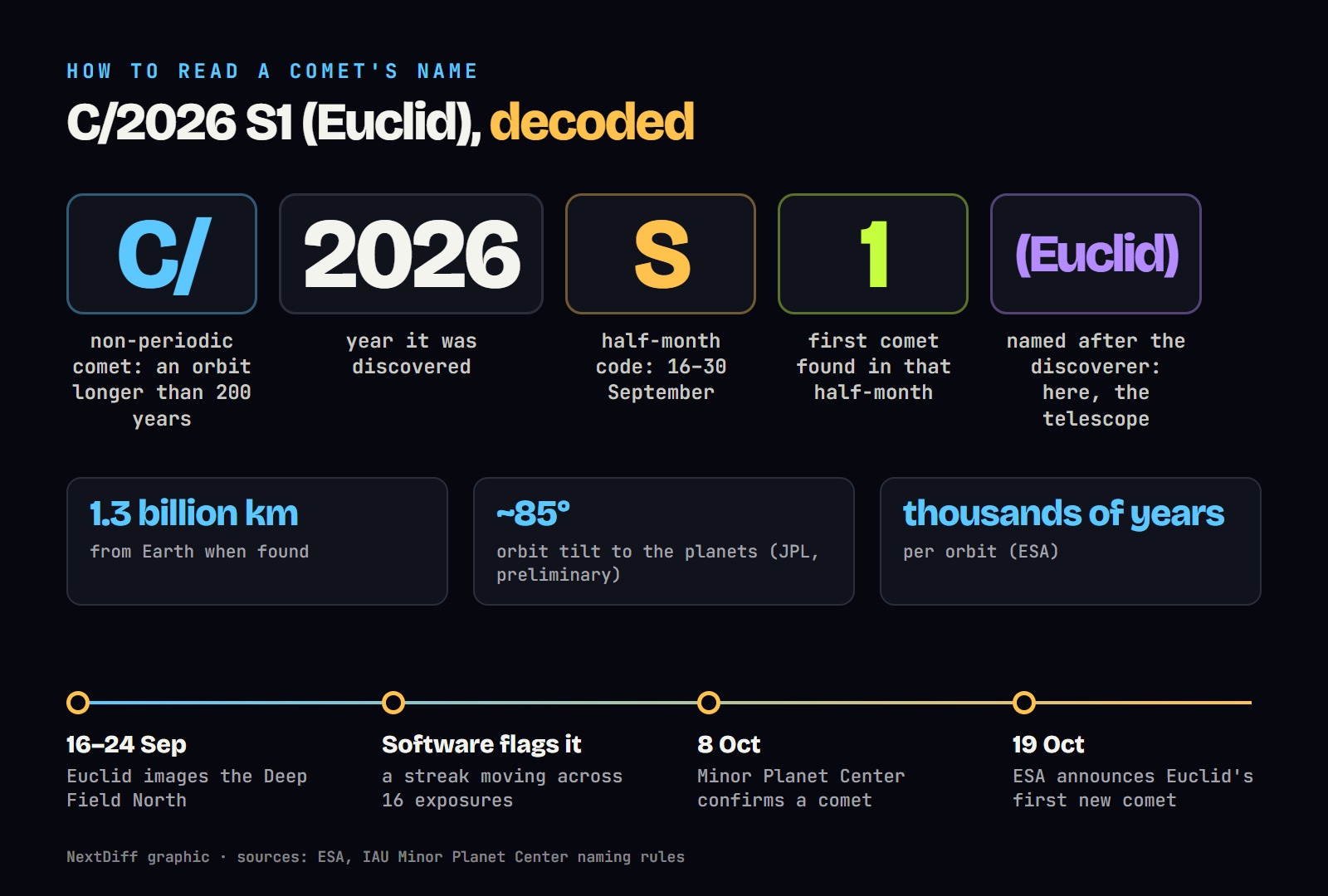 Graphic: NextDiff, from ESA, the Minor Planet Center and NASA/JPL data.
Where is the comet going?
ESA says the comet does not travel in the plane of the planets. Seen from the Sun, it is currently "straight up" above that plane, on an orbit that takes thousands of years to complete. The agency says the orbital period will be refined as more data comes in.
NASA JPL's Small-Body Database has a preliminary orbit from 56 observations over 27 days. It puts the tilt at about 85 degrees to the planets. The comet should make its closest approach to the Sun around September 2027, at about 8.7 times the Earth–Sun distance. That is roughly as far out as Saturn. JPL's figures also show the comet never comes close to Earth's orbit. Early orbits like this often change as more observations arrive.
Why it matters
Very few comets were expected from Euclid. "Very few comets are expected to be discovered by Euclid so it was a happy coincidence," said Bruno Altieri, Euclid Archive Scientist and a member of the discovery team.
There are two reasons comets are rare for Euclid. First, it avoids the band of sky along the plane of the Solar System, where dust glare would spoil its galaxy measurements. Second, its "step-and-stare" survey usually visits each patch of sky only once, so it cannot go back to check a suspect.
The find still shows that Euclid can catch comets while they are far from the Sun, before they brighten. And the tracking software has a second job: spotting moving objects helps the team clean comet trails and stray light out of images meant for mapping galaxies. "We are of course happy to have discovered a previously unknown comet for the Solar System community to follow up on," said Euclid Project Scientist Valeria Pettorino.
What's next, and the caveats
- The orbit is provisional. Its period and future path will sharpen as telescopes keep tracking it.
- No mission is planned. ESA says C/2026 S1 is not a suitable target for its future Comet Interceptor mission.
- Size and brightness weren't given. ESA's release does not say how big the nucleus is or whether amateurs can see it.
Euclid itself has years of surveying left. It launched in July 2023 to observe billions of galaxies out to 10 billion light-years and chart how dark matter and dark energy shape the Universe. With Pöntinen's software now running on its images, this is unlikely to be the last surprise in the data.
For another hidden science story we covered this week, see how lab-grown brain organoids read Braille.
Questions readers ask
- What is comet C/2026 S1 (Euclid)?
- It is the first previously unknown comet discovered by ESA's Euclid space telescope. It was found in images taken between 16 and 24 September 2026 and confirmed by the Minor Planet Center on 8 October 2026.
- Who discovered the new Euclid comet?
- Mikko Pöntinen, a PhD student at the University of Helsinki, made the initial discovery for the Euclid Consortium's Solar System Objects Science Working Group, using moving-object detection software he developed.
- Is comet C/2026 S1 (Euclid) a danger to Earth?
- No. NASA JPL's preliminary orbit keeps it out near Saturn's distance from the Sun at its closest, around September 2027, and its orbit never comes close to Earth's.
- Can I see comet C/2026 S1 (Euclid) with a telescope?
- ESA has not said it will be visible to amateurs. It was about 1.3 billion km from Earth when found, and follow-up so far has come from professional ground-based telescopes.
- What does the S1 in C/2026 S1 mean?
- S is the half-month code for 16 to 30 September, and 1 means it was the first comet found in that half-month. C/ marks a non-periodic comet, and (Euclid) names the discoverer.
+ Sources
- ESA — Euclid discovers new comet (19 Oct 2026)
- Minor Planet Center — MPEC K26/TE6: COMET C/2026 S1 (Euclid)
- NASA JPL Small-Body Database — C/2026 S1 (Euclid)
- Phys.org — Euclid discovers its first new comet 810 million miles from Earth
- Universe Today — The ESA's Euclid Space Telescope Has Discovered A New Comet
- Popular Science — New comet accidentally discovered by space telescope
- ESA — Comet C/2026 S1 (Euclid) images (CC BY-SA 3.0 IGO)
+ Rate this story
Get stories like this on your phone, the minute they drop.
 Scan with your Android phone


The Weekly Diff launches soon.
Subscribe on YouTubeKeep reading