Is Figma done? Why Indian product teams are looking at homegrown design tools
Figma isn't going anywhere, but Adobe's 2019 Venezuela shutdown showed how fast a foreign tool can disappear. With 21.9 million developers on GitHub, India has reason to own more of its design stack.
Is Figma done? No. But a design tool can be switched off for a whole country: in 2019 Adobe deactivated every account in Venezuela to comply with US sanctions. With 21.9 million developers on GitHub and new data-protection rules, Indian teams have reasons to weigh homegrown, code-first design tools such as SketchXFlow alongside Figma.
Disclosure: SketchXFlow is made by KriyaXlabs, the company that also publishes NextDiff. We cover it the way we would cover any product: facts are sourced, claims are labelled as the company's, and we list what it can't do.
On October 7, 2019, designers in Venezuela got a notice from Adobe: every Adobe account in the country would be deactivated by October 28 so the company could comply with a US executive order, and users had three weeks to download their files (Silicon UK). Adobe later offered refunds and said it would restore service when the law allowed. Nobody had done anything wrong. Their tool simply answered to another country's government.
That is the uncomfortable question behind "is Figma done?" The short answer is no. The longer answer is that the tools a country's product teams depend on are a strategic choice, and India now has more reasons than most to make it deliberately.
Is Figma done?
No. Figma is still the default canvas for product design, its file format and plugins sit at the centre of how most teams hand designs to engineers, and nothing in this piece suggests that changes soon. What has changed is the ground around it.
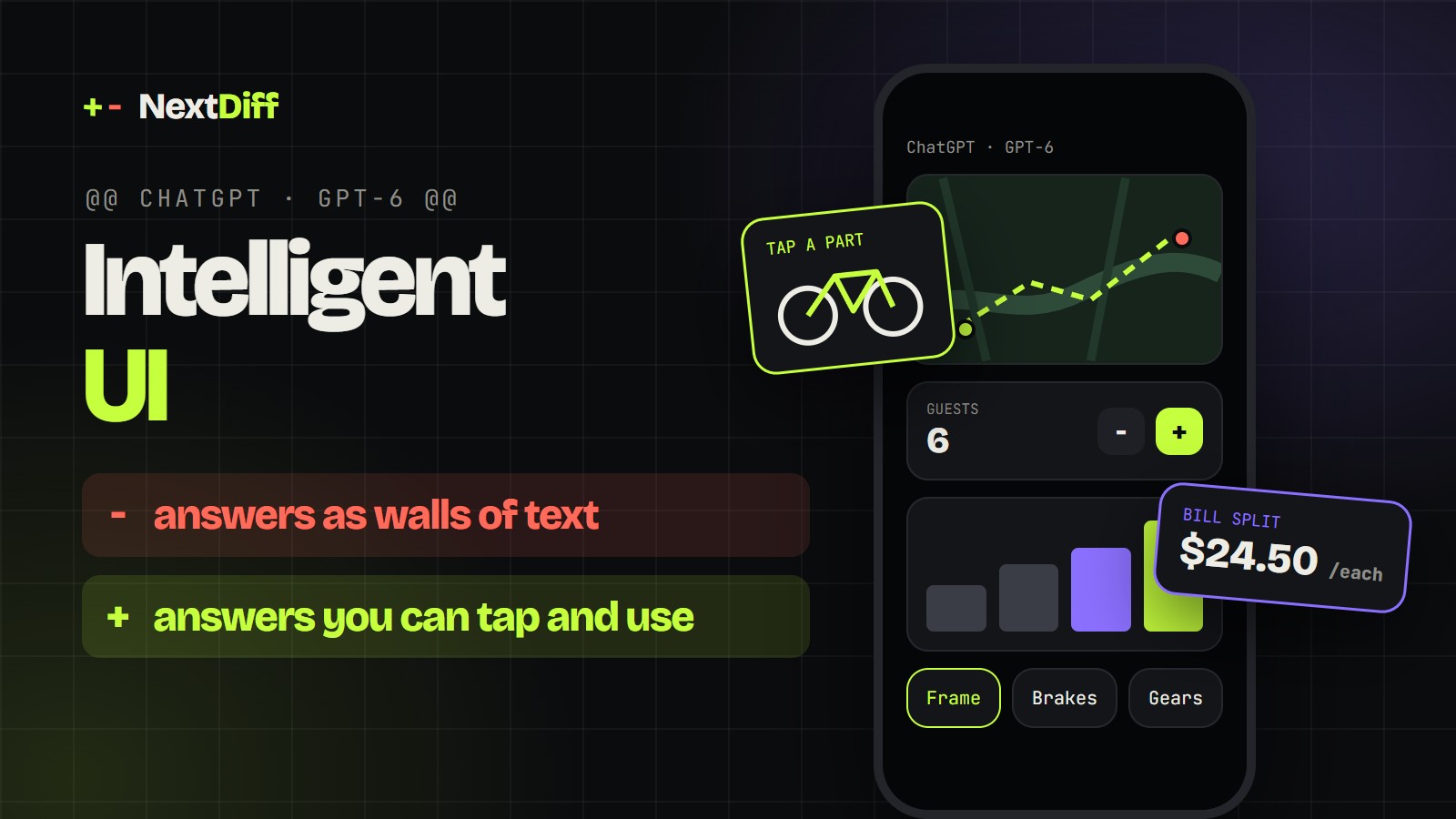
Two shifts are making teams look again. The first is dependency risk: a cloud design tool is a subscription to someone else's policies, prices and payment rails. The second is AI. Tools can now go from a written brief to a working, multi-page site with real code, which blurs the line between "design tool" and "website builder" and opens the door to new, often smaller, competitors. We saw the same move inside chat apps this week, when ChatGPT started building custom interfaces for its own answers.
What happened in Venezuela and Russia?
Venezuela is the clearest case. Adobe's 2019 shutdown covered every account in the country, from Creative Cloud to Acrobat, because of US Executive Order 13884. Designers who had built their work and careers on those apps had a deadline, not a choice.
Russia in 2022 was narrower. Figma's own policy, published on March 9, 2022, says it restricted accounts covered by US, UK or EU sanctions, stopped selling paid plans to new customers in Russia, and could not arrange payments after Visa and Mastercard suspended service there (Figma Help Center). Most individual users kept working, but teams could no longer simply pay for what they needed.
The lesson is not that these companies acted in bad faith. They followed the law of the country they are based in, as they must. It means your access to your own design files follows another country's foreign policy.
Why should India care?
Because of scale. India had 21.9 million developers on GitHub in 2025, up from 4.5 million in 2020, the second-largest population in the world. It added more than 5.2 million developers that year, more than any other country and over 14% of all new accounts. It now has the largest base of public and open-source contributors on GitHub, and GitHub projects 57.5 million Indian developers by 2030 (GitHub Octoverse 2025).
A builder base that big should not depend entirely on tools it cannot influence. It also creates a large home market for the people who build those tools.
There is a regulatory reason too. India's Digital Personal Data Protection Act, 2023 is now being switched on: the government notified its rules on November 14, 2025, with most obligations, including consent, security safeguards and breach reporting, taking effect in phases over about 18 months (The Week / PTI). Design files are not always just pictures. Prototypes often carry real names, real screenshots and real customer data, so where those files live becomes a compliance question, not just a preference.
What should "homegrown" actually mean?
"Made in India" alone is not a reason to switch tools. A homegrown design tool earns a place in your stack only if it passes three practical tests.
- Jurisdiction and data. Is the company governed by Indian law, and can you tell where your files and personal data are stored and who can be compelled to hand them over?
- Idea to code. Does it stop at a static mock-up that someone rebuilds by hand, or does it produce code your engineers can actually ship?
- Pricing and payments. Can an Indian startup pay for it the way it pays for everything else, with UPI, RuPay and GST invoices, without a foreign card and currency swings?
There is also a second route to independence that is not national at all: open source. Penpot, for example, is an open-source design tool that teams can host on their own servers. For some organisations, self-hosting will be the stronger form of sovereignty.
A homegrown example: SketchXFlow
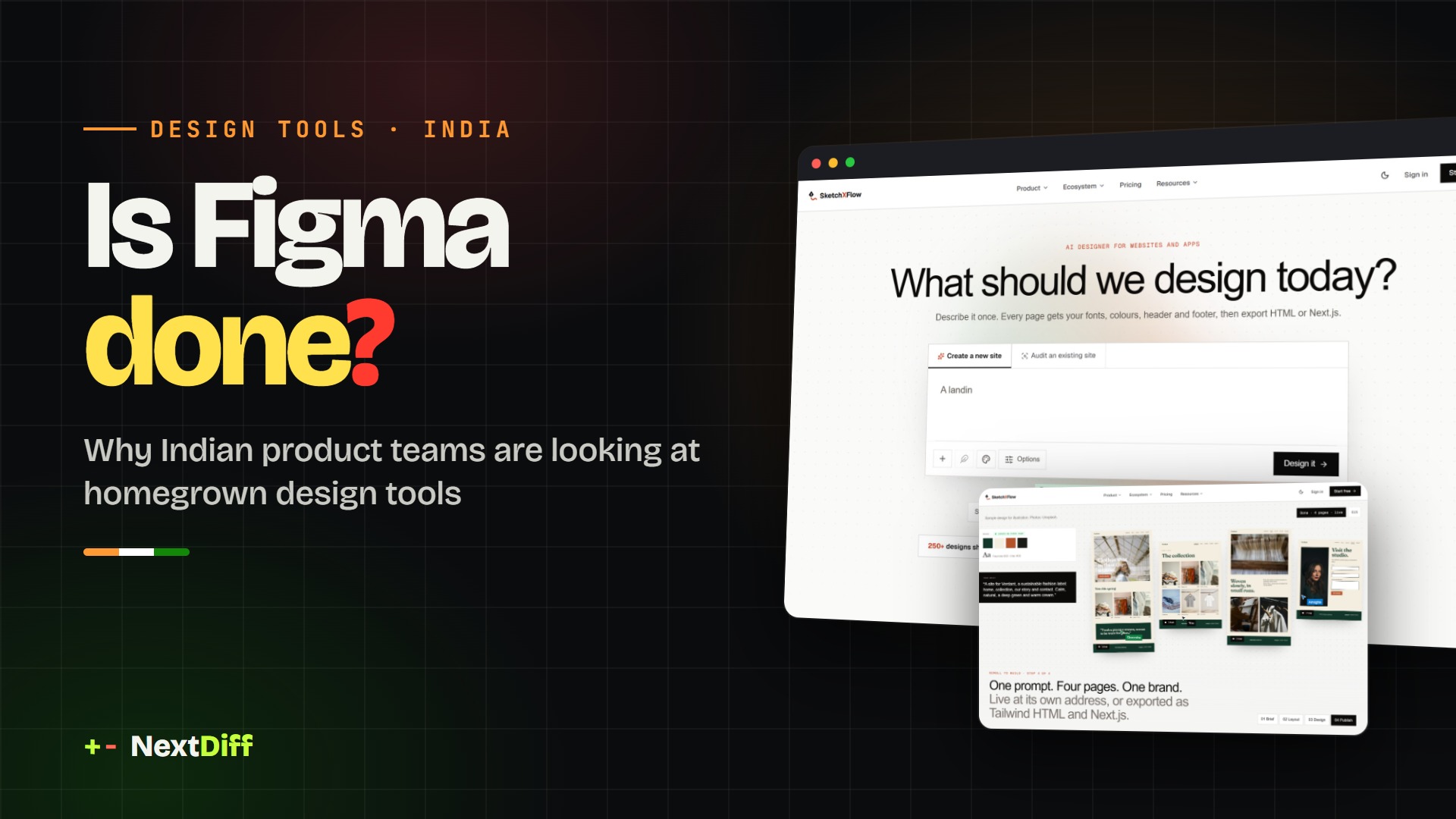
SketchXFlow is an AI design tool built by KriyaXlabs in Mangaluru, Karnataka. Its pitch is narrower than Figma's: describe a site once, and it designs every page on one consistent brand, then gives you code.
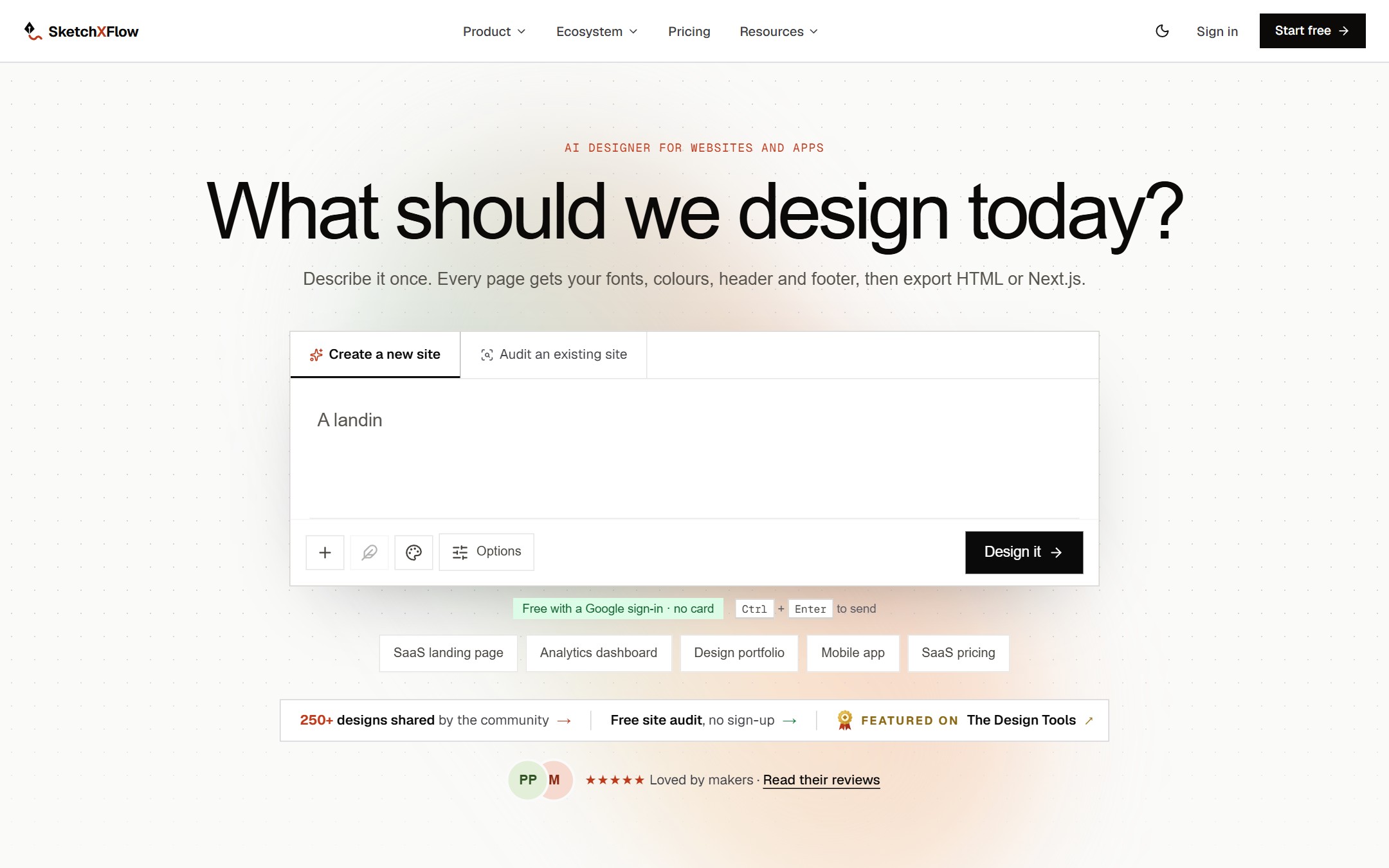
One prompt, a whole site. You start from a brief, such as "a site for Verdant, a sustainable fashion label", and it plans and designs a multi-page site (home, collection, story, contact in the example), each page sharing one palette, one font pairing, one header and one footer.
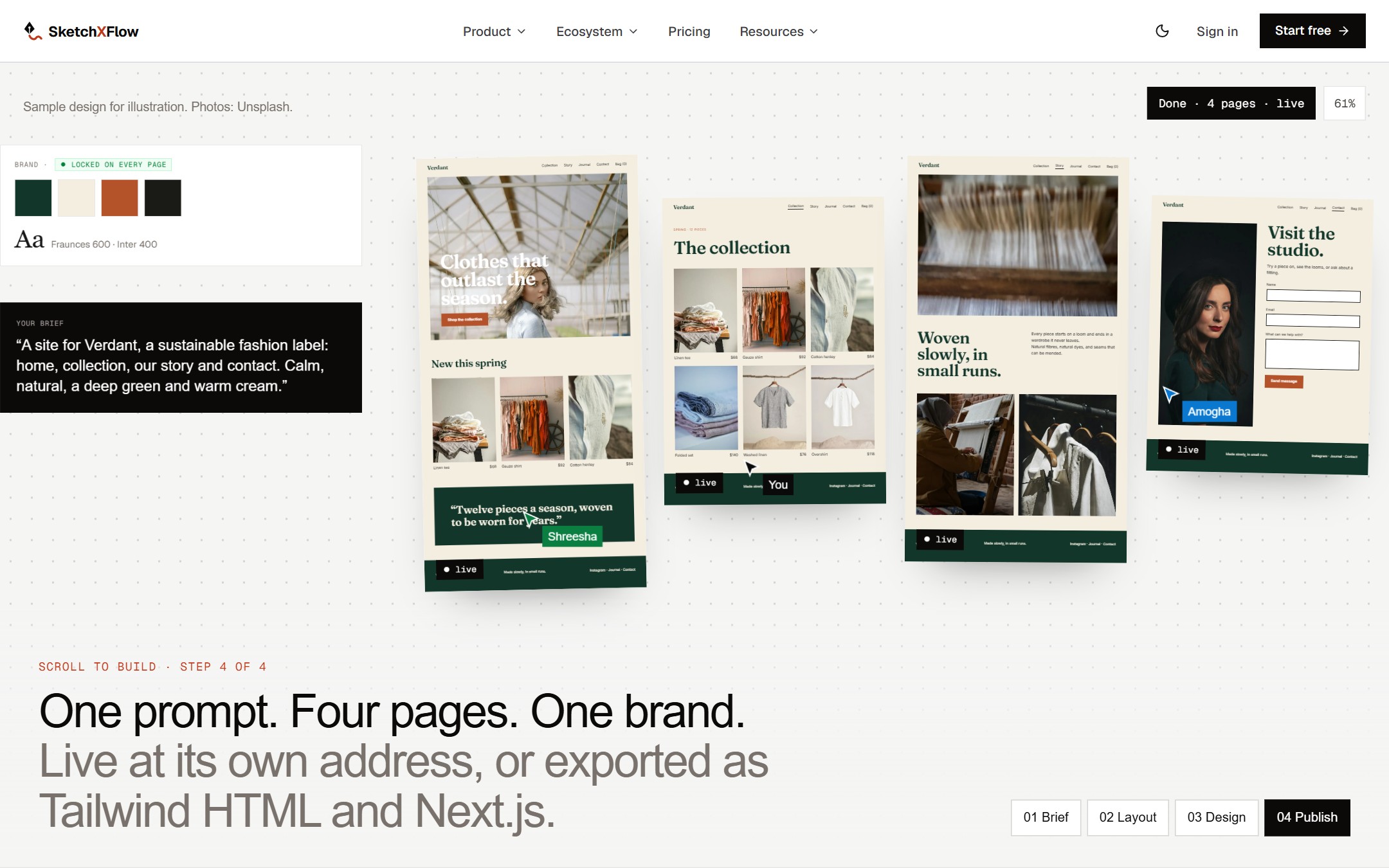
A design system, not just a design. The palette, typography, spacing and components are saved as a design system, and later edits follow it. You can ask for changes in plain language ("make the hero calmer") and the company says the change lands on every page it should and nowhere else. This is the part aimed at the most common complaint about AI site builders: the brand drifts by the tenth edit.
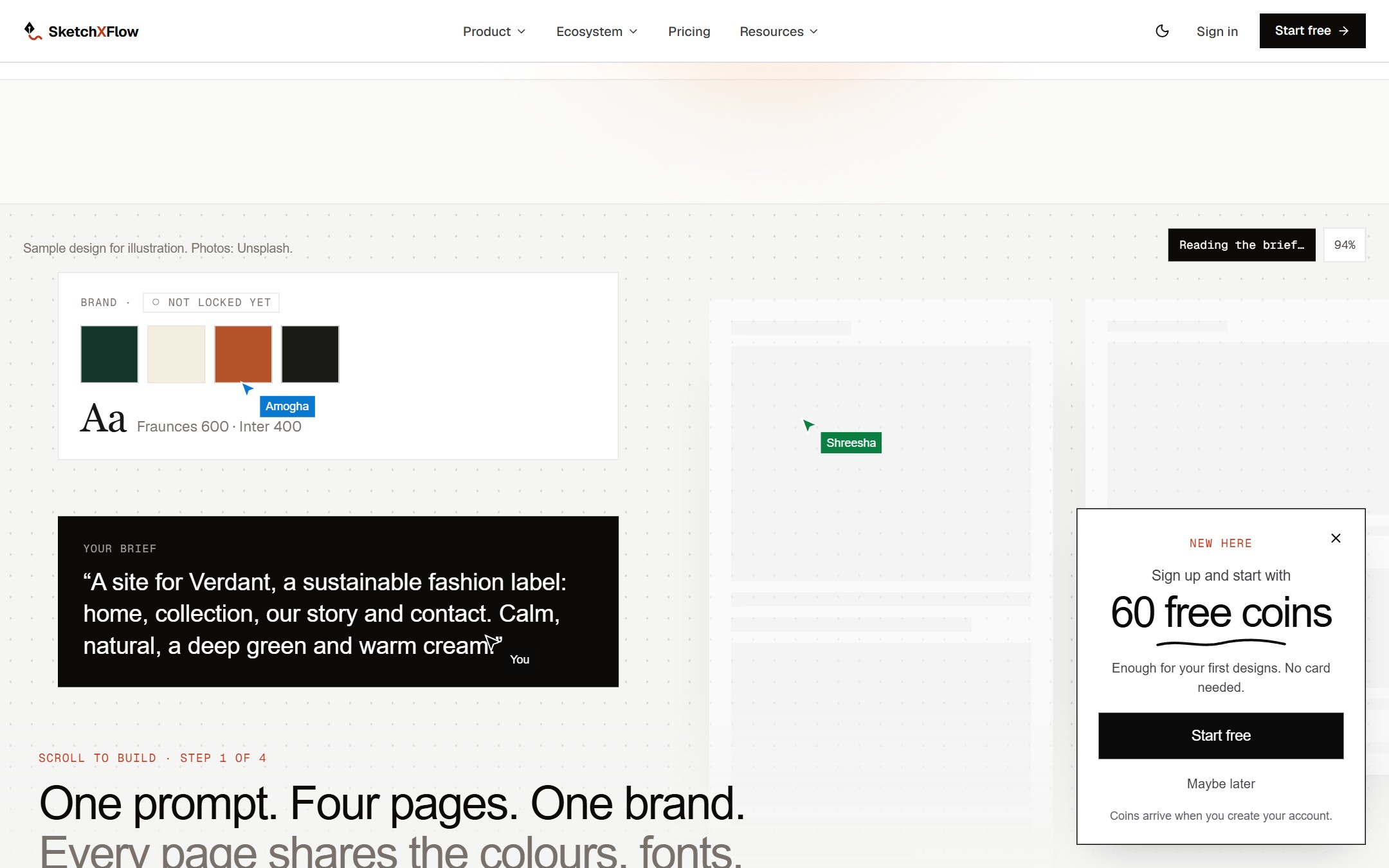
Audits. A free single-page audit scores an existing site on typography, colour, layout, hierarchy, accessibility and content, and can rebuild the page with the fixes applied. Whole-site audits are on the paid Pro plan.
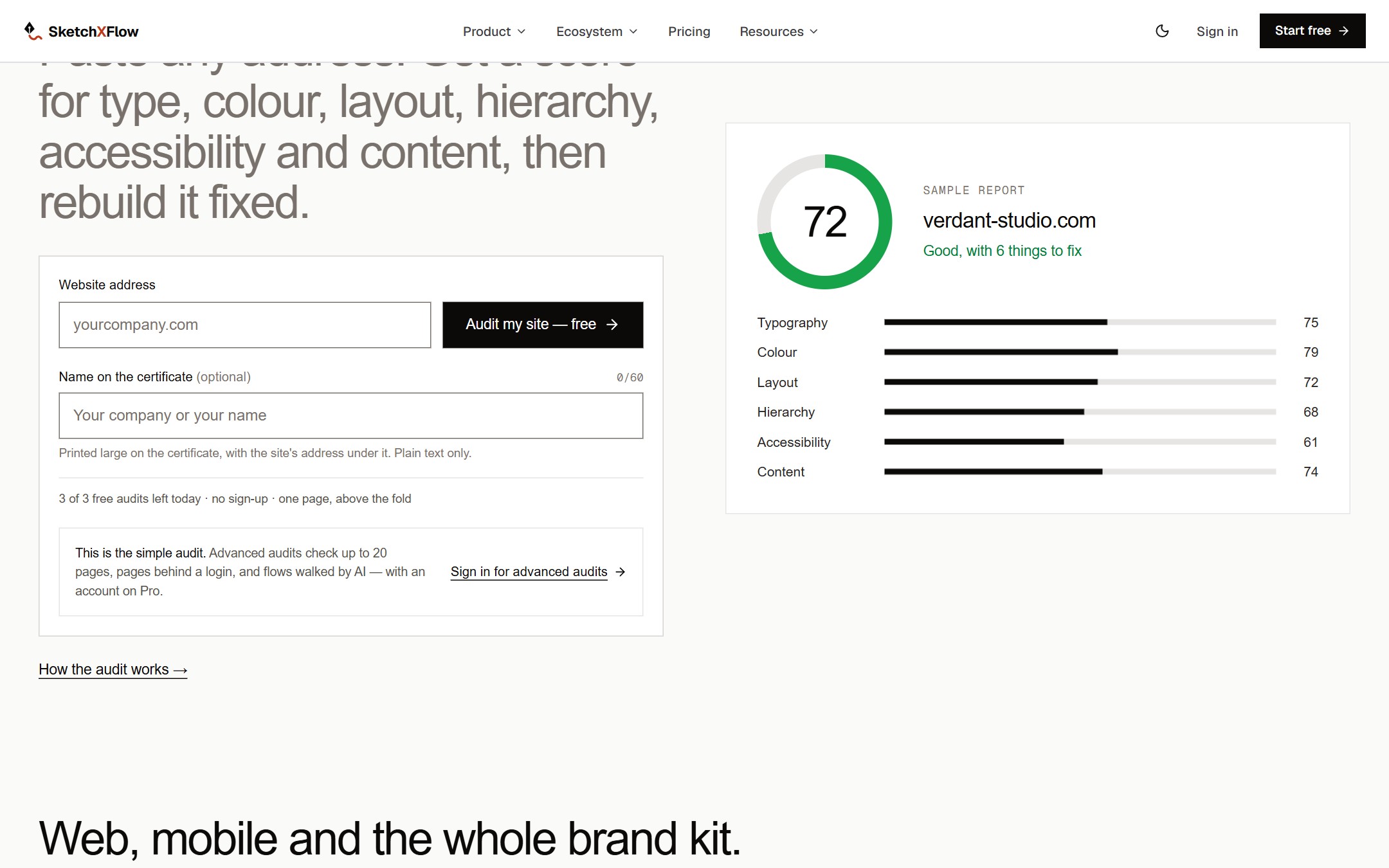
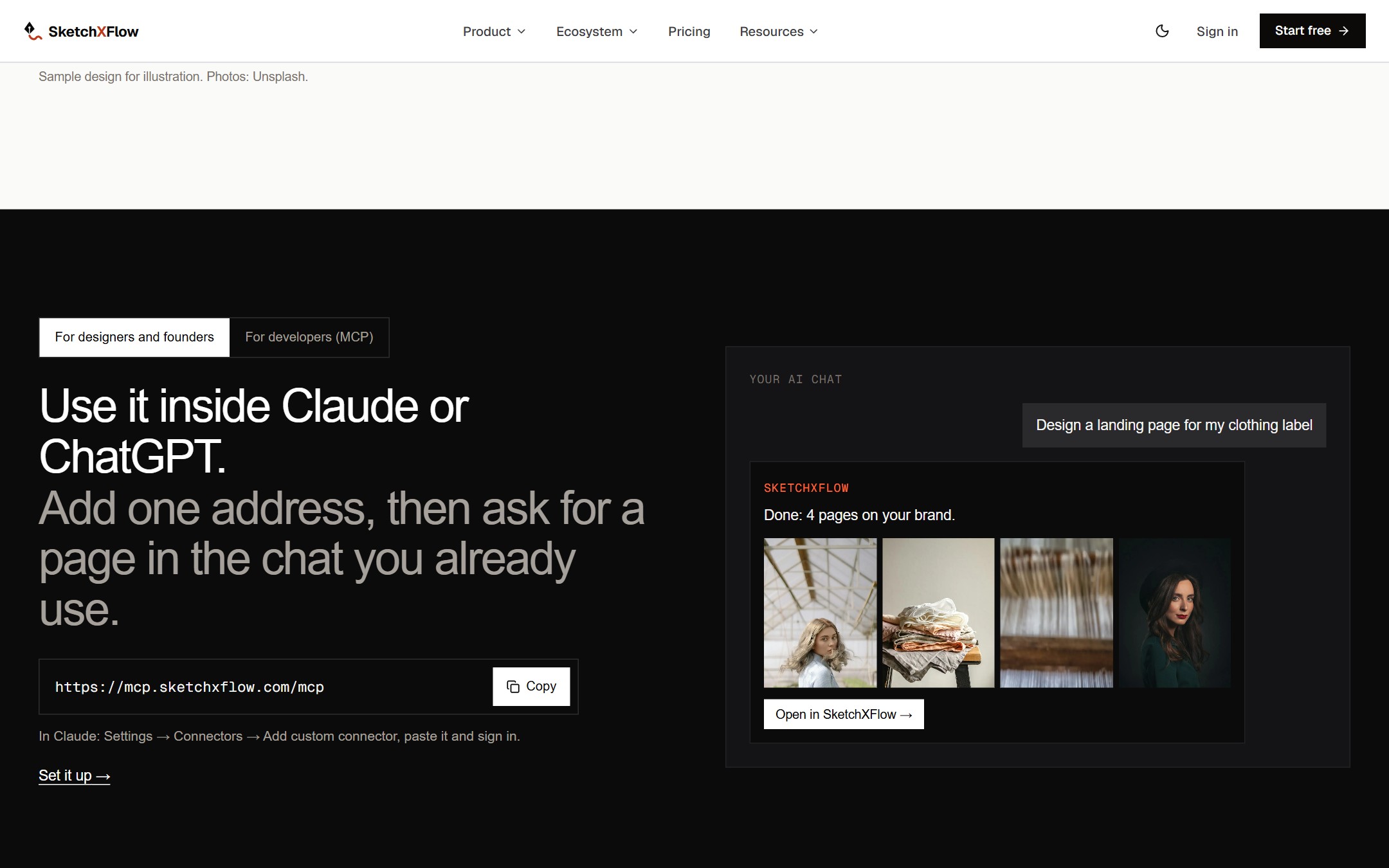
Real code, and inside your AI tools. The free plan exports PNG and PDF. Starter adds clean HTML and Next.js code, and Pro can push straight to GitHub or GitLab. SketchXFlow also runs inside Claude, Claude Code, ChatGPT, Cursor and Codex through an MCP connector, so you can design a page from the chat you already use.
Built for Indian teams. The free plan includes 60 coins, which the company says covers about five designs, with no card required. Starter is $19 a month (600 coins) and Pro is $49 a month (2,000 coins). Checkout accepts UPI and RuPay through Dodo Payments and Razorpay, and the company lists a GSTIN.
What SketchXFlow doesn't do
It is not a drop-in Figma replacement. Figma is a collaborative vector canvas for product teams; SketchXFlow is a prompt-driven designer for websites and app screens. Teams with large component libraries and design-to-engineering hand-off in Figma will more likely use it alongside Figma: the paid plans can copy designs into Figma.
It designs mobile app screens but, in its own words, "does not generate native app code". Collaboration today is read-only client previews and comments, not real-time co-editing. Plans are priced in US dollars even though they can be paid with Indian rails. And it is a young product: its public gallery lists 250-plus community designs, so judge it on your own projects rather than on a pitch, including this one.
Watch: the 60-second version
We turned this argument into a YouTube Short, with the Venezuela story, India's developer numbers and the three tests:
SketchXFlow posts its own product Shorts, including walkthroughs of the prompt-to-site flow, on its YouTube channel.
The bottom line
Figma isn't done. But "which design tool?" is no longer only a question of features. It is also a question of jurisdiction, of whether a design becomes shippable code, and of who can switch your access off. India now has the developer base to answer that question with tools of its own, and the regulations to make the question urgent. The right move for most teams is not to abandon Figma overnight, but to know which parts of their stack they could keep running if a foreign tool disappeared, and to try the homegrown options on a real project before they need to.
Questions readers ask
- Is Figma done?
- No. Figma remains the default product-design canvas. What has changed is that AI design-to-code tools and concerns about foreign-tool dependency are pushing teams, especially in India, to try alternatives alongside it.
- Is there an Indian alternative to Figma?
- There is no like-for-like Indian Figma clone, but India-built AI design tools such as SketchXFlow, made by KriyaXlabs in Mangaluru, design multi-page websites from a prompt with a saved design system and export HTML or Next.js code. Open-source Penpot is another option teams can self-host.
- What happened to Adobe users in Venezuela?
- In October 2019 Adobe deactivated every account in Venezuela to comply with US Executive Order 13884, gave users until October 28 to download their files, and later offered refunds.
- Can SketchXFlow export code?
- Yes. The free plan exports PNG and PDF; the Starter plan adds clean HTML and Next.js code, and the Pro plan can push code to GitHub or GitLab. It does not generate native mobile app code.
- How many developers does India have on GitHub?
- GitHub's Octoverse 2025 report counts 21.9 million developers in India, second only to the US. India added more than 5.2 million developers in 2025, the most of any country, and GitHub projects 57.5 million by 2030.
+ Sources
- Silicon UK — Adobe axes Venezuela services to comply with US sanctions (2019)
- CG Channel — Adobe to deactivate all accounts in Venezuela (2019)
- Figma Help Center — FAQ for users in Russia and Belarus
- GitHub — Octoverse 2025: A new developer joins GitHub every second
- The Week (PTI) — Govt notifies DPDP Rules, implementation in phases over 12–18 months
- SketchXFlow — product site, pricing and FAQ
- Penpot — open-source design tool
The Weekly Diff launches soon.
Subscribe on YouTubeKeep reading