Inkling 2 Mini vs Qwen 3.8: the free open AI that runs offline on a laptop
Mira Murati's Thinking Machines Lab released a 26.4B looped model under Apache 2.0 that runs on a 32 GB Mac, and in its demo it built a flight simulator offline mid-flight.
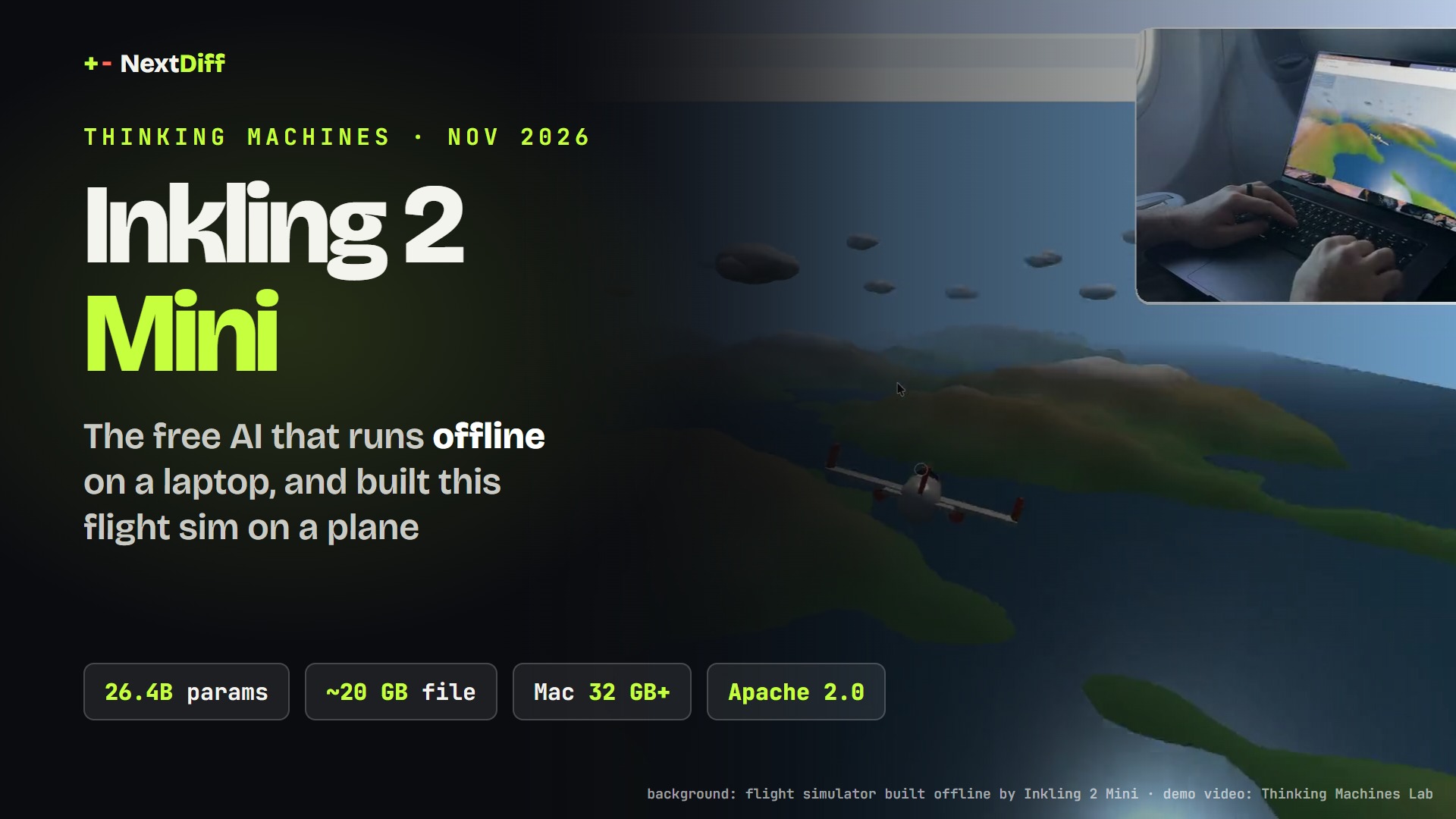
Thinking Machines Lab released Inkling 2 Mini on 20 November 2026, an Apache 2.0 open-weights model with 26.4 billion parameters that loops its middle layers three times per token. It runs offline on Macs with 32 GB of memory, ties Qwen3.8-27B on Artificial Analysis' index and beats it on most coding tests the company reported.
Thinking Machines Lab, the AI startup founded by former OpenAI CTO Mira Murati, released Inkling 2 Mini on 20 November: an open-weights model small enough to run on a laptop, which the company says beats every open model under 100 billion parameters at agentic coding. In its launch demo it built a playable flight simulator on a MacBook Pro in airplane mode, mid-flight, with no internet. Two days later it is one of the most-watched AI launches on YouTube, and the question people are typing is how it compares with Qwen 3.8 and whether their own machine can run it.
Our 23-second version:
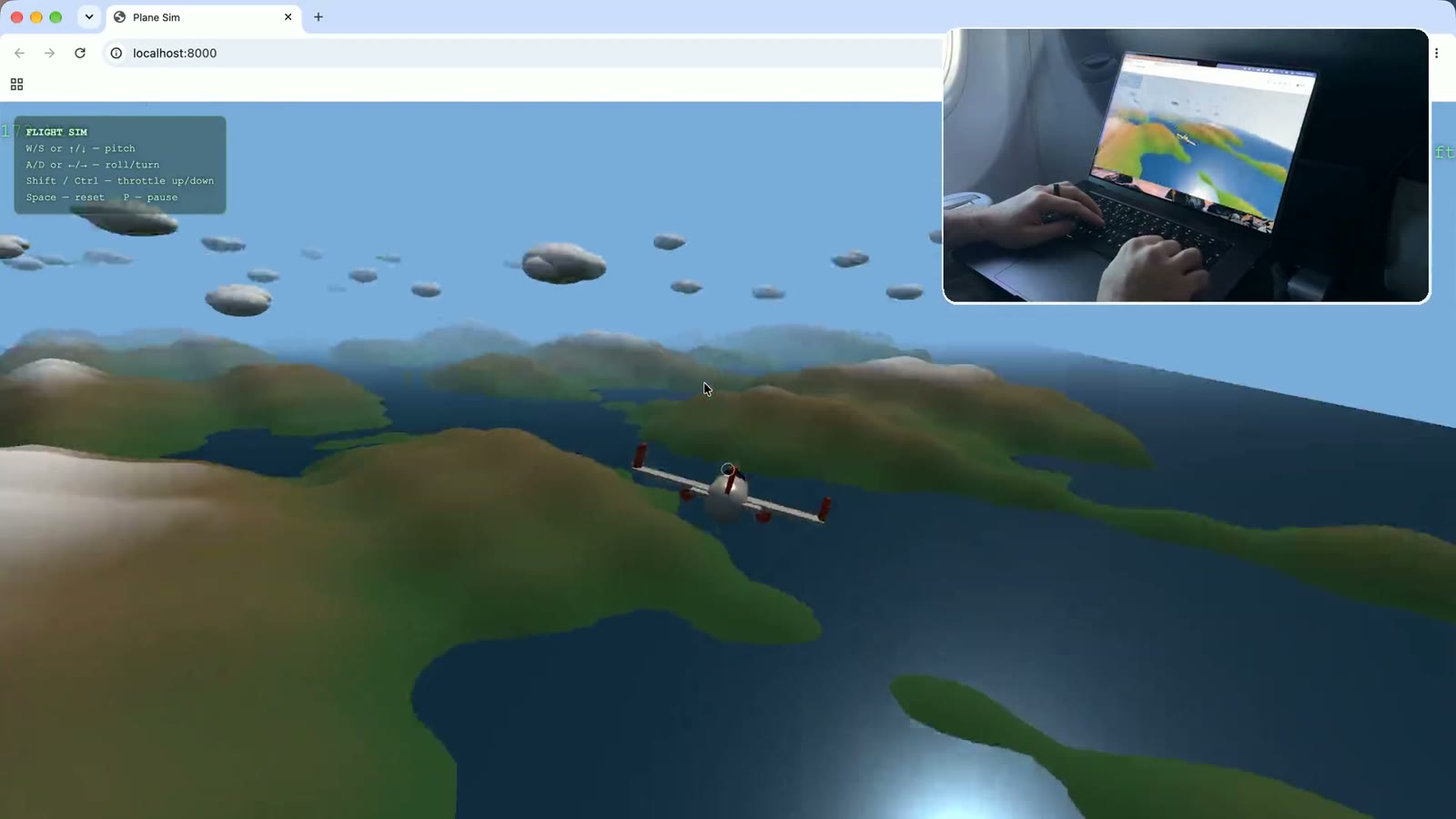 Image: Thinking Machines Lab (launch demo video). The inset shows the MacBook Pro the model ran on, offline, during a flight.
What is Inkling 2 Mini?
Inkling 2 Mini is a mixture-of-experts model with 26.4 billion parameters, of which about 3.4 billion are active for each token. It reads text and images and writes text, has a 1-million-token context window (per Ollama's listing and The Decoder), and ships under the permissive Apache 2.0 licence, so anyone can download, modify and use it commercially. The full checkpoint is about 20 GB.
It follows Inkling 2 Small, the larger model Thinking Machines released earlier in November, and the company says the two share the same strengths: long, multi-step "agentic" work such as coding and research with tools.
How does a looped model work?
The unusual part is the "loop". Inkling 2 Mini has 24 layers split into four blocks of six. The first and last blocks run once, but the two middle blocks run three times for every token, giving 48 layer passes from 24 stored layers. Because the loops reuse the same weights, each token gets roughly 5.4 billion parameters' worth of work while the file stays small.
Thinking Machines' reasoning: the middle layers do the abstract thinking, so running them again lets the model reason longer without writing that reasoning out as extra words. In its tests, looping the middle layers beat looping the last ones on 27 of 28 evaluations. The company also says it trained the model natively in 4-bit NVFP4 precision (the last four layers in 8-bit MXFP8), so the weights you download are the ones it trained, with no extra quantisation loss.
Inkling 2 Mini vs Qwen 3.8: which is better?
On Thinking Machines' own numbers, Inkling 2 Mini edges out Alibaba's Qwen3.8-27B, the open model most people compare it with, on coding and web research, but not everywhere.
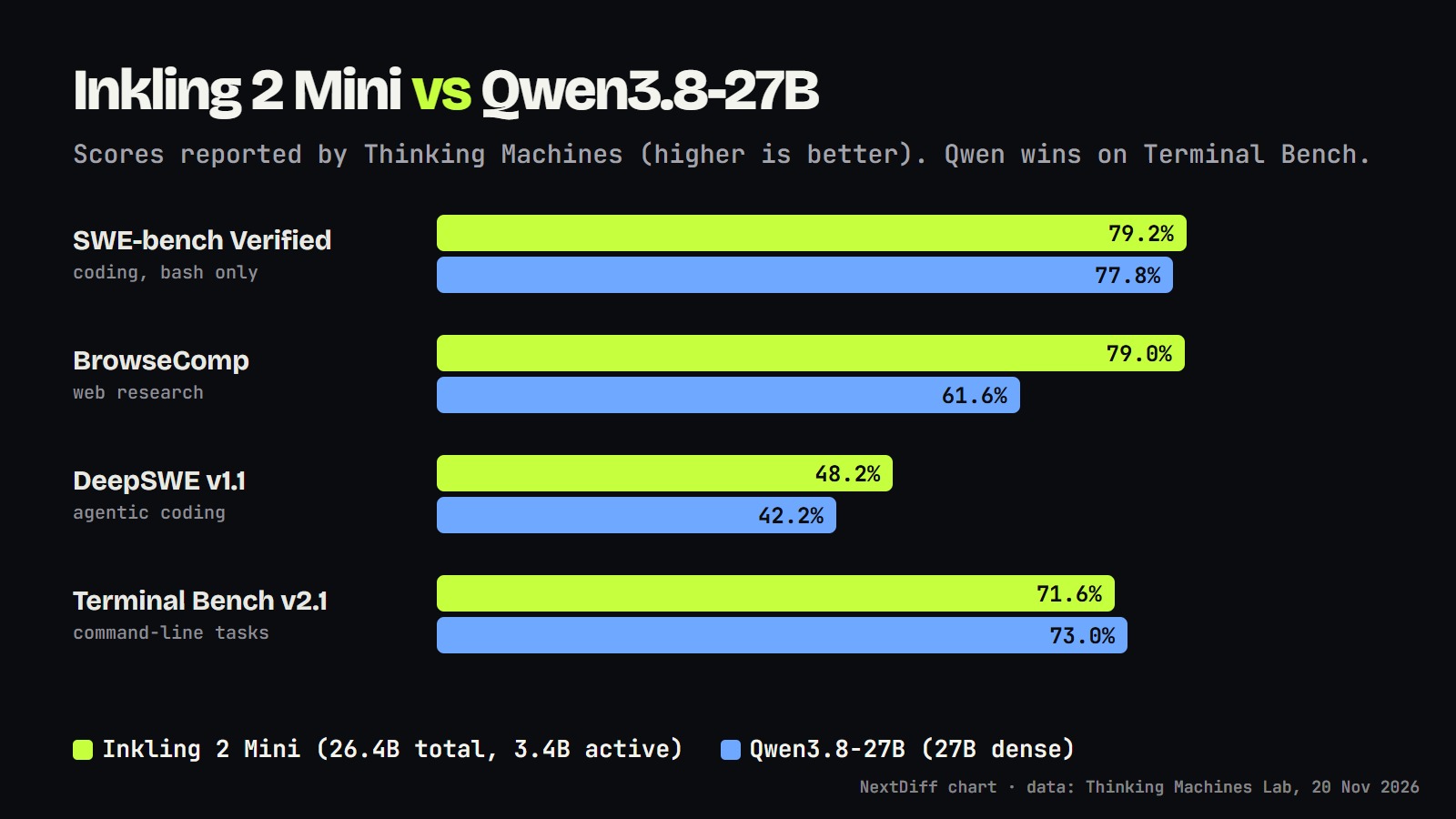 Chart: NextDiff, from scores published by Thinking Machines Lab.
| Test (reported by Thinking Machines) | Inkling 2 Mini | Qwen3.8-27B |
|---|---|---|
| SWE-bench Verified (coding) | 79.2% | 77.8% |
| DeepSWE v1.1 (agentic coding) | 48.2% | 42.2% |
| BrowseComp (web research) | 79.0% | 61.6% |
| Terminal Bench v2.1 (command line) | 71.6% | 73.0% |
| Artificial Analysis Intelligence Index | 20.1 | 20.1 |
The independent Artificial Analysis index scores them as a tie. Thinking Machines is also upfront about the gaps: Inkling 2 Mini is "not the strongest small model" for multi-turn chat or instructions with many constraints, where Qwen3.8-27B is ahead, and like any model this size it knows fewer facts than big models, which it makes up for by using search and tools. These are vendor-run benchmarks with setups that vary by model, so treat them as a starting point until independent tests land.
Can it really run on a laptop?
Yes, with enough memory. Officially, Inkling 2 Mini runs on any Apple-silicon Mac with 32 GB of RAM or more (MacBook, Mac mini or Mac Studio) and on Nvidia's DGX Spark desktop. On other PCs, Thinking Machines recommends a GPU with 32 GB or more of video memory. The easiest route on a Mac is Ollama: install it and run ollama run inkling-2-mini, which downloads the 20 GB model. Quantised GGUF versions from Unsloth and llama.cpp, plus SGLang and vLLM support, cover other setups. You can also chat with it in the browser in Thinking Machines' Tinker Playground. New to memory sizes? Read What is RAM?.
The model is already being squeezed further. A community project, LookAtMyQuant, has published compressed builds from 3.9 GB to 12.8 GB, and its 5.4 GB version reached the Hacker News front page. Its author reports that the larger builds match the original on maths and coding tests; those are one developer's results, not Thinking Machines', so expect some quality loss in the smallest files.
Why it matters
The demos are the point. Besides the flight simulator, Thinking Machines showed Thinkyville, a pixel town that Inkling 2 Mini built and in which the same model runs all 20 villagers at once on a single offline MacBook.
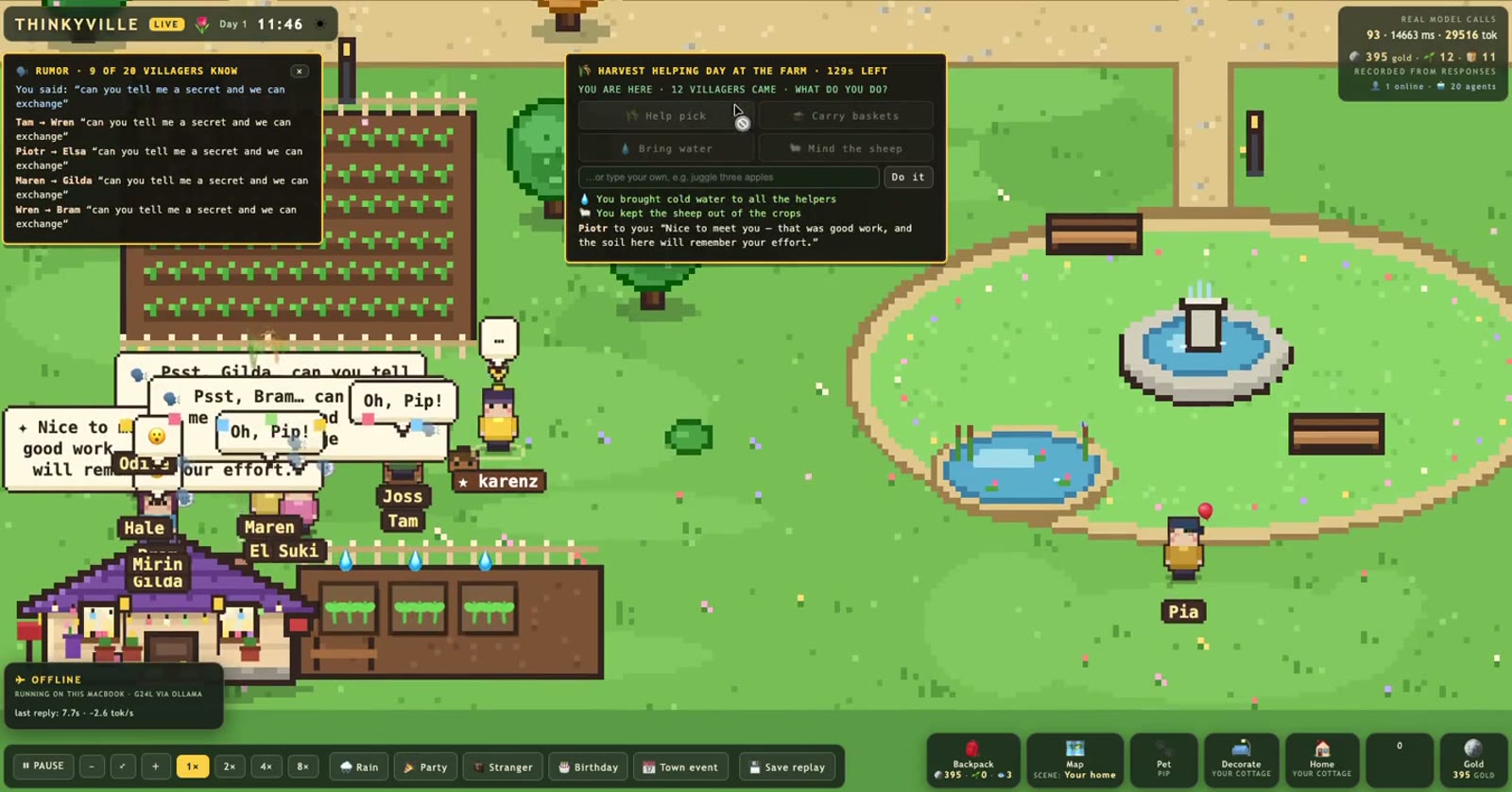 Image: Thinking Machines Lab (Thinkyville demo video).
A year ago, coding agents this capable needed a cloud API and a bill per token. An Apache-licensed model that does agentic coding on a laptop means private code never leaves the machine, works on a plane, and costs nothing per request. It also gives researchers one of the first open looped models to study, which Thinking Machines says did not get worse at "sabotage" tests as loops were added, and whose shorter chains of thought stayed readable.
What's next
Expect independent benchmarks over the coming week, and more community builds for smaller laptops and phones. The catch for most people is hardware: 32 GB Macs are not cheap, and the tiny community builds trade some accuracy for size. For how this race started, see our story on Qwen 4 Max and why Alibaba kept its biggest model closed, and our explainer What is open source?
Questions readers ask
- Is Inkling 2 Mini better than Qwen 3.8?
- On Thinking Machines' reported scores it beats Qwen3.8-27B on SWE-bench Verified (79.2% vs 77.8%), DeepSWE (48.2% vs 42.2%) and BrowseComp (79.0% vs 61.6%), but trails on Terminal Bench v2.1 (71.6% vs 73.0%) and in multi-turn chat. Artificial Analysis scores the two as a tie at 20.1.
- Can Inkling 2 Mini run on a laptop?
- Yes. Thinking Machines supports Apple-silicon Macs with at least 32 GB of memory and Nvidia's DGX Spark; other GPUs need about 32 GB of VRAM. Community-compressed builds from 3.9 GB to 12.8 GB exist but are not official.
- How do I use Inkling 2 Mini?
- On a Mac with 32 GB or more, install Ollama and run 'ollama run inkling-2-mini', which downloads the 20 GB model. You can also try it in the browser in Thinking Machines' Tinker Playground, or download the weights from Hugging Face.
- Is Inkling 2 Mini free?
- Yes. The weights are free to download from Hugging Face under the Apache 2.0 licence, which allows commercial use. Hosted inference and fine-tuning are offered on Thinking Machines' Tinker platform.
- Who made Inkling 2 Mini?
- Thinking Machines Lab, the AI startup founded by Mira Murati, OpenAI's former chief technology officer. It released Inkling 2 Mini on 20 November 2026, after the larger Inkling 2 Small earlier in the month.
+ Sources
- Thinking Machines Lab — Introducing Inkling 2 Mini
- Hugging Face — thinkingmachines/Inkling-2-Mini model card
- Ollama — inkling-2-mini
- The Decoder — New open model Inkling 2 Mini thinks in loops and still runs on a laptop
- TestingCatalog — Thinking Machines releases Inkling 2 Mini open-weight model
- LookAtMyQuant (GitHub) — Inkling-2-Mini compressed builds
+ Rate this story
Get stories like this on your phone, the minute they drop.
 Scan with your Android phone
The Weekly Diff launches soon.
Subscribe on YouTubeKeep reading