Green star discovered: white dwarf WD J1330+6435 is the first star known to glow green
Sodium from swallowed rocky debris absorbs the orange part of its light, leaving a ghostly chartreuse glow, Warwick astronomers report. The same study found pink, yellow and possibly the reddest star yet.
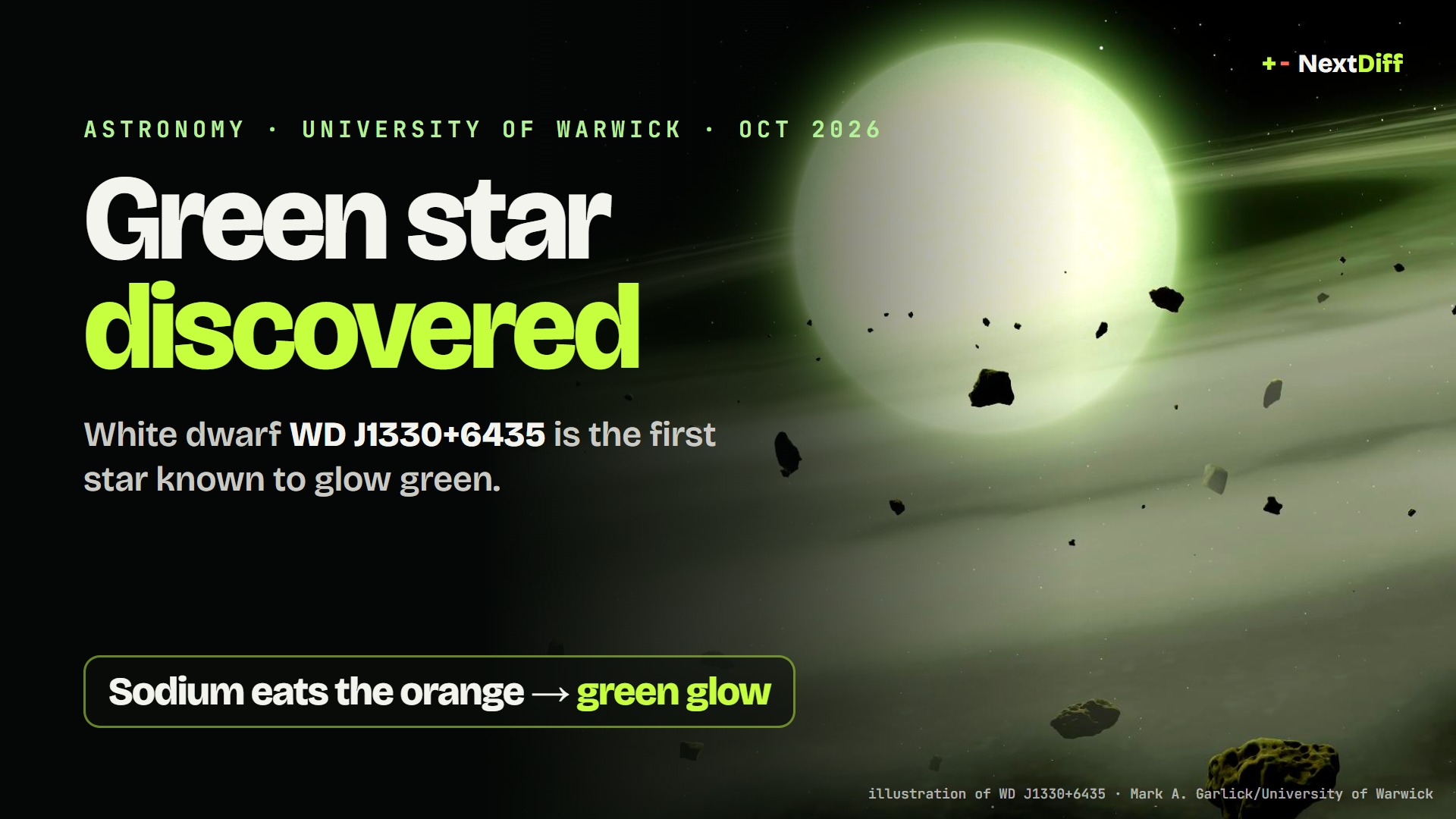
University of Warwick astronomers report the first green star discovered: the white dwarf WD J1330+6435, about 280 light-years away. Sodium from rocky debris in its ultra-dense atmosphere absorbs orange light, leaving a chartreuse glow. The October 2026 study also found pink and yellow white dwarfs and shows the average white dwarf is white, not blue.
Astronomers have found the first star known to glow green. A University of Warwick team led by Mark Hollands reports that the white dwarf WD J1330+6435 would look chartreuse green to a human eye. It's the first green star discovered: until now, no star, living or dead, had been credibly reported as green. The study appears in RAS Techniques and Instruments, and the university announced it on 15 October.
Our 44-second version, with how a star turns green:
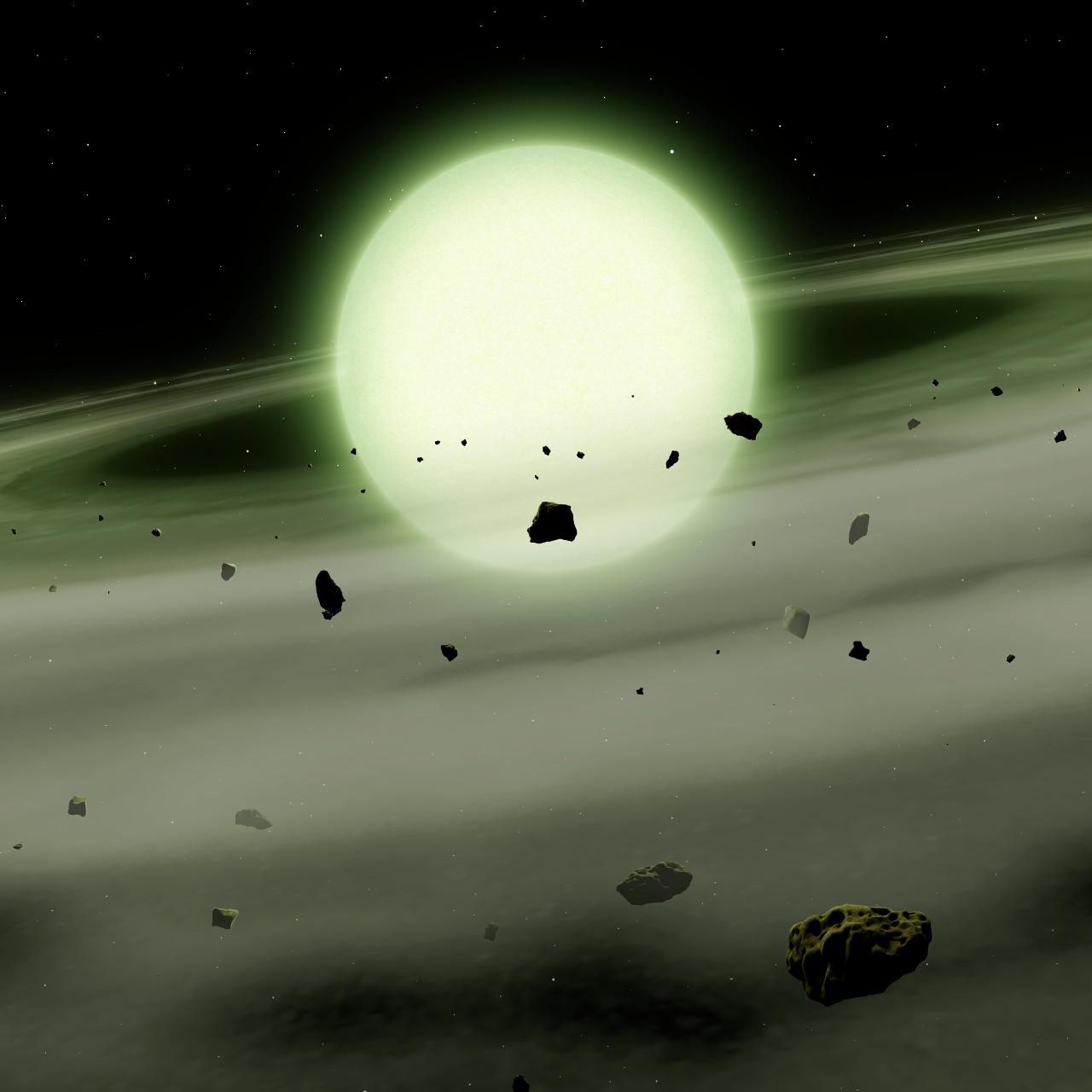 Illustration: Mark A. Garlick/University of Warwick (press release)
Why are there no green stars?
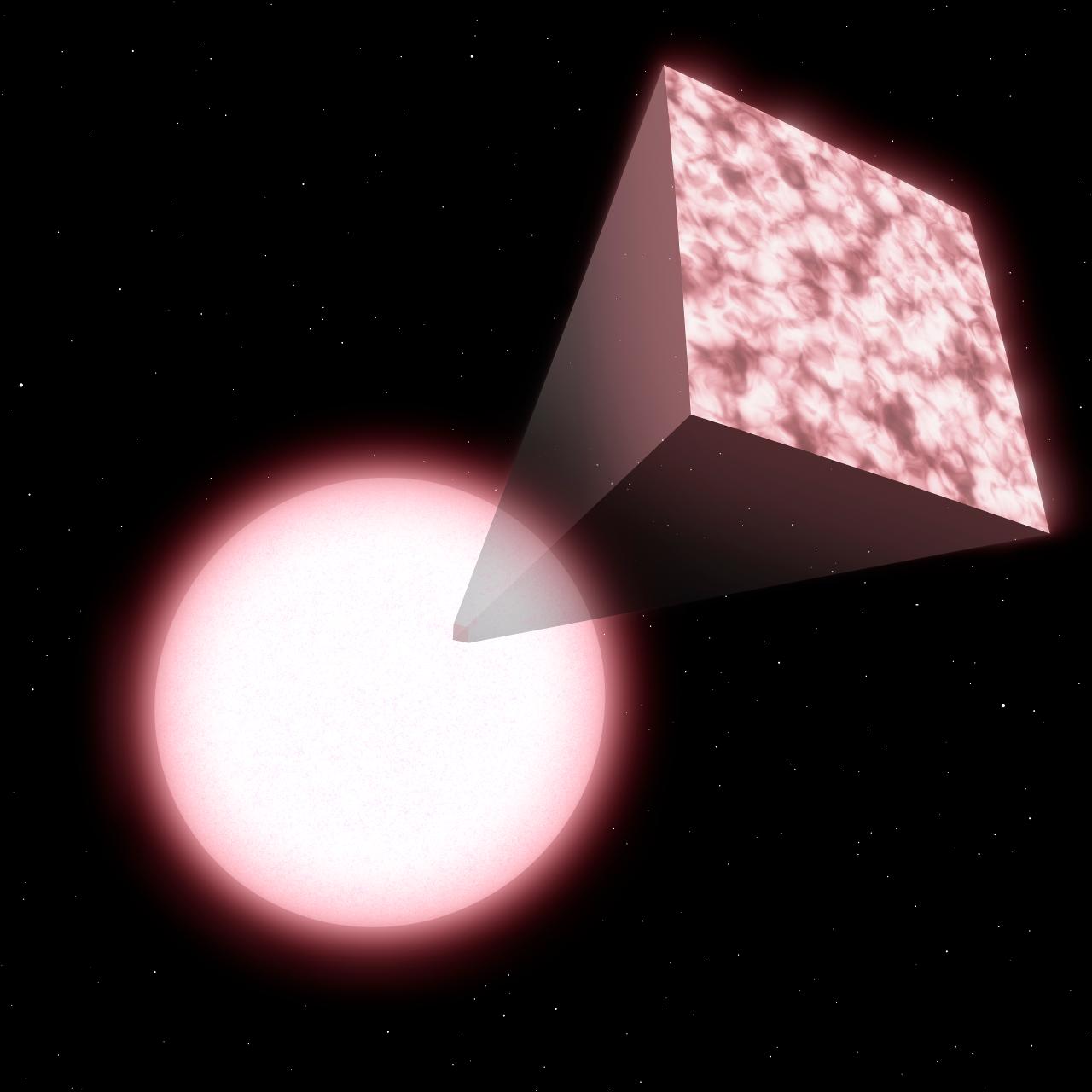
Most stars behave like what physicists call a "perfect radiator" (a blackbody): their colour is set almost entirely by temperature. Cool stars look orange, Sun-like stars look white and the hottest look pale blue. The Warwick release compares it to a blacksmith's iron going red, then orange, then white-hot.
Green never appears on that track. A star whose light peaks in the green, like the Sun, still pours out plenty of red and blue light at the same time, and your eye mixes the whole spread into white. To look green, a star has to lose light on both sides of the green part of the spectrum. Temperature alone can't do that.
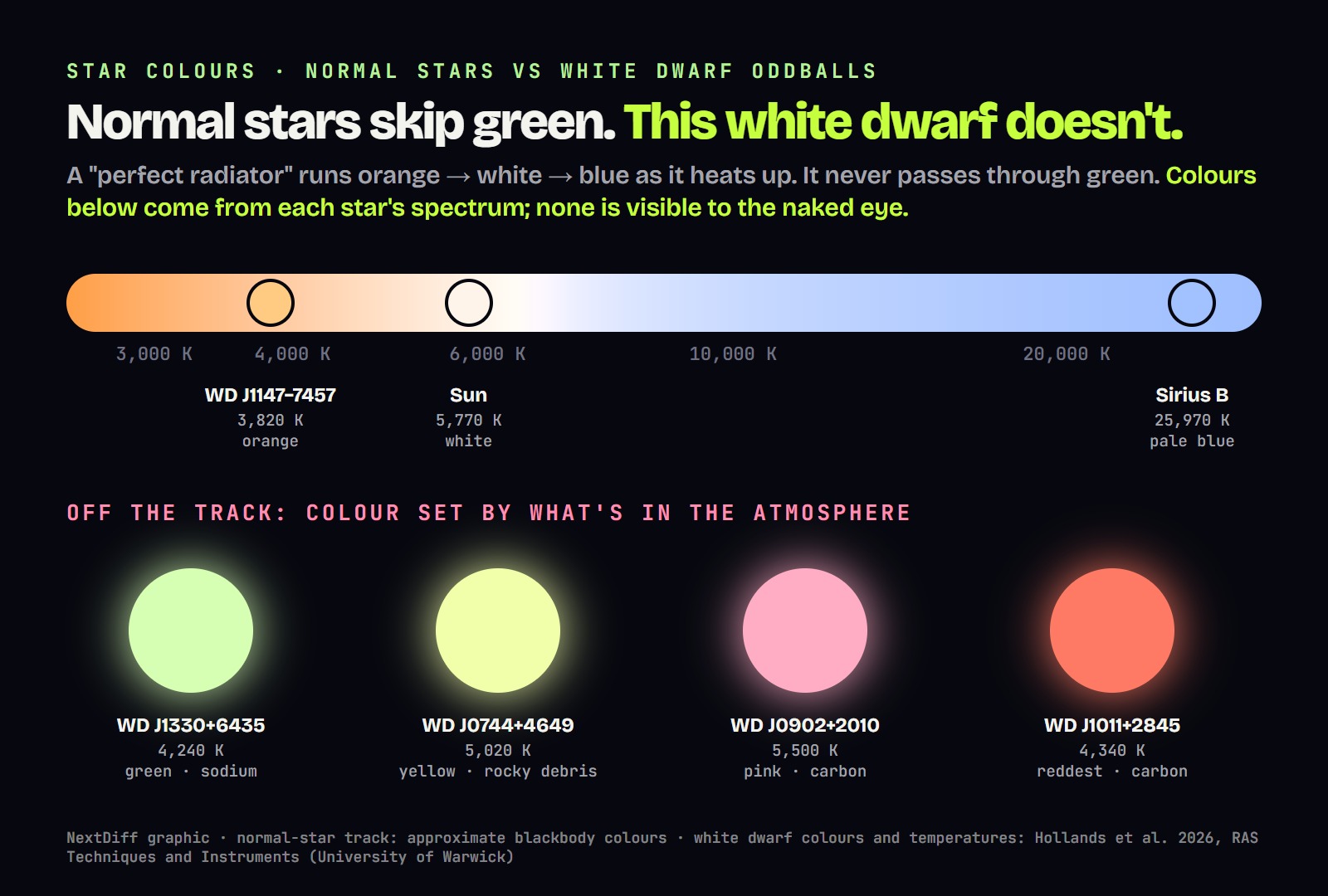 NextDiff graphic. White dwarf colours and temperatures: Hollands et al. 2026
How the green star discovered by Warwick gets its colour
WD J1330+6435 is a white dwarf: the dense, Earth-sized core left behind when a Sun-like star dies. It is cool for its kind, about 4,000 °C, and it has swallowed rocky debris from its old planetary system. That debris enriched its atmosphere with calcium, lithium and sodium.
The trick is density. The coolest white dwarf atmospheres reach about 1 gram per cubic centimetre, roughly the density of water and millions of times denser than the Sun's visible surface. Squeezed that hard, trace elements absorb light over a much wider band than usual. In this star, sodium soaks up yellow, orange and red light. "The traces of sodium in the atmosphere of this white dwarf absorb the orange part of the spectrum, leaving behind a ghostly green glow," Hollands said.
Nobody has actually seen the green. No white dwarf is close or bright enough. The team took each star's spectrum, the rainbow "fingerprint" astronomers already record, and ran it through a model of human colour vision to work out the colour a person would perceive.
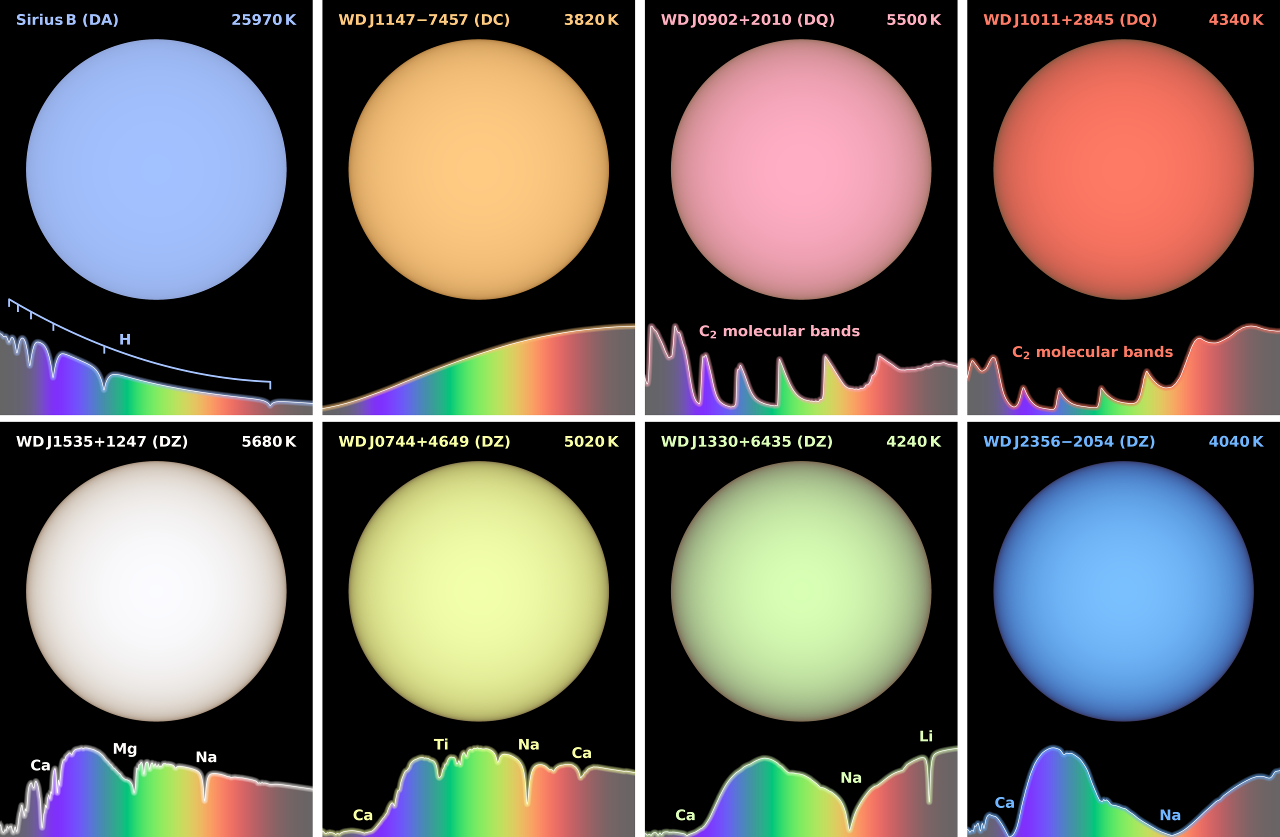 Simulated colours of eight white dwarfs with their spectra. WD J1330+6435 is third on the bottom row. Image: Mark Hollands/University of Warwick (press release)
Pink, yellow, cyan and the reddest star yet
The green star is the headline, but the paper sorts white dwarfs into colour families by what is in their atmospheres:
- Pink or purple: a deep convection zone dredges carbon up from the core, and carbon molecules (C₂) absorb blue, green and yellow light.
- Yellow: atmospheres polluted by shattered asteroids and comets.
- Cyan or pale blue: cool stars with mixed hydrogen and helium, where hydrogen molecules colliding with helium absorb red light.
At the other extreme, WD J1011+2845, just 48 light-years away, may be the reddest star ever recorded. Its carbon molecules push almost all its light beyond 600 nanometres, giving it a deep salmon-pink colour.
 The pink white dwarf WD J0902+2010, "enriched from below" by carbon. Illustration: Mark A. Garlick/University of Warwick (press release)
Can you see the green star?
No, not with your eyes and not as green. In the Gaia catalogue of white dwarfs, WD J1330+6435 has a parallax that puts it roughly 280 light-years away, and it shines at magnitude 20.6. That is hundreds of thousands of times fainter than the dimmest star visible to the naked eye. A large telescope's camera picks it up as a faint dot; the colour exists only in the spectrum. Hollands put it this way: imagine standing on a planet and looking up at a green star.
Why it matters
- The average white dwarf is white, not blue. In the 151 white dwarfs within 20 parsecs (about 65 light-years), the median colour temperature was about 6,800 K, which looks white. Hotter, bluer white dwarfs are brighter and easier to spot from far away, so brightness-limited surveys made them look typical.
- About 1 in 30 has an odd colour. Five of the 151 nearby white dwarfs stood out: two yellow, three pink. "One in thirty might not sound like a huge fraction," said co-author Boris Gänsicke, but across the whole population "that is still a lot of oddly coloured stars."
- Dead stars record dead planets. The green colour comes from rocky material that fell in. Polluted white dwarfs are one of the few ways to measure what planets around other stars were made of. Our own Sun will become a white dwarf in about five billion years.
Caveats and what's next
- The colours are modelled from spectra, not photographed. The method is standard colour science, but it is still a calculation.
- "First green star" means the first credibly reported one. The team says it knows of no earlier case. A wider search through new spectroscopic surveys could find more, and the authors suggest the oddly coloured fraction holds across the galaxy.
- The paper appeared in RAS Techniques and Instruments, a Royal Astronomical Society journal focused on methods. The result is a new way of reading existing data, not a new observation.
For another surprise found in existing telescope data, see how ESA's Euclid found a new comet by accident.
Questions readers ask
- Has a green star been discovered?
- Yes. In October 2026 University of Warwick astronomers reported that the white dwarf WD J1330+6435 would look chartreuse green to the human eye. It is the first star credibly reported as green.
- Why are there no green stars?
- Ordinary stars shine like blackbodies, so their colour depends on temperature and runs from orange to white to blue. A star that peaks in green also emits lots of red and blue light, so the eye sees white. To look green, a star must lose light on both sides of green, which takes unusual chemistry.
- What is the green star called?
- The green star is the white dwarf WD J1330+6435 (also written WDJ1330+6435). It is a cool white dwarf of about 4,000 °C whose atmosphere is polluted with sodium, lithium and calcium from rocky debris.
- Can you see the green star with your eyes or a telescope?
- No. WD J1330+6435 is magnitude 20.6, hundreds of thousands of times fainter than the faintest naked-eye star. Its green colour was calculated from its spectrum, not seen directly.
- How far away is the green star?
- Gaia's parallax measurement puts WD J1330+6435 roughly 280 light-years from Earth. The reddest white dwarf in the study, WD J1011+2845, is much closer at about 48 light-years.
+ Sources
- University of Warwick — Green, pink and purple: astronomers reveal the surprising true colours of white dwarf stars
- Hollands et al. (2026), RAS Techniques and Instruments — Any colour you like: the diverse chromaticities of white dwarfs
- ScienceDaily — Astronomers discover a ghostly green star unlike any known before
- CNN — Astronomers say they've discovered the first green star
- Nautilus — Astronomers find first green star
- Gentile Fusillo et al. (2021) Gaia EDR3 white dwarf catalogue (VizieR J/MNRAS/508/3877)
+ Rate this story
Get stories like this on your phone, the minute they drop.
 Scan with your Android phone


The Weekly Diff launches soon.
Subscribe on YouTubeKeep reading